


Most Dog Fights Happen at Home. Pick the Second Dog Accordingly.
The hard part of getting a second dog isn't deciding to. It's choosing which one. A study of 305 fighting pairs shows exactly where the risk lives, and it isn't where most people look.

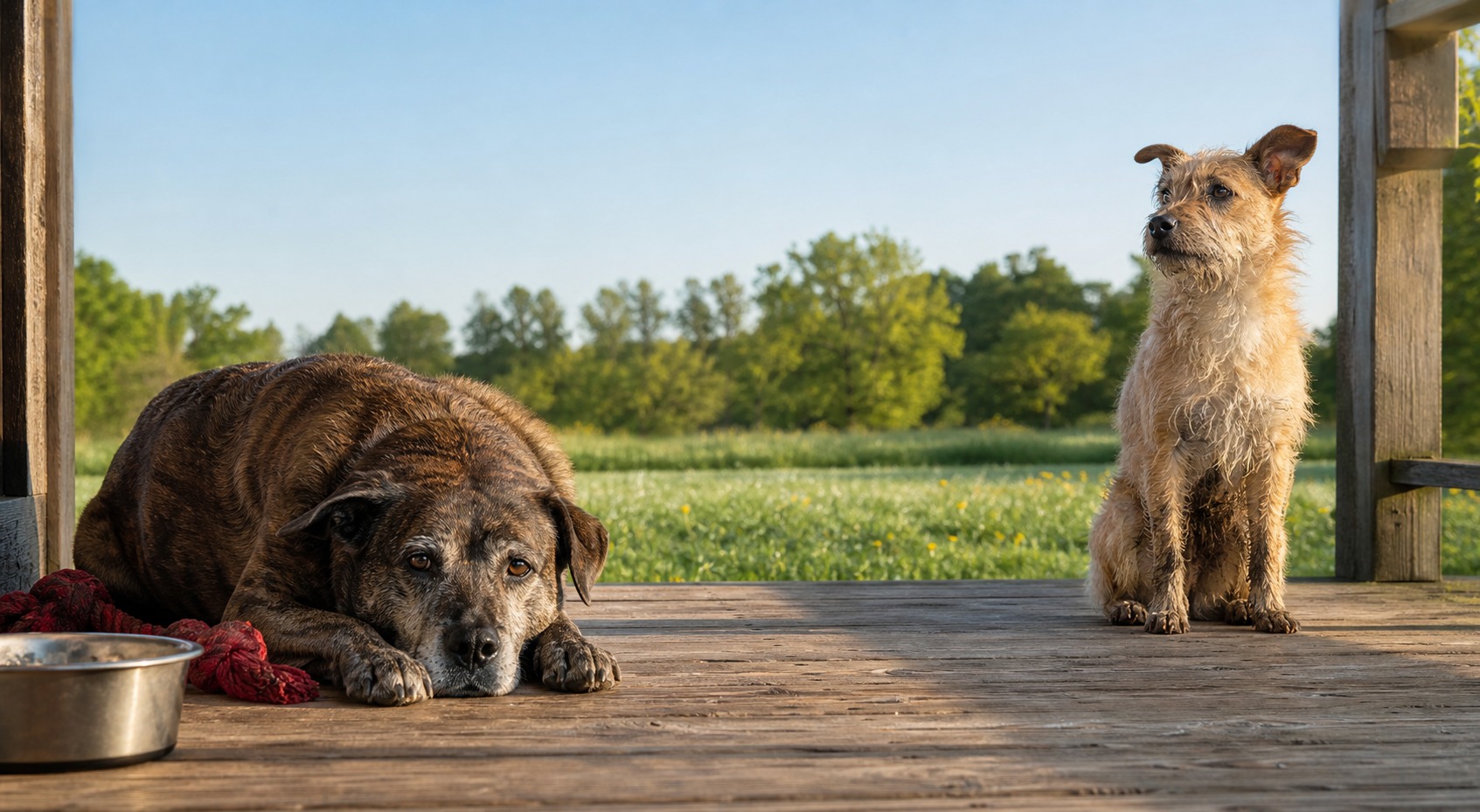
The internet has a stock answer for the second-dog question, and it is a bad one: get your dog a friend. Your dog is lonely, or bored, or aging, so you add another dog and the problem takes care of itself.
It does not work that way, and the reason is simple. Whatever is happening in your house right now is about to happen twice. A second dog is not a treatment for the first dog. It is a second dog.
Which means the real question is never should I. Once you have honestly decided that you want another dog, for your own reasons, and that you have the time, money, and patience to raise one from scratch, the only question left is the hard one: which dog?
That is where the stakes actually sit. Because the fights that break dog households are not the ones at the dog park.
The risk lives in the pairing, not the dog
Veterinary behaviorists have a name for the thing that ends multi-dog homes: intra-household aggression. Not a fight with a stranger’s dog on a walk. A fight with the dog who sleeps in the same room.
A study published in the Journal of the American Veterinary Medical Association looked at 305 pairs of dogs living in the same home who were fighting each other. The pattern that comes out of it is not a list of bad dogs. It is a list of bad matches.
Here is what the data actually says.
Resources start it. Guarding something valuable, food, a toy, a sleeping spot, a person, triggered the fighting in about 73 percent of pairs. This is far and away the dominant cause, and it is the one people ignore because it looks so minor in a one-dog house. A dog who stiffens over a chew when you walk by is telling you something about who they will be when a second dog walks by.
The newcomer is usually the aggressor. In roughly 59 percent of pairs, the dog doing the attacking was the one who arrived second. The comfortable story, that the resident dog defends their turf, is mostly wrong.
And the aggressor skews younger and heavier. On average, the aggressor was about 16 months younger and roughly three pounds heavier than the dog on the receiving end. A younger, bigger, pushier dog moving into an older dog’s house is the single most legible risk profile in the whole dataset.
Same-sex pairs fared worse. About 62 percent of the fighting pairs were same-sex, and same-sex pairing was among the factors associated with a poor outcome, along with bites that broke skin and aggression triggered simply by the sight of the other dog.
Read those four findings together and a specific, avoidable scenario emerges: a resource-guarding resident dog, an incoming dog who is younger, bigger, and the same sex. That is the pairing to be careful about. It is also, unfortunately, exactly the dog many people choose, because a young, sturdy, energetic dog is fun to meet at a shelter.
People shop for a second dog the way they shopped for the first one, by falling for an individual. But you are not adopting a dog. You are creating a relationship between two animals who did not choose each other, and one of them already lives there.
Read your current dog before you read any adoption profile
Your dog has been telling you how this will go. You just have to ask the right questions.
Do they enjoy other dogs, or tolerate them? A dog who greets happily on walks, has easy encounters, and comes back for more is a promising candidate. A dog who enjoys another dog for four minutes and then is visibly done is telling you that a housemate, every day, all day, with no exit, is a different proposition entirely.
What happens near their stuff? Can another dog walk past their food bowl, their bone, their bed? This is the resource question, and it is the highest-value thing you can observe, because it is the trigger in nearly three-quarters of the fights.
What happens near you? If your dog objects when another dog comes to you for attention or a scratch, understand what a second dog means: that competition moves in permanently.
How does their body feel? A dog with arthritis or any chronic pain has a lower tolerance for a pest, and being body-slammed by a bouncy adolescent hurts. Pain is a legitimate reason a lovely, dog-social senior will be miserable with a new roommate.
None of these are automatic disqualifiers. Plenty of resource-guarding, dog-selective, achy dogs live happily with a second dog. But every “yes” you give here is a promise about the work you are signing up for: separate feeding, managed spaces, gates, and part of every day spent apart. Make that promise with your eyes open, or do not make it.
Match on play style and stamina, not on age and size
Once you know who your dog is, here is what actually predicts a good fit.
Play style first. Dogs play in dialects. Some wrestle. Some chase. Some body-check. Some play tug and nothing else. A wrestler paired with a chaser is not a disaster, but it is a negotiation the dogs have to conduct every single day. Two dogs who play the same game are two dogs who get to have fun instead of a conflict.
Then stamina. A dog who wants five minutes of play, twice a day, is going to be harassed by a dog who wants ninety. That mismatch does not read as aggression at first. It reads as one dog fleeing to the bedroom, and then, months later, as one dog snapping.
Age and size matter less than you think. A Chihuahua and a Great Dane can be devoted. A twelve-year-old and a puppy can be sweet together, and a young dog does sometimes visibly reinvigorate an older one, which is a genuinely beautiful thing to watch. But it cuts both ways: for every senior who gets a second wind, there is another whose golden years get noisier and less peaceful than they should have been. Similar ages and sizes make the match easier. They do not make it good.
Sex is a thumb on the scale, not a rule. The fight data supports the old advice to consider adopting the opposite sex, and if everything else is equal, it is worth doing. But it is the weakest of these levers. Millions of same-sex pairs live in perfect harmony. Do not pass on a beautifully matched dog over this, and do not assume an opposite-sex dog is safe because of it.
If you have already chosen, front-load the work
Set the house up so the top trigger never gets a chance.
Feed the dogs separately, in different rooms, behind a door, from day one, before anything has gone wrong. Pick up the high-value chews unless the dogs are physically separated. Give each dog a bed the other cannot claim. Do the greetings and introductions on neutral ground and slowly.
Then watch for the signs the study flagged as markers of a bad trajectory: a bite that breaks skin, or aggression triggered by nothing more than the sight of the other dog across a room. Those are not “they are working it out.” Those are the point at which you call a veterinary behaviorist, not a trainer with a message board opinion.
The households that succeed are boring on purpose. They manage the food, they manage the toys, they give both dogs somewhere to be alone. The drama they avoided was never worth having.
What newer research adds
The older advice on second dogs leaned almost entirely on the sex of the two dogs. The newer picture is more useful, and more hopeful, because it points at things you can control.
Resource guarding is a trainable behavior. Play style is something you can watch for in an hour at a shelter. Stamina is something a foster or a rescue can tell you about honestly if you ask. The variables that matter most turn out to be the ones you can actually screen for, if you slow down long enough to do it.
The other update is about what a second dog does not do. If your dog is panicking when left alone, adding a companion is not the fix that folk wisdom promises. Dogs with separation-related distress are attached to their person, and a second dog usually gives you two dogs at the window instead of one. Treat the first dog’s problem as its own problem. Then, if you still want a second dog, get one because you want one.
That is the whole test, honestly. Not whether your dog needs a friend. Whether you want a dog.
References
- Characteristics of intrahousehold interdog aggression and dog and pair factors associated with a poor outcome — Journal of the American Veterinary Medical Association, 256(3)
- Interdog household aggression: 38 cases — Journal of the American Veterinary Medical Association
- Separation anxiety in dogs — American Veterinary Society of Animal Behavior
- Introducing a new dog to your home — ASPCA
Common questions
Should I get a dog of the opposite sex as my current dog?
It slightly tilts the odds in your favor. In a study of 305 fighting pairs, about 62 percent were same-sex, and same-sex pairing was one of the factors linked to a worse outcome. But it is a nudge, not a rule. Play style, stamina, and resource behavior tell you far more about whether two dogs will get along.
Will a second dog fix my dog's separation anxiety or boredom?
Almost never. A second dog is a second dog, not a treatment. If your dog's problem is panic at being left alone, adding another animal usually gives you two anxious dogs instead of one. Solve the first dog's problem first, then decide whether you want a second one for your own sake.
What actually starts most fights between dogs in the same house?
Resources. Guarding food, toys, sleeping spots, or a person was the trigger in about 73 percent of the pairs in the study. If your current dog stiffens over a bone or a couch cushion, that is the behavior to address before a second dog walks in.
Dr. Chen is a small-animal veterinarian who leads health and safety coverage at The Pet Times. She writes and reviews the bulk of our illness, condition, and safety content, translating clinical guidance into clear, practical advice owners can act on at home.
Meet our experts ↗Keep reading
 TrainingYour Dog Doesn't Miss You the Way You Think. It's Better.Dr. Nina Kohl · 6 min
 TrainingSending Your Dog to Its Crate as Punishment Ruins the One Room That's TheirsDr. Amara Solis · 7 min
 TrainingStop Rushing the Sniffs. Your Dog's Nose Is Doing Real Work.Jordan Ellis · 6 min
 TrainingYour Dog Picked the Foot of the Bed on Purpose. It's a Compromise.Dr. Ravi Mehta · 6 min
 LivingHis Dog Walks Into the Office at 5 P.M. and Ends the WorkdayJames Okafor · 6 min
 TrainingStop Steering. The Walk Is the One Thing Your Dog Should Get to Decide.Dr. Lena Park · 7 min