


The Stuffed Kong Won't Save You: 7 Lies About Separation Anxiety
Almost everything you have been told about a dog who panics alone is wrong, including the part where it's your fault. Here is what actually moves the needle.

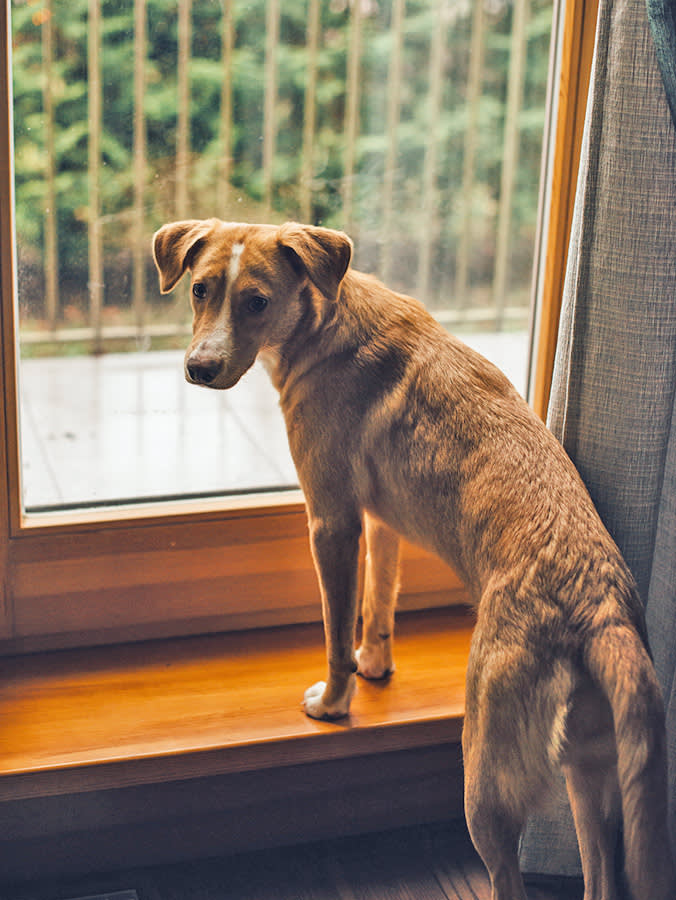
Start with a distinction that decides everything that follows.
Most dogs would rather you didn’t leave. A dog with separation anxiety cannot survive you leaving. Those are not two points on a spectrum. They are different animals with different problems, and the fix for one does nothing for the other.
The dog who mildly objects is well served by the standard advice: exercise, a food puzzle, a comfortable place to wait it out. That dog is bored and mildly put out, and boredom has easy answers.
The dog with separation anxiety is in a panic state. He is not bored. He is not spiting you. He is having something closer to a panic attack, and every piece of advice you will be handed by well-meaning people at the dog park is aimed at the wrong dog.
Here are the seven pieces of that advice, ranked by how much damage they do: from the ones that merely burn your time, through the ones that cost real money, to the ones that hurt the dog, and finally to the one that hurts you.
Lie 1: “Just give him a stuffed Kong.”
This one is nearly universal, and it is not merely useless. It can be counterproductive.
Compare a stuffed food toy to actual desensitization work, and the food toy loses badly. Desensitization means systematically getting your dog used to your departure cues — putting on shoes, picking up keys, touching the doorknob — until those cues stop predicting abandonment. That is the mechanism that works. A treat is not.
And here is the part nobody mentions:
- Handing your dog something wonderful as you walk out the door adds the toy to the departure routine. Now the Kong is one more signal that you are leaving. You have made your prediction problem worse, not better.
- Many anxious dogs are too upset to eat at all. The Kong sits there untouched, which tells you exactly how much good it is doing.
- And the dogs who do eat often finish it and then panic, because now the food is gone and the human is still gone.
A stuffed Kong is a lovely thing for a dog who is fine. It is a garnish on a crisis.
Lie 2: “Tire him out and he’ll be fine.”
Exercise is good, and nothing here should be read as an argument against it. Dogs enjoy it, it is good for their bodies, and it helps a lot of them sleep, which helps everything else. Add more. Your dog’s life gets better either way.
None of that makes it a treatment. Physical exertion solves a great many things in a dog, and this is one of the ones it simply cannot reach.
The analogy that lands: trying to cure a dog’s separation anxiety with longer walks is like trying to cure your own fear of heights, or spiders, by taking up jogging. You will be fitter. You will be exactly as afraid.
A tired dog who panics alone is a tired dog who panics alone.
Lie 3: “Get a second dog. He just needs company.”
The most expensive myth on this list, because the mistake comes with a fifteen-year commitment attached.
Separation anxiety is, in the great majority of cases, about being without a human, not about being without company. A second dog does not fill that hole. What you frequently get instead is two dogs in the house and one of them still panicking, now with an audience, and sometimes with a second dog who has learned to find departures distressing by watching the first one.
There are excellent reasons to get another dog. This is not one of them. Solve the problem you have before you buy a second one.
Lie 4: “Only you can calm him down.”
This is the belief that makes people feel trapped in their own homes, and it is mostly false.
The widespread assumption is that a dog with separation anxiety needs his person. In most cases, what he actually needs is a person. Dogs with separation anxiety are generally fine when someone is with them, even a stranger, a dog walker, a neighbor, a friend. They fall apart when they are alone, not when they are away from you specifically.
The logistics of this are enormously freeing once you understand it. You do not have to be with your dog every waking minute. You have to make sure someone is, while the training does its work.
That is still hard. It requires a rota, a network, and a lot of asking for favors. But it is a solvable scheduling problem rather than a life sentence, and a community makes it possible. Being with your dog twenty-four hours a day sounds wonderful right up until it is your actual life.
Lie 5: “Crate him. He’ll settle.”
Now we get to the advice that does actual harm.
The temptation is understandable. If he chews the furniture, empties his bladder and bowels on the carpet, and drools through the floorboards every time you leave, confining him to a small space feels like doing something.
It is not. Confinement does nothing to touch the panic. At absolute best, it contains the mess in a smaller area, which is a laundry improvement, not a treatment.
What it can do is considerable damage:
- The crate itself can become frightening. A dog who used to settle happily in there when people were home may end up unable to go near it, which means you have burned a resource you needed.
- It can cause real injuries, because a panicking dog who is desperate to get out and find you will try to get out. Broken teeth, torn nails, and lacerated gums are not rare in this population.
If your dog panics, the crate is not containment. It is a second cage inside the first one.
Lie 6: “Only use medication if nothing else has worked.”
This is the myth that costs dogs the most time, and it needs to be inverted.
Medication is not a last resort. It is often what makes the training possible.
The mechanism is simple: a brain flooded with panic cannot learn. Medication, prescribed by your vet, lowers that baseline enough that your dog can actually take in what you are teaching him. Dogs on appropriate medication respond faster and more effectively to behavior modification than dogs who are drowning.
So it is not the thing you try when you have given up. It belongs in the plan from the beginning, as one prong of a multi-pronged approach.
Talk to your vet about it now, at the start, rather than in six months when you are exhausted and it feels like a white flag. Whether it is appropriate for your dog is a medical decision, and it is theirs to make, not the internet’s.
Lie 7: “You did this to him.”
This is the cruelest one, and it is the one people repeat most confidently, usually to someone already at the end of their rope.
It is false.
The reason it is so popular is that it is comforting to the person saying it. If separation anxiety only happens to people who made mistakes, then it cannot happen to them, because they are careful and good. That is not how it works.
Separation anxiety arises from any number of causes — breed tendencies, individual temperament, a natural stress response, genetics, history you were never told about. It is not evidence of a failure of parenting.
Blaming people for their dog’s suffering is misplaced and unkind, and the world offers enough of that without help. If someone tells you this is your fault, they are telling you about their own anxiety, not about your dog.
The families who make progress fastest are the ones who stop litigating whose fault it is in week one. It isn’t anyone’s fault. It’s a condition, it has a treatment, and the guilt is just tax you’re paying for no reason.
So what does work?
Strip the myths away and the actual protocol is unglamorous and effective.
Find out what is really happening. Set up a camera. This is not optional and it is the single most useful thing you will do. Most people have no idea what their dog does when they leave, and the footage answers the only question that matters: does he settle after ten minutes, or does he panic for three hours? A dog who settles does not have separation anxiety. A dog who never settles does.
Work below the threshold. Find the duration your dog can genuinely handle alone without distress. If that is forty seconds, it is forty seconds. Then extend it in small, non-linear increments, always staying under the point where he starts to unravel. Absences that push him into panic are not practice, they are setbacks.
Neutralize the departure cues. Pick up your keys and sit back down. Put your shoes on and make dinner. Touch the doorknob and walk away. Do this until those actions predict nothing at all, because right now they predict the worst thing in his world.
Do not leave him alone during treatment. This is the hard, boring, unglamorous core of it, and it is why the rota above matters. Every full-blown panic he rehearses undoes work.
Get medication on the table early. See Lie 6.
What newer research adds
Two developments worth knowing.
First, remote training has changed the economics of this. Separation anxiety work is almost uniquely well suited to video: the training happens in absences, the dog must not be crowded by a stranger in the room, and the whole thing is measured on camera anyway. Certified separation anxiety specialists now routinely work with clients across the country, which means you are no longer limited to whoever happens to practice in your city.
Second, the veterinary behavior field has moved firmly toward treating this as a panic disorder, not a training deficit, and the medication conversation has moved with it. Newer agents and combination protocols have made it possible to get many dogs to a place where they can learn, and vets are prescribing earlier in the process rather than after everything else has failed.
The through-line of both is the same, and it is the opposite of the folk wisdom: this is a real disorder, it responds to a real protocol, and the most common reason it doesn’t get better is that everyone kept trying the Kong.
References
- de Assis, L. S., et al. “Developing Diagnostic Frameworks in Veterinary Behavioral Medicine: Disambiguating Separation Related Problems in Dogs.” Frontiers in Veterinary Science, 2020. https://www.frontiersin.org/articles/10.3389/fvets.2019.00499/full
- Sargisson, R. J. “Canine separation anxiety: strategies for treatment and management.” Veterinary Medicine: Research and Reports, 2014. https://pmc.ncbi.nlm.nih.gov/articles/PMC6070017/
- Ogata, N. “Separation anxiety in dogs: What progress has been made in our understanding of the most common behavioral problems in dogs?” Journal of Veterinary Behavior, 2016. https://www.sciencedirect.com/science/article/abs/pii/S1558787816300946
- American Veterinary Society of Animal Behavior, “Position Statement on Humane Dog Training.” https://avsab.org/wp-content/uploads/2021/08/AVSAB-Humane-Dog-Training-Position-Statement-2021.pdf
- DeMartini-Price, M. Separation Anxiety in Dogs: Next Generation Treatment Protocols and Practices. Dogwise Publishing, 2020. https://www.malenademartini.com/
Dr. Solis is a board-certified veterinary dermatologist with over twelve years of clinical experience. She advises on skin conditions, allergies, and grooming practices that affect coat and skin health. All dermatology and allergy content at The Pet Times is reviewed by her team before publication.
Meet our experts ↗Keep reading
 TrainingYour Dog Isn't Aggressive at the Door. He's Scared, and the Door Makes It Worse.Dr. Mara Chen · 4 min
 Training'Overprotective' Is Usually Fear Wearing a Nicer NameDr. Ravi Mehta · 8 min
 TrainingStop Letting Your Dog 'Say Hi' on the LeashDr. Priya Nair · 5 min
 TrainingYour Dog Nibbles You Like Corn on the Cob. Two Experts Disagree About What to Do.Dr. Nina Kohl · 8 min
 TrainingYou Didn't Cause Your Dog's Leash Reactivity. Here's How to Manage ItDr. Amara Solis · 7 min
 TrainingYour Reactive Dog Can't 'Settle.' Stop Asking and Give Them a Job.Dr. Mara Chen · 8 min