


'Overprotective' Is Usually Fear Wearing a Nicer Name
When a dog guards you from your own family, it feels like loyalty. Underneath, it's often fear or resource guarding, and treating the label instead of the emotion is why it doesn't get better. Here's what actually works.

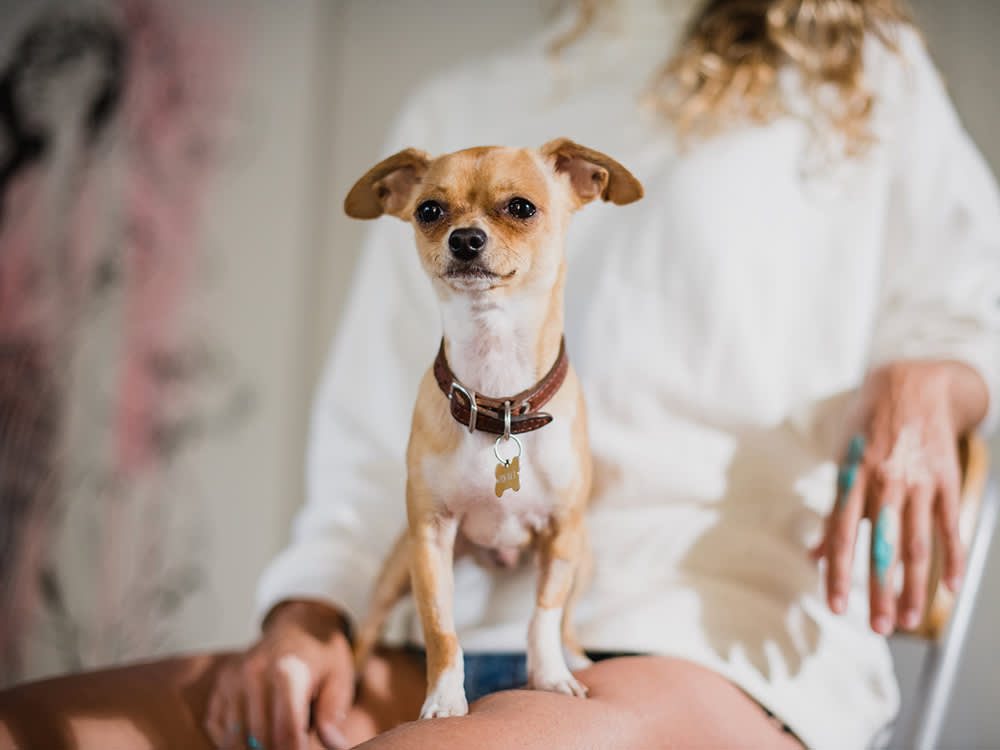
A reader wrote in about her dog, who won’t let her teenage kids hug her without getting defensive. He plants himself between them, stiffens, maybe growls. She isn’t sure whether he’s just intimidating them or would actually bite, and understandably, she doesn’t want to find out. It’s a scary situation, and it’s also one of the most misunderstood problems in dog behavior, because of the word almost everyone reaches for to describe it: protective.
Here’s the reframe this whole piece rests on. “Protective” sounds like loyalty, like your dog loves you so much he’s guarding you from harm. Sometimes there’s a grain of that. But far more often, the behavior we flatter as protectiveness is something less romantic underneath, fear, or resource guarding, with you as the resource. And that distinction isn’t academic, because it changes the entire approach. Treat the label, “he’s just protective,” and you’ll keep managing symptoms forever. Treat the emotion driving it, and the behavior can actually change.
So before anything else, the diagnostic question: why is your dog doing this? Watch him closely as your kids approach. Is he barking and growling? Are his hackles up? Is he stiff, staring, moving to put himself between you and them? Is he protecting, guarding, or afraid? The answer shapes everything that follows.
Where the instinct comes from, and where it curdles
It’s worth understanding the raw material first, because the instinct itself isn’t a defect. Dogs are social animals who bond hard, and they read the people they live with as their group. Many were bred over generations to watch homes and land and to alert their people to anything out of place, a stranger, a strange animal. So a baseline urge to notice threats and sound the alarm is normal dog equipment, and in moderation it’s even nice to have.
The problem is the thin, blurry line between that healthy watchfulness and something that’s gone wrong. Real protectiveness is proportionate and switches off: your dog notices something unusual, alerts, and then settles once it’s clear there’s no threat. What people call overprotectiveness is different. The dog reacts when the situation plainly doesn’t call for it, can’t stand down, and may escalate toward harming a person or animal who comes near you. That version usually isn’t love talking. Aggression, even the kind aimed at “defending” you, tends to grow out of fear or insecurity, and left unaddressed it can tip into biting.
Reading which one you’ve got
Genuine protective signaling and fear-driven guarding can look similar from across the room, so learn the cues. Signs a dog is in protective mode include putting their body between you and a perceived threat, barking at strangers, noises, or other animals, growling in warning, and staying vigilant and scanning for danger. Those are the behaviors themselves. The motivation underneath is what you’re really after, and this is where a professional’s read matters, because the same growl can come from “this is mine” (resource guarding) or “I’m scared” (fear), and the two need slightly different handling even though the training tools overlap.
One pattern worth knowing: dogs often guard hardest over the family members they read as least able to defend themselves, which is why babies and small children can become the trigger, or the guarded party, in these situations.
The core fix: change the emotion, not just the behavior
Because the behavior is downstream of a feeling, the most effective work changes how your dog feels about the thing that sets him off, rather than just suppressing the reaction. Here’s the practical version for the hugging problem, and it generalizes.
Start with a “stay” cue through a barrier, a baby gate works well, something that separates without fully blocking the view like a tall fence would. Put the dog on a “stay,” have your kids approach, let them give you a hug, move away, and then reward the dog with a high-value treat. Repeat it many times. What you’re actually doing is rewiring the dog’s emotional association with people approaching and hugging you, from threat to good-things-happen. If a full hug is too much to start, break it down smaller: begin with a handshake, or just people talking near you, and build up.
If the behavior toward the kids is genuinely scary and aggressive, you’ll need to work through increasingly challenging versions of what stresses him, carefully. The Karen Overall Relaxation Protocol, free to find online, is a solid scaffold for that: it builds calm in graded steps, and you can design the later ones around the exact scene that sets your dog off, a family member walking over to hug you. Where the risk is real, run that work with a barrier or a genuine buffer of distance between the dog and everyone else.
Sometimes a dog does fine with a “stay” through a barrier at five feet but still reacts right next to their person. In that case you practice in gradually closer proximity, closing the distance only as the dog stays comfortable.
Safety while you train
If there’s true danger, a muzzle can keep everyone safe during practice, but with a critical caveat: muzzle training is its own project. You don’t just strap one on a dog. It requires proper desensitization so the muzzle itself doesn’t become another source of stress, and resources like The Muzzle Project walk you through it. Work the muzzle desensitization in parallel with the “stay” and counter-conditioning work, and only combine the two once the dog is comfortable with each.
Alongside the targeted work, some general structure helps any reactive dog. Predictability is itself a treatment: a day that unfolds the same way each time gives an anxious dog fewer things to brace against, so hold the training line steady and introduce anything new, a person, another dog, an unfamiliar setting, in doses small enough to be boring. Manage your own nerves too. Dogs are excellent readers of the human at the other end of the leash, and a tense handler hands the dog one more reason to worry, so model the loose, curious energy you want back. Keep your distance from others when you’re out until you have the behavior under control, always use a leash for introductions so you can calmly move the dog away if things get tense, and keep working on socialization, which is possible even with an adult or newly adopted dog and does more than almost anything to prevent reactivity from taking root.
And one firm rule: never punish a dog for being overprotective. Punishment adds fear to a problem that’s usually already made of fear. Instead, ask for an alternative behavior and reward it.
The word ‘protective’ does a lot of quiet damage, because it tells the owner the dog is doing something noble and just needs to dial it back. But when I watch these dogs, I’m usually not seeing a bodyguard, I’m seeing a worried dog who has decided the safest move is to control who gets near their person. Once you treat it as fear instead of loyalty, everything you do gets gentler and more effective. You’re not disciplining a hero. You’re reassuring an anxious dog.
When to get help, and when it’s serious
This is a problem worth bringing a professional into early, and often two: a qualified behaviorist for the training plan, and your vet to check whether pain, illness, or anxiety is fueling the reactions and what might reduce them. There’s a cluster of signals that separates a dog in real trouble from a dog who is merely wound up: the body goes rigid, the stare locks on and holds, the dog plants himself in the gap between you and whoever is walking toward you, and then comes the growl, the bark, the lunge. That is forward aggression, it is serious, and it is not a project to take on by yourself.
Two more principles from behavior professionals are worth internalizing. First, when your dog reacts, ask for an incompatible behavior instead, a “sit,” or a “come behind me,” and reward it heavily, so the dog has a job that isn’t guarding. Second, read your dog’s body language and warn other people when he’s worried, and above all, manage the environment so the situation doesn’t arise in the first place. Put plainly: if your dog isn’t social, the brewery patio isn’t the place to prove otherwise.
With patience, consistency, and the combined help of a vet and a behaviorist, overprotective behavior can genuinely improve. But it improves fastest when you stop managing a “protective” dog and start reassuring a frightened one, because that’s usually who’s actually standing between you and the hug.
Because this involves aggression risk and safety, treat this as background and work with a qualified behaviorist and your vet on any dog showing forward aggression, especially around children.
References
- Overall, Karen L. “Protocol for Relaxation: Behavior Modification Tier 1.” Manual of Clinical Behavioral Medicine for Dogs and Cats, Elsevier, 2013.
- “Aggression in Dogs – Territorial.” VCA Animal Hospitals.
- “How to Stop Territorial Barking.” Cummings School of Veterinary Medicine at Tufts University, 15 Apr. 2020.
- Van Bourg, Joshua, et al. “Pet Dogs (Canis lupus familiaris) Release Their Trapped and Distressed Owners: Individual Variation and the Importance of Obedience.” Arizona State University, 2020.
Dr. Mehta is a board-certified veterinary nutritionist who evaluates pet food formulations, ingredient quality, and the science behind dietary trends. He writes and reviews all nutrition content at The Pet Times, including our food rankings and feeding guides.
Meet our experts ↗Keep reading
 TrainingYour Reactive Dog Can't 'Settle.' Stop Asking and Give Them a Job.Dr. Mara Chen · 8 min
 TrainingYour Dog Nibbles You Like Corn on the Cob. Two Experts Disagree About What to Do.Dr. Nina Kohl · 8 min
 TrainingThe Algorithm Rewards Bad Dog Training. Here Are 10 Tells.Dr. Mara Chen · 7 min
 TrainingStop Letting Your Dog 'Say Hi' on the LeashDr. Priya Nair · 5 min
 TrainingThe Stuffed Kong Won't Save You: 7 Lies About Separation AnxietyDr. Amara Solis · 9 min
 TrainingYour Dog Isn't Aggressive at the Door. He's Scared, and the Door Makes It Worse.Dr. Mara Chen · 4 min