


Your Dog Nibbles You Like Corn on the Cob. Two Experts Disagree About What to Do.
Trainers say cobbing is self-soothing and shouldn't be stopped. A rescue founder says no teeth on skin, ever. They're both right, and the way you resolve that tension decides whether your dog's sweetest habit stays sweet.

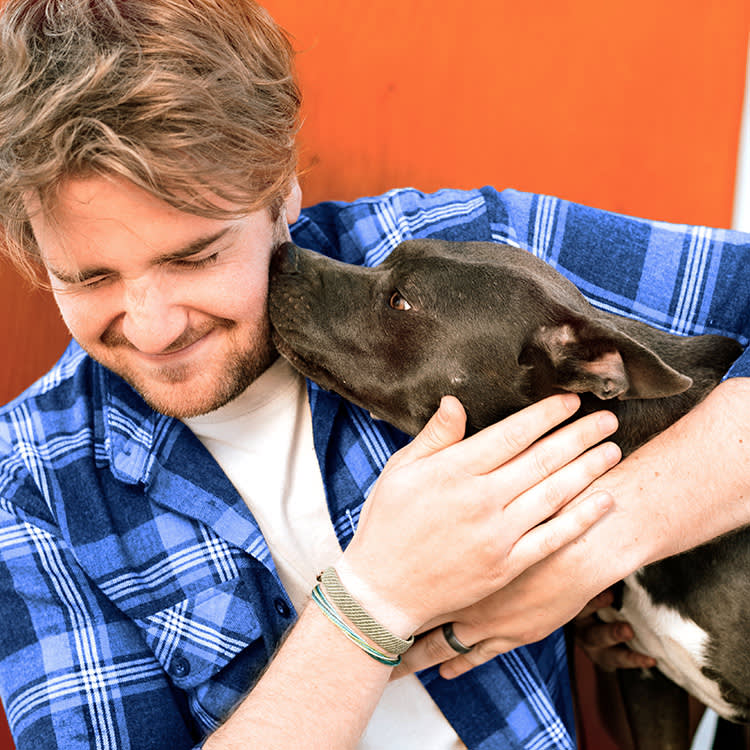
You are on the couch. Your dog is pressed against you. And then you feel it: a delicate, rhythmic nibbling along your forearm, incisors going at it in tiny rapid strokes, like someone typing. It does not hurt at all. It goes on long enough to be genuinely puzzling.
That is cobbing, so named because it looks exactly like a dog eating corn on the cob. Dogs do it to people, to other dogs, to blankets, to toys, and to their own legs and feet. It gets called a love bite, and it feels like one.
Now here is the interesting part, and the reason this deserves more than a cute explainer.
Ask a dog trainer what to do about cobbing and you will be told, firmly, that it should not be discouraged. Ask an animal rescue founder the same question and you will be told, equally firmly, that no dog should ever put teeth on human skin, ever, full stop.
They are both experienced. They are both right. And the collision between them is the actual subject here.
What cobbing is
First, the reassuring part, because it is true.
Dog trainer and behavior specialist Sarah Rutten is unambiguous that there is nothing harmful, aggressive, or badly behaved about it. In her reading it is a way for the dog to settle themselves, sitting in roughly the same category as a person sucking their thumb or drumming their fingers.
That framing is the key to everything else. Cobbing sits in a family of ordinary, developmentally normal mouth behaviors alongside nipping and mouthing. It is not a bite, and it is not on the road to becoming one.
Certified dog behavior consultant Karis Nafte calls it perfectly normal, and adds something warmer: it may be a sign your dog feels safe with you and considers you family. Dogs are social animals who groom their siblings and their loved ones, and a gentle nibble sits comfortably in that vocabulary.
But Rutten’s account of when it surfaces is the more useful clinical detail. The moments that produce cobbing, she finds, are the ones in which a dog is carrying more feeling than they can comfortably hold: over-aroused, torn between two impulses, or simply too excited and reaching for a way to bring themselves back down. This is not a diagnosis of a permanently anxious animal. It is a snapshot of one specific minute in which the dog had something large to process.
Which reframes the whole behavior. Cobbing is not an act of affection so much as an act of self-regulation that often happens to be aimed at someone the dog trusts. Your arm is not being kissed. Your arm is being used as a fidget toy, by an animal who feels safe enough to fidget on you.
Rutten’s summary of the correct response is that the behavior rarely calls for discouragement. What it calls for is comprehension.
The counter-argument, which is not soft
Now the other side, and it deserves to be taken seriously rather than waved off as harshness.
Jme Thomas, founder of Motley Zoo Animal Rescue, works at the end of the pipeline where behavior problems become life-or-death, and her position reflects that vantage point.
Her concern is not that cobbing is aggressive. It is that it is teeth, on skin, in a world that does not grade on a curve. Direct that nibble at the wrong person and the consequences are not behavioral, they are legal, and at the far end of the scale a dog can lose their life over it. So her rule is short and has no exceptions, and it hardens further the moment a child is anywhere nearby: teeth do not touch human skin. Not gently, not affectionately, not once. Give the dog another way to reach you instead.
She also names a mechanism the trainers only gesture at: cobbing can become operant. A dog who nibbles, receives attention, and files that away has learned a lever. Reward that lever whenever the dog chooses to pull it, she warns, and you will end up living with an animal who pursues your attention relentlessly, on their schedule. Charming, and frequently not appropriate.
Liz Gibbs, general manager of the dog care center Woofie’s, lands in the same place from a different angle. Cobbing can mean many things, self-soothing, affection, overstimulation, anxiety, and dogs of any age do it. It is not inherently bad. But, she says, it can become excessive and addictive, and whether it is a problem depends partly on the human, because some people do not mind it and others do not want to be on the receiving end of love bites at all.
Resolving the disagreement
Line the two positions up and the contradiction dissolves, because they are answering different questions.
The trainers are answering: what does this behavior mean? Answer: it is self-soothing, it is normal, and suppressing it without addressing why it is happening is both cruel and useless.
The rescue founder is answering: what should the behavior be aimed at? Answer: not human skin, because the world will not be as forgiving as you are.
Put together, you get a rule that satisfies both, and it is the right one:
Do not stop the coping mechanism. Change the object.
Rutten makes exactly this point, and it is the hinge of the whole article. Since the nibbling is usually how the dog is metabolizing stress, shutting it down while leaving the stress in place is not a solution. Anything you take away has to be swapped for something, and the swap is usually a chew toy, offered gently. What you do not do is punish it, pin the dog, or teach them that a coping strategy is a crime.
Your dog needs somewhere to put the feeling. Take away the outlet and leave the feeling, and you have not fixed anything. You have just made your dog handle it alone.
The instinct people have is to either allow everything or forbid everything, and both are mistakes. Cobbing is your dog telling you they are holding a big emotion. Take that seriously and give them something better to hold. What you never do is take away the coping tool and hand them nothing back.
The one place the hard line is genuinely hard
The “no teeth on skin” rule looks unnecessarily strict for an adult who does not mind a gentle nibble on the forearm. In your own home, on your own arm, with your own dog, honestly, it probably is.
Around children, it is not strict at all. It is the correct rule, and the reason is not the dog.
A child cannot calibrate. A child does not read the difference between a gentle self-soothing nibble and a warning, does not know how to hold still, and will often respond to teeth by shrieking and yanking their arm away, which is precisely the movement most likely to convert a soft mouth into a graze. And a dog who has learned that teeth-on-people is an acceptable channel of communication has one more tool available in a moment of stress, which is a bad thing to have available around a small, fast, unpredictable human.
Add to that Thomas’s point about consequences. The world outside your living room does not distinguish between a love bite and a bite. A dog reported for putting teeth on a child does not get a hearing about intent.
So: your arm, at home, your call. Anyone else’s skin, and any child’s skin, redirect it every single time.
How to redirect it, practically
Offer something better. Gibbs would have you hand the dog a chew, or start up some other activity they enjoy. The practical corollary is to keep one within arm’s reach wherever the nibbling tends to start, because a redirection that requires a trip to another room is a redirection that is never going to occur.
Use the cuddle rule. If your dog starts cobbing you while you are cuddling, stop all interaction. Not a scolding. Just a full stop. Then resume, and reward, only when they are calm. This teaches something very clean: teeth end the good thing, calm restarts it.
Look at what happens right before. The smartest tip in the pile, and the most neglected. Gibbs’s instruction is to stop watching the nibble and start watching the thirty seconds preceding it, hunting for the pattern. If it reliably fires when one particular person walks in, or when the other animal in the house appears, that is not coincidence. That is your dog naming the thing that makes them feel torn. Head it off at that moment with something else to do, and the pressure never accumulates in the first place.
Track the antecedent, not the behavior. That is how you actually solve it.
Escalating means look upstream. If the cobbing is getting worse or more frequent, Rutten’s advice is to stop treating it as a habit and look at your dog’s overall condition: their stress levels, routine, sleep, and emotional support. A behavior that is intensifying is a symptom of a load that is increasing.
The line worth keeping
Rutten’s closing point applies to far more than cobbing, and it is worth pinning above the couch.
Nothing a dog does is arbitrary. Whatever they are doing made sense to them, from inside how they felt at that moment. What you are looking at is data, not a defect.
The nibbling on your arm is a message. You are allowed to decline to be the mailbox. But do not shoot the messenger, and do read the mail.
References
- American Veterinary Society of Animal Behavior. “Position Statement on Humane Dog Training.” https://avsab.org/resources/position-statements/
- American Veterinary Society of Animal Behavior. “Position Statement on Dog and Child Interactions.” https://avsab.org/resources/position-statements/
- Overall, K. L. Manual of Clinical Behavioral Medicine for Dogs and Cats. Elsevier. (Displacement and self-soothing behaviors.)
- American Veterinary Medical Association. “Dog bite prevention.” https://www.avma.org/resources-tools/pet-owners/dog-bite-prevention
- Landsberg, G., Hunthausen, W., & Ackerman, L. Behavior Problems of the Dog and Cat. Saunders.
Dr. Kohl is a board-certified veterinary dentist with a particular interest in preventive oral care. She reviews all dental health content at The Pet Times and contributes practical guides on home dental routines, professional cleaning, and oral disease prevention.
Meet our experts ↗Keep reading
 TrainingThat Friendly On-Leash Hello Is Teaching Your Dog to Melt DownDr. Amara Solis · 6 min
 TrainingStop Letting Your Dog 'Say Hi' on the LeashDr. Priya Nair · 5 min
 TrainingYour Dog Isn't Being Rude. He's Cornered.Dr. Amara Solis · 8 min
 TrainingYour Reactive Dog Can't 'Settle.' Stop Asking and Give Them a Job.Dr. Mara Chen · 8 min
 TrainingThe Algorithm Rewards Bad Dog Training. Here Are 10 Tells.Dr. Mara Chen · 7 min
 TrainingYour Dog Isn't Aggressive at the Door. He's Scared, and the Door Makes It Worse.Dr. Mara Chen · 4 min