


Your Reactive Dog Can't 'Settle.' Stop Asking and Give Them a Job.
Reactive dogs have measurably worse impulse control than calm ones. So the standard fix, teaching them to sit quietly near the scary thing, asks for the exact skill they're missing. Play works better, and here's the mechanism.

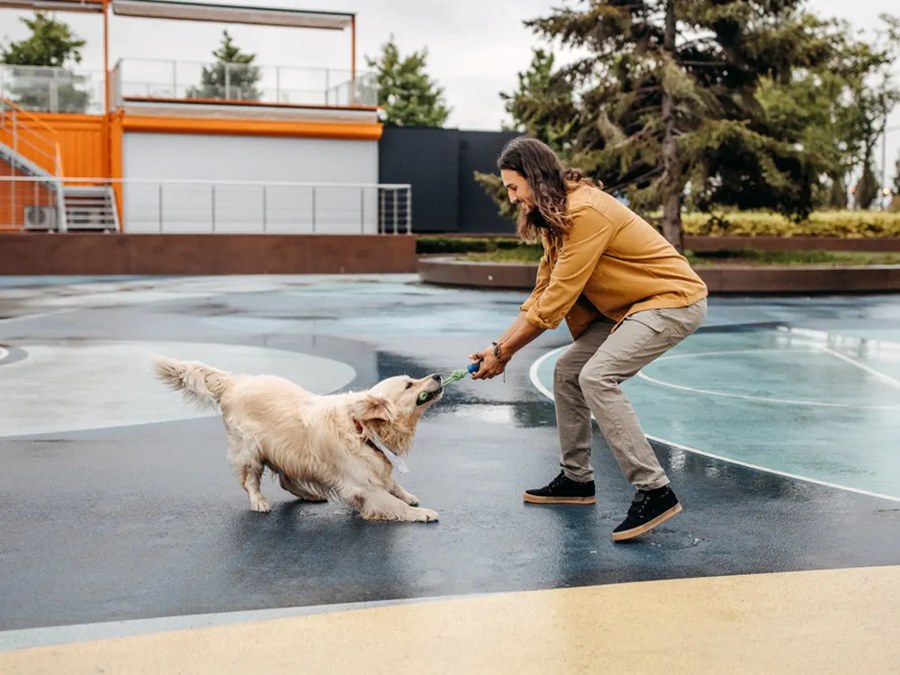
Almost every reactive dog gets the same prescription. When the trigger appears, ask your dog to sit. Ask for a down. Ask them to look at you and hold it. Reward the calm.
It is sensible-sounding advice built on a sound principle, and for a large number of dogs it simply does not work. Owners then conclude their dog is stubborn, or too far gone, or that they themselves are bad at training. Usually none of that is true. The advice is asking the dog for the one thing they are worst at, at the exact moment they are worst at it.
There is research pointing straight at why. Dogs showing high levels of aggressive reactivity perform measurably worse on tests of self-control and inhibition than non-reactive dogs. Impulse control is not incidental to the problem. It is close to the center of it.
Now read the standard advice again. Hold still. Be quiet. Do nothing, while every system in your body is screaming at you to do something. We are handing a dog with poor brakes a task made entirely of braking.
The alternative is not to lower the bar. It is to change what we ask for. Instead of demanding stillness from a dog who cannot produce it, we give the arousal somewhere legitimate to go.
We give the dog a job. Usually the job is a game.
Why an active behavior beats a static one
The underlying logic is old and reliable: to stop a dog doing one thing, teach them something they cannot do at the same time. A dog who is sitting is not jumping on your aunt.
The wrinkle is that incompatible behaviors come in two flavors, and they are not equally available to an aroused animal.
Static behaviors are sit, down, stay, settle on a mat. They require suppressing movement. They demand the exact executive control that a reactive dog is short on.
Active behaviors are fetching a toy, gripping a tug, running to a target, chasing you. They redirect movement rather than suppressing it. The energy still comes out. It just comes out pointed somewhere useful.
For a highly aroused dog, the second category is enormously easier to perform, which means it is enormously easier to train under pressure. You are working with the dog’s physiology instead of filing a complaint against it.
There is a second effect, and for fearful dogs it may be the more important one. Play changes emotion, not just behavior. A play-motivated dog who is frightened of strangers will often respond better to a game than to food, even if that dog would normally sell you their soul for a piece of chicken. Fear yields to play faster and more completely than it yields to snacks. A dog eating a treat next to a scary thing is a dog tolerating the scary thing. A dog playing next to it is a dog whose emotional state has genuinely changed.
People keep trying to install a brake, and what the dog needs is a steering wheel. If you have a dog who cannot be still, asking for stillness is a losing bet. Ask for something they can actually do at full throttle, and you’ll get it.
The four games, and the dog each one is for
Not every game suits every dog. Match the tool to the problem.
Fetch, for the dog who erupts at movement
Some dogs come apart when the environment starts moving. Someone stands up from the sofa. Someone crosses the kitchen. The dog spins, barks, and sometimes puts their teeth on a moving ankle, and the more it happens the more wound up they get.
Fetch is a superb fit, because the fix is a role reversal. Movement becomes the cue to go get a ball and bring it back. The act of picking up a toy is itself faintly calming for many dogs, and the anticipation reframes the trigger completely. The household getting up off the couch stops meaning chaos incoming and starts meaning the game is about to start.
The same game can be pointed at fear. If a dog who is frightened of visitors loves fetch, then every visitor throws the ball. Do that enough times and the arrival of a stranger stops predicting danger and starts predicting the best part of the day. This is classical conditioning doing what it does best: not teaching a behavior, but changing what an event means.
Tug, for the dog who cannot look away
The dog who fixes on another dog through the window, or from across the street, and cannot be called off. Owners of these dogs have usually tried food and been humiliated by it. The dog is not ignoring the treat out of defiance. The dog is not available.
Tug earns its place here for specific mechanical reasons:
- It keeps the dog physically near you rather than lunging away.
- It occupies the mouth, which matters enormously in a dog whose escalation ends in teeth.
- It lets you steer where the dog is looking, which is decisive for a visually triggered dog. Turn your body, and the dog’s eyes follow the rope.
- It is intense enough to compete with the trigger, which food often is not.
One caveat, and it is not optional: tug must not be part of the aggression. For a small number of dogs, tug tips them further over rather than pulling them back. If the game escalates your dog into something uglier, it is the wrong game. That is a real result, not a failure.
Chase, for the dog who works for motion
Some dogs are trained beautifully, know every cue, and can perform all of them in the presence of another dog, right up until they see the other dog first. Then the barking, lunging, and pulling arrives with enough force to put a person on the pavement.
For these dogs, the mistake is often the reward, not the training. Food is simply not the thing they want in that moment. Motion is. So make motion the paycheck: any behavior other than reacting earns a run. The dog holds it together, and you take off, and the dog gets to chase you.
Dogs like this learn the rule with startling speed, because for the first time the deal is being offered in a currency they actually want.
Toys, variety, and play stations, for the dog whose aggression is really frustration
Then there is the dog whose aggression is not fear and not reactivity at all, but a play drive with nowhere to go. The classic case is a young dog in a house with an older one: the puppy wants to play constantly, the senior wants to play for about ninety seconds, and when the older dog opts out, the youngster escalates, growls, pounces, and sometimes injures a housemate who did nothing except get tired.
No amount of correction fixes this, because the dog is not misbehaving. The dog is under-stimulated and has one outlet.
The fix is to build more outlets, aggressively. Work out what this individual dog likes, and the answer for young dogs is often everything: plush toys, ropes, balls, squeakers, puzzle feeders, chews. Then set up several play stations around the house so play is available in more than one place. Teach independent games, the kind that do not require a partner: tossing an object and catching it, nosing a ball around, pushing a toy down a ramp and chasing it.
Crucially, the humans have to play more too. The reason the older dog is being harassed is that they are the only entertainment on offer. Take that job away from them.
Get this right and the young dog still plays with the senior, briefly and appropriately, a few times a day. When the senior taps out, the youngster now has somewhere else to go.
What this approach is not
It is not a universal fix, and anyone selling it as one is selling something.
Play helps dogs whose behavior is driven by frustration, arousal, poor impulse control, boredom, or fear. That is a large slice of the reactive population, but it is not all of it. Aggression with other roots, pain, resource guarding with a bite history, or genuine predatory behavior, needs a different plan and often a professional in the room.
It is also not a replacement for distance management. You still do not march a reactive dog into the middle of a crowded dog park to try out a tug rope. The game works because it happens at a distance where the dog can still think, and it closes that distance slowly.
And it is not permission to skip the boring parts. A game that isn’t fluent in the kitchen will not survive on the street.
What newer research adds
The most useful development for owners is the growing evidence base underneath the impulse-control story. Work published in the last few years found that dogs with high aggressive reactivity show impaired performance on self-control and inhibition tasks compared with calmer dogs. That is the clearest scientific case yet that reactivity is, in part, an executive-function problem rather than a purely emotional one, and it explains why “just ask for a sit-stay” fails so consistently in the field.
Related work has looked at what happens in the body during these outbursts, documenting the cardiovascular and hormonal surge that accompanies aggressive reactivity. Whatever else is happening, this is a dog in a genuine physiological state, not a dog making a choice you can talk them out of.
Two practical implications, both underrated:
Reactive dogs are not being difficult, and the framing of stubbornness or dominance is not just unkind, it points training in the wrong direction. And structured training of almost any kind appears to support the underlying cognitive skills. The games are not a workaround for real training. In a dog whose brakes are weak, they may be the most direct route to building them.
References
- Dogs Exhibiting High Levels of Aggressive Reactivity Show Impaired Self-Control Abilities (PMC)
- Neuroendocrine and Cardiovascular Activation During Aggressive Reactivity in Dogs (PMC)
- American Kennel Club: Dog Reactivity, Understanding the Difference Between Reactivity and Aggression
- Play interactions improve the dog–owner relationship (research summary)
Dr. Chen is a small-animal veterinarian who leads health and safety coverage at The Pet Times. She writes and reviews the bulk of our illness, condition, and safety content, translating clinical guidance into clear, practical advice owners can act on at home.
Meet our experts ↗Keep reading
 TrainingYour Dog Isn't Being Rude. He's Cornered.Dr. Amara Solis · 8 min
 TrainingStop Letting Your Dog 'Say Hi' on the LeashDr. Priya Nair · 5 min
 Training'Overprotective' Is Usually Fear Wearing a Nicer NameDr. Ravi Mehta · 8 min
 TrainingThe Stuffed Kong Won't Save You: 7 Lies About Separation AnxietyDr. Amara Solis · 9 min
 TrainingThat Friendly On-Leash Hello Is Teaching Your Dog to Melt DownDr. Amara Solis · 6 min
 TrainingYour Dog Isn't Aggressive at the Door. He's Scared, and the Door Makes It Worse.Dr. Mara Chen · 4 min