


Your Dog Isn't Being Rude. He's Cornered.
Barking and lunging on leash is not a manners problem. It is a request for space from a dog who can't make space himself, and the fix starts with giving him some.

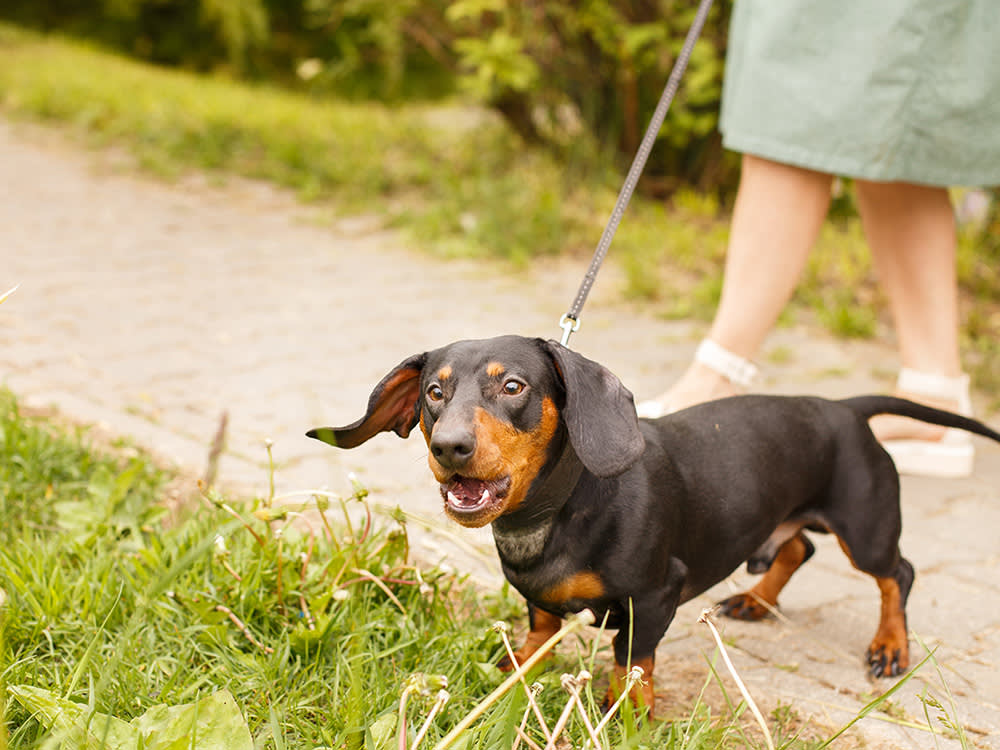
Here is the sentence that reframes the whole problem: a leash removes your dog’s ability to leave.
Everything else about leash reactivity follows from that. A loose dog who is uneasy about an approaching stranger has a quiet, elegant option available. He arcs. He drifts wide, sniffs the grass, angles his body, and adds ten feet of distance without anyone noticing that a negotiation just took place. Dogs do this constantly. It is one of their most sophisticated social skills, and it is almost invisible once you know to look for it.
Clip six feet of nylon to his collar and that option disappears. He cannot arc. He cannot leave. The only distance-increasing tool left in the box is noise, and so he uses it: hackles up, weight forward, a bark that means stay back, I am serious, do not come closer.
That is what the lunging is. It is not aggression, not usually, and it is not a commentary on your competence as an owner. It is a dog making the loudest possible request for the one thing he cannot get for himself.
The word we should use less
Leash reactivity gets defined technically as barking, lunging, or growling on leash in response to a specific trigger, most often another dog. That definition is accurate and it is useless, because it describes the noise instead of the ask.
Try this one instead: your dog is asking for distance and has no polite way left to ask.
That reframe does real work. It tells you what he wants, which tells you what to give him, which tells you what the training plan is. The plan is not “make him stop barking.” The plan is “make him not need to.”
Once you hear the barking as a request instead of a tantrum, the answer stops being a correction and starts being a decision about where you’re standing. Most people are trying to train a dog who is too close to think. Move first, train second.
The part nobody warns you about: the embarrassment
Let’s name it, because it drives more bad decisions than any training error does.
When your dog explodes at the end of the leash on a quiet street, you feel watched. You apologize to the other person. You yank, because yanking looks like you are Doing Something. You march your dog straight past the trigger to prove he can handle it, because turning around feels like losing.
Every one of those responses makes the next walk worse. The yank pairs pain with the sight of the other dog. The march holds him at a distance where he is already over threshold. The apology puts your attention on the stranger’s opinion instead of on your dog, who is the only one in the equation who needs you right now.
You are allowed to turn around. Turning around is not failure. It is the intervention.
Read the dog before the bark
The bark is the last thing that happens, not the first. There is a ladder underneath it, and if you learn the bottom rungs you get seconds of warning, which is all you need.
Watch, in roughly this order:
- The freeze. Movement stops. Weight shifts forward or back. This is often the first honest signal.
- The stare. Hard, unblinking, locked on. A dog who cannot look away is a dog who cannot yet learn.
- The stiffening. Ears up and forward or pinned flat, tail high and rigid or tucked, a closed mouth on a dog who was panting a second ago.
- The commitment. Weight loads onto the front end. The bark is already in the mail.
Rungs one and two are your window. Once you are at rung four, you are no longer training anything; you are managing an emergency, and the only good move is distance.
The distance rule
Every dog has a number. Below it, he cannot think. Above it, he can. Your entire job is to find that number and then work just outside it.
Practically:
- Find the threshold. How far away can another dog be before yours notices and can still take a treat, still look at you, still breathe with his mouth open? That distance, whatever it is, is where you train. If it is forty feet on a bad day, it is forty feet. It is not a moral failing.
- Protect it. Cross the street early. Duck behind a parked car. Step into a driveway and let them pass. Use whatever visual barrier the street gives you, because a dog who cannot see the trigger is a dog whose nervous system gets a rest.
- Change what the trigger means. The moment your dog spots a dog at a workable distance, food starts happening. Not as a bribe, not as a reward for behaving, but as a fact: other dog appears, chicken appears. Other dog leaves, chicken stops. Repeat that a few hundred times and the sight of an approaching dog stops predicting threat and starts predicting snacks. This is the engine of the whole thing.
- Then, and only then, add a cue. A “look at me” or “watch” gives your dog something to do instead of scanning. It works beautifully at a distance he can already handle, and it fails completely at a distance he cannot. Cues are steering, not brakes.
The magic moment, when it comes, is not that your dog obeys. It is that he clocks the other dog, decides on his own that he would rather look at you, and does. The first time it happens you will want to shout. Do not shout. Pay him.
What to put on him, and what not to
A front-clip harness or a well-fitted Y-front harness gives you steering without choking a dog who is already scared. A six-foot leash gives you room to move; a retractable leash gives you nothing but a bad grip at exactly the wrong second.
What does not belong on a reactive dog is anything that hurts. Prong, choke, and electronic collars all work by making the dog feel worse in the presence of the trigger, and the trigger is already the problem. You can absolutely suppress the bark this way. What you get in exchange is a dog who has learned to say nothing before he bites.
What newer research adds
The case against correction-based training used to be an ethical argument. It is now a data one.
Dogs trained mostly with aversive methods show more stress behavior during sessions, higher post-training cortisol, and, in cognitive bias testing, a measurably more pessimistic outlook on ambiguous situations than dogs trained with rewards. That last finding matters for reactivity specifically, because a reactive dog’s core problem is that he already reads ambiguous situations as bad news.
The efficacy argument is gone too. In a controlled study whose trainers were nominated by the electronic collar manufacturers’ own trade body, e-collar training was no more effective than reward-based training at achieving the same outcomes. There is no results-based reason left to hurt a frightened dog.
One more update worth knowing: veterinary behaviorists are far more willing than they were a decade ago to add medication to a training plan when a dog’s baseline anxiety is high enough that he cannot learn. If you have been doing everything right for months and the threshold will not budge, that is a conversation worth having with your vet, not a sign that you have failed.
The point of all of it
You brought a member of another species into your house and asked him to walk through a world designed by primates. He is doing his best with the vocabulary he has.
The walk does not have to be a fight. Give him room, pay him for noticing, and stop apologizing to strangers who will forget you both in twenty seconds.
References
- Vieira de Castro, A. C., et al. “Does training method matter? Evidence for the negative impact of aversive-based methods on companion dog welfare.” PLOS ONE, 2020. https://journals.plos.org/plosone/article?id=10.1371/journal.pone.0225023
- Casey, R. A., et al. “Dogs are more pessimistic if their owners use two or more aversive training methods.” Animal Cognition, 2021. https://www.ncbi.nlm.nih.gov/pmc/articles/PMC8463679/
- China, L., Mills, D. S., & Cooper, J. J. “Efficacy of Dog Training With and Without Remote Electronic Collars vs. a Focus on Positive Reinforcement.” Frontiers in Veterinary Science, 2020. https://www.frontiersin.org/articles/10.3389/fvets.2020.00508/full
- American Veterinary Society of Animal Behavior, “Position Statement on Humane Dog Training.” https://avsab.org/wp-content/uploads/2021/08/AVSAB-Humane-Dog-Training-Position-Statement-2021.pdf
Dr. Solis is a board-certified veterinary dermatologist with over twelve years of clinical experience. She advises on skin conditions, allergies, and grooming practices that affect coat and skin health. All dermatology and allergy content at The Pet Times is reviewed by her team before publication.
Meet our experts ↗Keep reading
 TrainingThat Friendly On-Leash Hello Is Teaching Your Dog to Melt DownDr. Amara Solis · 6 min
 TrainingStop Letting Your Dog 'Say Hi' on the LeashDr. Priya Nair · 5 min
 TrainingYou Didn't Cause Your Dog's Leash Reactivity. Here's How to Manage ItDr. Amara Solis · 7 min
 TrainingYour Dog Nibbles You Like Corn on the Cob. Two Experts Disagree About What to Do.Dr. Nina Kohl · 8 min
 TrainingThe Stuffed Kong Won't Save You: 7 Lies About Separation AnxietyDr. Amara Solis · 9 min
 Training'Overprotective' Is Usually Fear Wearing a Nicer NameDr. Ravi Mehta · 8 min