


That Friendly On-Leash Hello Is Teaching Your Dog to Melt Down
Letting two leashed dogs meet nose-to-nose feels polite, but trainers say it's one of the fastest ways to create leash reactivity and erode your dog's trust in you. Why it backfires, and the safer way to introduce dogs.

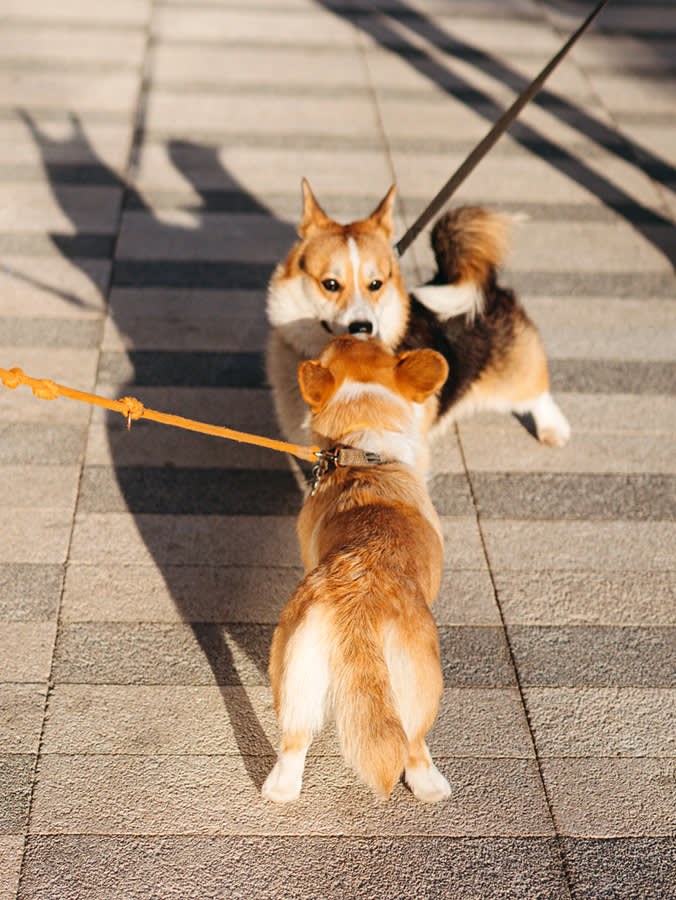
It looks like the friendly thing to do. Two dogs spot each other on the sidewalk, both owners slow down, the leashes shorten, and the dogs are steered nose-to-nose for a hello. Polite, sociable, harmless. Except that a lot of trainers would tell you it is quietly one of the worst things you can do to your dog, and that the tidy little greeting you just brokered may be planting the seed of the exact leash meltdowns you dread.
The claim sounds counterintuitive, so it is worth stating the thesis plainly: on-leash, face-to-face greetings are not a neutral courtesy. They stack the deck against your dog by combining an unnatural approach, a restraint that blocks normal communication, and a nervous handler telegraphing tension straight down the leash. Understand why each of those hurts and you will see why “just let them say hi” is advice worth ignoring, and what to do instead.
The problem starts with geometry
Left to their own devices, dogs do not greet head-on. They approach in a curve, swinging wide and coming at each other from the side, and they investigate by circling and sniffing rear ends. That arc is not random; it is a deliberate signal that says, roughly, “I am not a threat.” A straight-line, face-to-face approach carries the opposite message. In dog terms, marching directly at another dog reads as a challenge, which is why two dogs pushed nose-to-nose can feel defensive and act on it, even when the humans meant nothing by it.
A leash makes it worse by design. It forces a head-on geometry that dogs would naturally avoid, and it removes their ability to arc, retreat, or control their own spacing. The dog is committed to an interaction it cannot shape and cannot leave. That loss of choice is where a lot of the trouble comes from.
The leash carries your nerves, too
There is a subtler mechanism at work, and it runs through the leash itself. When we see another dog approaching and feel unsure, we tend to do one automatic thing: tighten the leash. To the dog on the other end, that sudden tension is information. It reads as “my person is worried, so I should be worried too.” You have effectively transmitted your anxiety into your dog’s body at the exact moment they are meeting a stranger, and a dog primed to be nervous is a dog more likely to react or fight.
The leash is one of your main channels of communication with your dog, and using it this way muddies that channel. Worse, repeatedly overriding a dog’s boundaries this way can erode their trust in you. If a dog learns that their handler will keep letting strange dogs rush into their space, they may stop looking to that handler for protection, start ignoring cues, and decide they are on their own, running up to any dog they see. Once a dog concludes they cannot count on you to manage the situation, the obedience you built starts to slip.
Even a “good” greeting can backfire
Here is the part owners find hardest to accept: the on-leash greeting that goes well can still cause problems. Say two dogs meet, both stay calm and cordial, everyone relaxes. Lovely. But your dog just learned that dogs on the sidewalk are for greeting. Now they want to say hello to every dog they see, and when you cannot or will not allow it, the thwarted expectation curdles into frustration, which comes out as pulling, whining, barking, or lunging. That frustration-driven reactivity is one of the most common problems trainers see, and it often traces back to a history of “successful” leashed greetings that taught the dog to expect them.
So the risk is not only the greeting that turns tense. It is the pattern the habit builds. Every leashed hello, good or bad, tends to raise your dog’s baseline expectation that other dogs are available and reachable, which is a setup for daily frustration on a leash that, by definition, keeps most dogs out of reach.
The dogs I see for leash reactivity are very rarely ‘aggressive’ dogs. They’re usually social dogs who were allowed to greet on leash over and over until they came to expect it, and now they lose their minds when they can’t. The kindest thing you can do on a walk is decide that other dogs are just scenery. Your dog does not need to meet them, and a dog who isn’t waiting to greet every passerby is a dog who can actually relax outside.
The better way to introduce dogs
None of this means dogs should not meet other dogs; it means the leashed sidewalk is the wrong venue. The ideal introduction happens in a neutral, controlled, enclosed space, a fenced yard or similar, with both dogs off-leash so they can use their natural greeting behavior and manage their own distance. For dogs who do not know each other, having a professional trainer oversee the meeting is genuinely worth it. Pick a low-stimulation setting rather than a busy park or crowded street, and avoid staging it around mealtimes or near prized toys that might trigger guarding.
If you truly must introduce two dogs on leash, there is a way to lower the risk. Start by walking the two dogs parallel to each other at a comfortable distance, letting them move together without pressure. Then allow one dog to drop slightly behind and sniff the other, then switch so the second dog gets a turn. If those steps go smoothly, move to a large enclosed space and, when appropriate, drop the leashes rather than yanking them off, keeping the leash attached to the collar so you can step in if needed. The sequence matters: parallel movement and calm sniffing first, face-to-face contact last, if at all.
And on an ordinary walk, give yourself permission to opt out entirely. You have no obligation to any other person or their dog, only to your own. Steering clear of strange dogs is not rude; it is you advocating for your dog. Save the greetings for dogs, and owners, you actually know and trust.
What’s new in leash-greeting guidance
The advice to skip on-leash greetings has moved from a trainer’s contrarian opinion toward mainstream consensus. Force-free and fear-free training communities now widely promote the idea of the dog as “scenery,” teaching handlers to reward calm attention rather than orchestrate meetings, and the phrase “not every dog needs to say hi” has become a common refrain in modern reactivity work.
There is also more emphasis now on the handler’s role in the exchange, the recognition that your own body language and leash handling feed directly into your dog’s arousal, and that staying loose and neutral matters as much as anything the dog does. Structured programs for leash reactivity increasingly build on exactly the principle at the heart of this piece: manage distance, protect your dog’s space, and let calm passing become the default, rather than treating every sidewalk encounter as an opportunity to socialize. The tools have gotten more refined, but the core lesson has only gotten firmer with time.
References
- DiBono, C. (Body and Mind K9), trainer commentary on on-leash greetings.
- American Kennel Club. “Why On-Leash Greetings Can Go Wrong.”
- Fear Free Pets / force-free training resources on leash reactivity and dog-dog introductions.
- Overall, K. L. Manual of Clinical Behavioral Medicine for Dogs and Cats (on greeting behavior and arousal).
Common questions
Why shouldn't dogs meet face-to-face on a leash?
A head-on approach reads as a threat in dog body language, and the leash prevents the natural arcing, sniffing greeting dogs prefer. Add the tension owners put on the leash when nervous, and a leashed nose-to-nose meeting often creates anxiety, reactivity, or a fight.
Can on-leash greetings cause leash reactivity?
Yes. Even a friendly on-leash meeting can teach a dog to expect to greet every dog they see, then react with frustration, pulling, barking, or lunging when they can't. Repeated over time, this is a common route to leash reactivity.
What's the safest way to introduce two dogs?
Introduce them in a neutral, enclosed, low-distraction space with both dogs off-leash if possible, ideally with a trainer present for unfamiliar dogs. If you must use leashes, walk parallel first and let them sniff one at a time before any face-to-face contact.
Dr. Solis is a board-certified veterinary dermatologist with over twelve years of clinical experience. She advises on skin conditions, allergies, and grooming practices that affect coat and skin health. All dermatology and allergy content at The Pet Times is reviewed by her team before publication.
Meet our experts ↗Keep reading
 Training'Overprotective' Is Usually Fear Wearing a Nicer NameDr. Ravi Mehta · 8 min
 TrainingStop Letting Your Dog 'Say Hi' on the LeashDr. Priya Nair · 5 min
 TrainingThe Stuffed Kong Won't Save You: 7 Lies About Separation AnxietyDr. Amara Solis · 9 min
 TrainingYou Didn't Cause Your Dog's Leash Reactivity. Here's How to Manage ItDr. Amara Solis · 7 min
 TrainingThe Algorithm Rewards Bad Dog Training. Here Are 10 Tells.Dr. Mara Chen · 7 min
 TrainingYour Reactive Dog Can't 'Settle.' Stop Asking and Give Them a Job.Dr. Mara Chen · 8 min