


Your Dog Isn't Being Bad. Leash-Biting Is Excitement With Nowhere to Go.
The dog who grabs the leash and pogos around the second it clips on isn't defying you. He's overflowing with excitement and the leash is the only thing in reach. Once you see it that way, the fixes are simple.

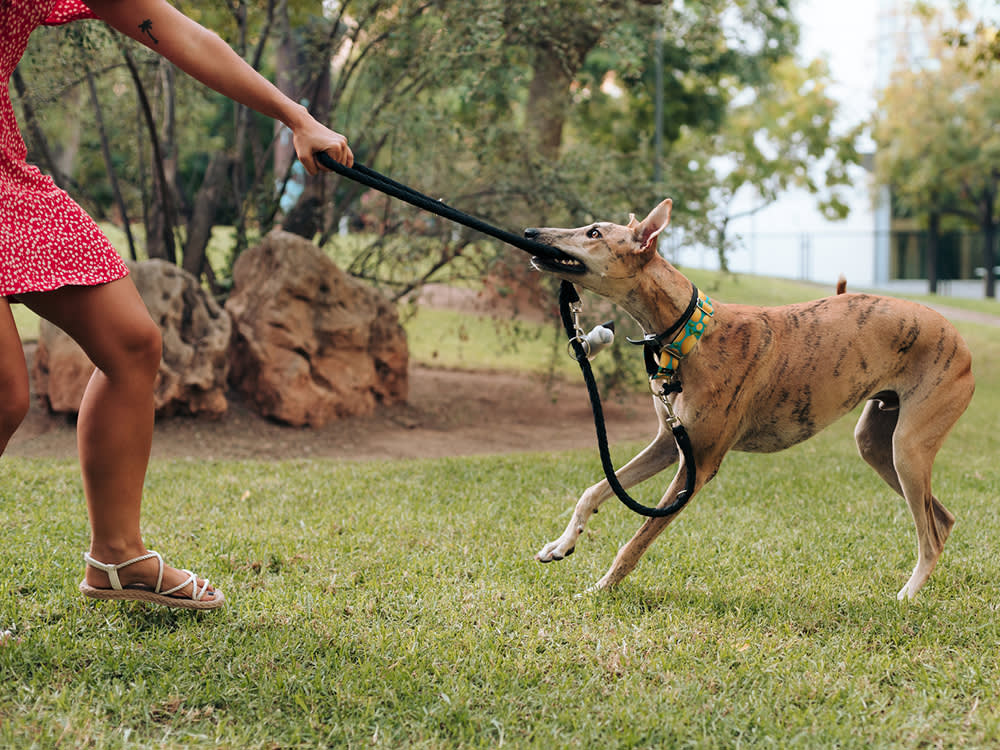
You clip on the leash, and your dog transforms. He grabs it in his mouth, thrashes, bounces like he’s on a pogo stick, and suddenly a simple walk feels like wrangling a shark. Add a second, well-behaved dog to the mix and it can tip into full chaos. It is frustrating, and it drains the joy out of an outing that is supposed to be the good part of the day.
Here is the reframe that changes everything: your dog is not being bad, and he is not trying to win a power struggle. He is overflowing with excitement, and in that revved-up state he gets mouthy. The leash is simply the thing right there in front of his face. Once you stop reading it as defiance and start reading it as arousal with nowhere to go, the solutions get obvious.
Owners take leash-biting personally, like the dog is challenging them. He isn’t. He’s a bottle of soda someone just shook, and the leash is the cap. Your job isn’t to punish the fizz, it’s to open a different valve before he pops.
The one move that fixes most cases: give the mouth a job
If a dog needs something in his mouth, give him something better than the leash. Hand him a toy to carry as you head out. With his mouth already occupied, the leash loses its appeal. It sounds almost too simple, and it is often the entire fix, because you are not fighting the urge to grab, you are redirecting it.
You may have to experiment to find something he likes more than the leash. Let his taste guide you, with safety first: the item should be too big to choke on. Good options include a ball, a rope tug toy, a soft fleece animal, or a flying disc. Plenty of dogs love to carry a stick, but skip real sticks, which cause splinters and mouth and throat injuries; if your dog is a die-hard stick fan, a sturdy stick-shaped toy (brands like Kong make heavy-duty ones) scratches the itch safely.
Then lower the fizz before you clip on
Redirection works even better when the excitement is dialed down to begin with. A few habits help:
Make the leash boring. If clipping the leash on is the starting gun for a party, practice putting it on and taking it off indoors, calmly, several times a day, going nowhere. When the leash stops predicting instant excitement, the outburst shrinks.
Wait for calm to move. Only open the door and start walking when your dog has four paws down and a soft mouth. If he grabs the leash or launches, simply stand still and wait. The walk resumes the instant he settles. You are teaching a clear rule: calm makes the walk happen, chaos pauses it.
Take the edge off first. A dog who has burned some energy is a dog with less to bottle up. A short game of fetch or a few minutes of sniff-heavy backyard time before you leash up can take a keyed-up dog down a notch.
Don’t play the game he’s inviting
The most common accidental mistake is tugging back when your dog clamps the leash. To him, that is a glorious game of tug, the exact outburst he wanted, and it teaches him that biting the leash gets a fun reaction. Instead, go still and quiet. No tug, no drama, no scolding match. When he lets go and his mouth softens, mark it (“yes!”) and reward with a treat or by moving forward. You are rewarding the behavior you want and starving the one you don’t.
A couple of gear tweaks
Gear won’t do the work for you, but it can help. Some dogs lose interest in a leash that doesn’t feel good to bite, so a wider, rounded rope or a coated biothane leash can be less satisfying to chomp than a thin flat strap. A slightly longer leash can also reduce the tight tension that some dogs find grabbable. Avoid anything with a bungee section for a determined tugger, since the springy give can feel like the tug-of-war reward.
When to bring in help
Most leash-biting is ordinary over-excitement and responds well to the steps above within a few weeks. But if the mouthiness comes with growling, stiffness, or snapping that feels like genuine frustration or reactivity rather than play, or if it escalates around other dogs, loop in a certified positive-reinforcement trainer or a veterinary behaviorist. That is not a failure; it is matching the right help to a bigger feeling. For the everyday pogo-stick dog, though, a carried toy and a calmer send-off usually turn the walk back into the best part of the day.
References
Common questions
Why does my dog bite the leash on walks?
It's almost always over-arousal, not disobedience. Many dogs get intensely excited about a walk, get mouthy in that state, and the leash is the nearest thing to grab. Giving them something else to hold and lowering the excitement usually solves it.
Should I tug the leash back when my dog bites it?
No. Pulling back turns it into a game of tug, which is exactly the outburst your dog is looking for and makes the habit stronger. Stay still, redirect to a toy, and reward a calm mouth instead.
Dr. Mehta is a board-certified veterinary nutritionist who evaluates pet food formulations, ingredient quality, and the science behind dietary trends. He writes and reviews all nutrition content at The Pet Times, including our food rankings and feeding guides.
Meet our experts ↗Keep reading
 TrainingDogs Don't Forgive After a Fight. What They Do Is SmarterDr. Ravi Mehta · 5 min
 TrainingYou Didn't Cause Your Dog's Leash Reactivity. Here's How to Manage ItDr. Amara Solis · 7 min
 TrainingMarking Isn't a Potty Accident. Punishing It Backfires.Dr. Nina Kohl · 6 min
 TrainingFace Bites Are Almost Always Our Fault, Not the Dog'sDr. Amara Solis · 5 min
 TrainingStop Punishing Your Puppy. It's Backfiring.Dr. Amara Solis · 9 min
 TrainingYour Dog Isn't Wrecking the Yard. They're Doing a Job. Name It.Dr. Mara Chen · 8 min