


Marking Isn't a Potty Accident. Punishing It Backfires.
Your dog isn't forgetting their house training when they lift a leg on the couch, they're leaving a message. Here's what marking actually communicates, why punishment makes it worse, and the management-first plan that curbs it indoors and out.

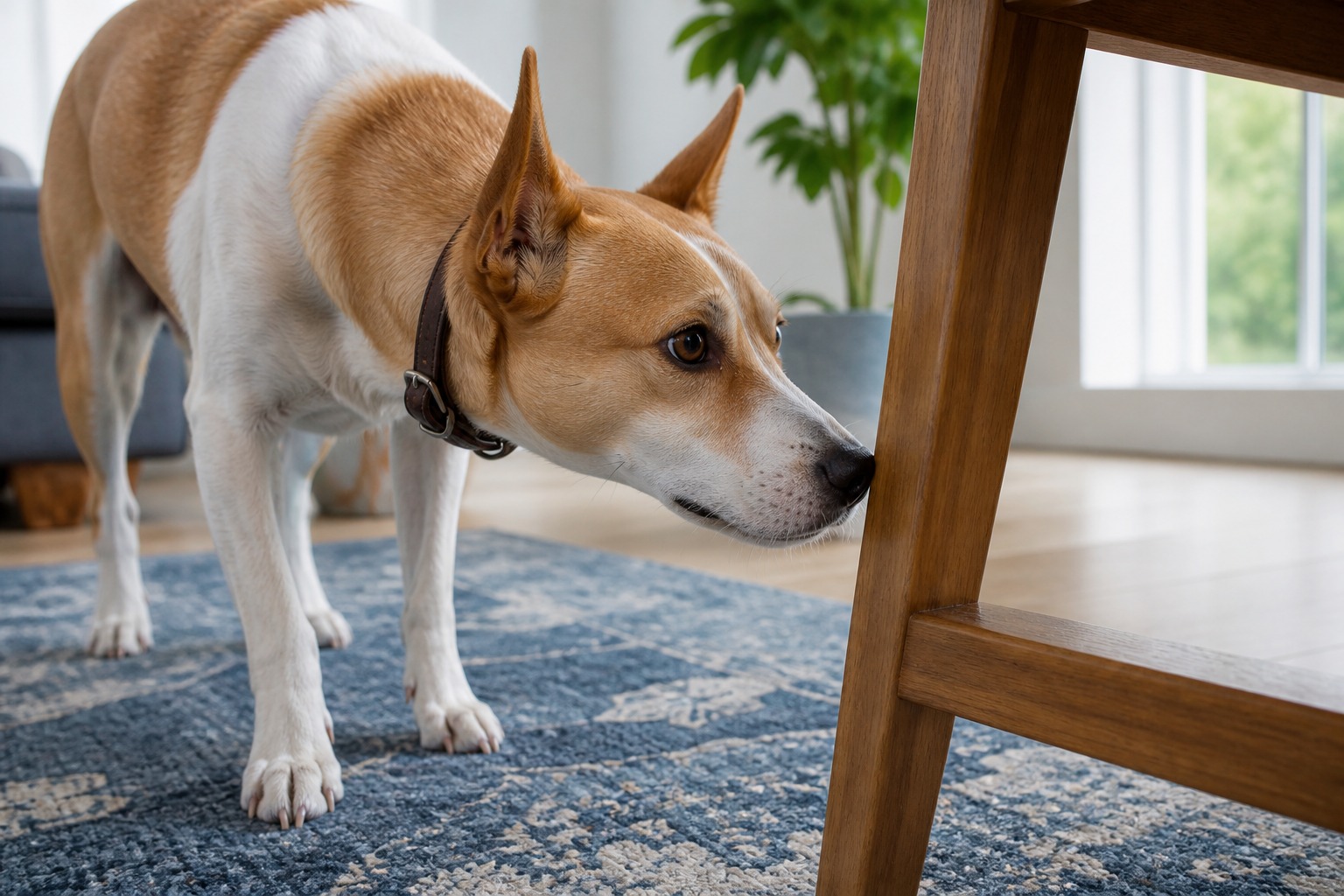
Here’s the reframe that changes everything about this problem: when your dog lifts a leg on the table leg, they are not having an accident. They’re writing something. Dog urine is loaded with chemical information, sex, rough age, health, reproductive status, and marking is the act of posting that information on a surface where other dogs will read it. Treat it as a broken house-training and you’ll reach for the wrong tools, including the one tool guaranteed to backfire. Treat it as communication you need to manage, and the path forward gets a lot clearer.
That distinction matters because you cannot punish a message out of a dog. You can only change what they have access to, catch them before they post, and remove the old messages that invite new ones. Everything below follows from that.
Marking and peeing are two different behaviors
A house-training accident is a bladder problem: a dog needs to go, can’t hold it, and lets loose wherever they are. Marking is a communication problem in the neutral sense, small squirts, usually against something vertical, delivered by a dog whose bladder is nowhere near full. Both males and females do it, intact or not, though intact males are the most enthusiastic markers. Spayed females and neutered males mark too, just usually less.
Knowing which one you’re looking at tells you what to fix. Big puddles on the floor from a young or newly adopted dog point to house-training or a medical issue. Repeated dabs on the same table leg, door frame, or corner, especially after something changed in the household, point to marking.
Why dogs mark in the first place
The behavior is a way of planting a flag and broadcasting “I’m here,” the canine equivalent of a signature left on a wall. A few specific triggers push the behavior from occasional to constant.
A change in the household is a big one. A new baby, a new roommate, a new partner, even rearranged furniture can unsettle a dog enough that they start reasserting their territory. Stress and separation anxiety do the same; a dog left anxious and alone may mark alongside barking, pacing, or destructiveness. The arrival, or even the scent, of another dog nearby is a classic prompt, since marking is how dogs draw boundaries with rivals they can smell but not see. And reproductive signaling drives plenty of it: an intact dog uses marks like a dating profile, broadcasting availability to anyone downwind.
There’s also a medical angle worth ruling out first. A urinary tract infection, bladder stones, or any condition that increases thirst and urination can mimic marking by making a dog pee more, and more urgently, than usual. If the pattern is new, unusually frequent, or seems to cause discomfort, see your vet before you assume it’s behavioral. Females are more prone to UTIs, which is one clue among several.
People bring me a dog they’ve labeled ‘spiteful’ for marking, and almost every time the dog is anxious, not defiant. Once you see the leg lift as a nervous dog trying to feel safe, punishing it stops making any sense, you’d be scolding a dog for the exact stress you then made worse.
One quirky wrinkle from the research: little dogs may mark more, not less. Studies of scent-marking suggest smaller dogs raise a leg and aim higher relative to their size than big dogs do, a possible bit of bluffing, posting their “height” taller than they really stand. If your ten-pound dog seems weirdly obsessed with marking, that’s not your imagination.
The management-first plan
Because marking is driven by scent and emotion, the plan that works is mostly about controlling both. Punishment isn’t on the list, and that’s deliberate.
Start with cleanup, because scent is the strongest trigger of all. A spot that still smells like urine to a dog, even one you’ve scrubbed and can’t smell yourself, is a standing invitation to mark it again. Use an enzymatic cleaner made for pet urine rather than a general household spray. The enzymes break down the odor compounds at the source instead of masking them, which is the difference between a dog thinking “handled” and “post here again.” Ordinary cleaners, especially anything ammonia-based, can actually smell like urine to a dog and make things worse.
Next, limit access and remove the targets. If your dog fixates on a particular object or corner, block it off or take the object away entirely while you retrain. Use baby gates, closed doors, or a leash indoors to keep your dog in sight and out of their favorite marking zones. A dog that can’t sneak off to the dining room can’t quietly redecorate it.
Then learn the tell and interrupt it. Marking has a reliable prelude: a few seconds of intent sniffing while the dog reads the surface, then a turn to bring the body parallel to the target, then the leg. The sniff is your window. A calm, firm verbal interrupter at the sniffing stage, followed by walking your dog outside or to an acceptable spot, teaches them where posting is allowed. Reward heavily when they go in the right place. If you can’t supervise, a crate or a small confined space where a dog is unlikely to mark buys you time.
Address the trigger, not just the symptom. If a new person set this off, have that person become the source of good things, treats, walks, feeding, so your dog files them under “safe” instead of “threat.” If it’s separation stress, treat the anxiety directly rather than just the puddles. If it’s another dog outside, manage the visual and scent exposure where you can.
Consider spaying or neutering, with realistic expectations. Altering frequently reduces the drive to mark, and doing it before the habit is deeply grooved gives you the best odds. If your dog has been marking for years, hormones are only part of the story and the behavior may persist as a learned routine, which loops you back to management and consistency.
And the thing not to do: don’t punish, and don’t try to “dominate” the behavior out of your dog. The old pack-leader framing, that you must assert control so your dog submits, is both outdated and counterproductive. Punishment raises stress, stress feeds marking, and you end up chasing your own tail while your dog trusts you less. Redirect, reward, and manage the environment. That’s the whole game.
What newer research adds
The most useful update is a firmer scientific footing under the “don’t punish” advice. Modern behavior work consistently ties aversive, confrontational methods to more anxiety and more of the unwanted behavior, not less, and marking is a textbook example because so much of it is stress-driven to begin with. The dominance model that once justified scolding and “alpha” corrections has been broadly abandoned by behavior professionals. On the cleanup side, enzymatic cleaners have become the clear standard for a concrete reason: they chemically dismantle the odor molecules a dog is cueing off, where masking sprays just cover them for a human nose. The throughline is that marking responds to changing the environment and lowering the dog’s stress, and resists being scared away.
This piece touches on behavior and stress. If your dog’s marking is sudden, frequent, or seems tied to real anxiety or possible illness, a vet or a qualified behavior professional can help you sort the cause before it becomes a habit.
References
- Wynne, C.D.L. “Dominance in dogs: Owners and the outdated ‘alpha’ model.” Journal of Veterinary Behavior. https://www.sciencedirect.com/journal/journal-of-veterinary-behavior
- McGuire, B. “Scent marking in shelter dogs: Effects of body size.” Applied Animal Behaviour Science. https://www.sciencedirect.com/science/article/abs/pii/S0168159118303484
- American Veterinary Society of Animal Behavior. “Position Statement on the Use of Dominance Theory in Behavior Modification of Animals.” https://avsab.org/resources/position-statements/
Common questions
Is marking the same as my dog not being house trained?
No. House-training accidents are about emptying a full bladder in the wrong place. Marking is small, deliberate deposits aimed at vertical surfaces to leave a scent message. A fully house-trained dog can still mark, which is why the fixes are different.
Will neutering stop my dog from marking?
It often reduces the urge, especially in intact males, but it is not a guarantee. Once marking has become a well-practiced habit, removing the hormones may not erase the behavior on its own. Neutering works best paired with management and consistency.
Should I punish my dog for marking in the house?
No. Punishment adds stress, and stress is one of the things that drives marking in the first place, so it tends to make the problem worse while damaging your dog's trust in you. Interrupt, redirect, and clean thoroughly instead.
Dr. Kohl is a board-certified veterinary dentist with a particular interest in preventive oral care. She reviews all dental health content at The Pet Times and contributes practical guides on home dental routines, professional cleaning, and oral disease prevention.
Meet our experts ↗Keep reading
 TrainingYour Dog Isn't Being Rude. He's Cornered.Dr. Amara Solis · 8 min
 TrainingThe Algorithm Rewards Bad Dog Training. Here Are 10 Tells.Dr. Mara Chen · 7 min
 TrainingYour Dog Isn't Wrecking the Yard. They're Doing a Job. Name It.Dr. Mara Chen · 8 min
 TrainingThe One-Word Diagnosis Is Ruining Your Dog's TrainingMarcus Webb · 7 min
 TrainingYou Taught Your Dog to Paw at You. Here's How to Untrain It.Dr. Amara Solis · 7 min
 TrainingFace Bites Are Almost Always Our Fault, Not the Dog'sDr. Amara Solis · 5 min