


You Taught Your Dog to Paw at You. Here's How to Untrain It.
The paw on your leg isn't one message, it's a question your dog has learned always gets answered. Read the context, spot the medical exceptions, and fix the demanding version without shutting down the sweet one.

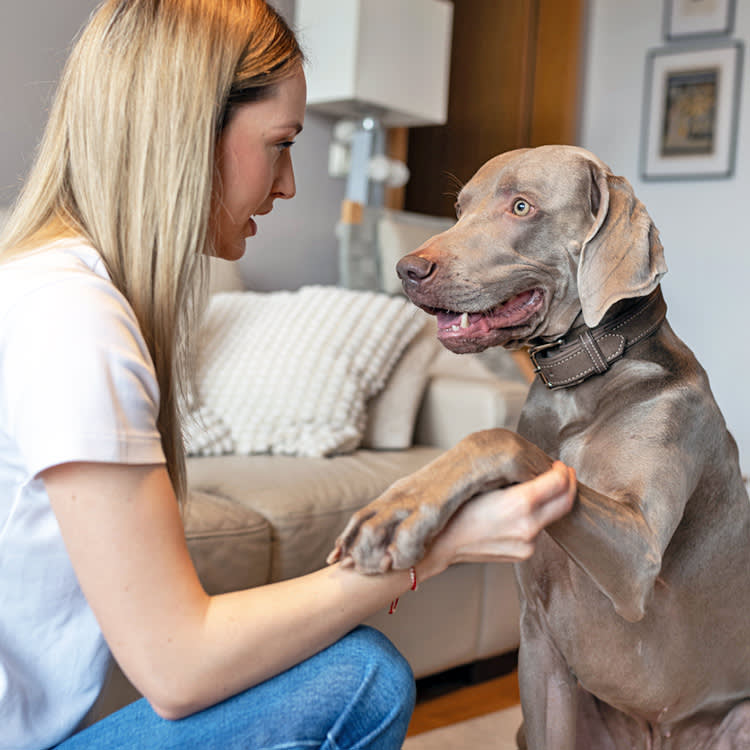
The first time, it was adorable. A soft paw on your knee, big eyes, the whole routine. You looked up. You said something warm. You probably petted them.
Congratulations: you just ran a training session. Your dog learned, in one repetition, that a paw on the leg makes the human materialize. And dogs are extremely good at repeating things that work.
That’s the uncomfortable part of pawing that most explainers skip. Yes, the paw means something. But the reason your dog keeps doing it, twelve times an hour, while you’re holding coffee, is not the meaning. It’s the payoff. Which is good news, because payoffs are something you control.
First, rule out the one version that isn’t about you
Before you touch the training, do the medical check. It takes ten seconds and it’s the only version of this behavior with a clock on it.
A pawing habit your dog has always had is behavioral. A pawing habit that appeared suddenly is a symptom until proven otherwise.
Look for pawing that is new, escalating, or out of character, especially alongside:
- Limping, or reluctance to put weight on a leg
- Obsessive licking or chewing of one paw
- Sudden clinginess in a dog who was never clingy
- Restlessness, panting, or pacing at night
- Any change in appetite, drinking, or sleep
Pain, itching, and some neurological problems all push dogs toward seeking contact, and a dog in discomfort will often use the one gesture they know reliably gets your attention. If the paw showed up out of nowhere, book the checkup before you start ignoring it.
Everything below assumes you’ve cleared that.
What the paw is actually asking
Pawing isn’t a word. It’s a bid. And a bid can be about almost anything, which is why “why does my dog paw at me” has never had a single clean answer. Read the context, not the paw.
The clock is the biggest clue. If the paw lands at 5:40 p.m. every day and your dog eats at 5:45, it isn’t a mystery. It’s a meal reminder, reinforced by the fact that you have gotten up and filled the bowl every single time.
The door is the second biggest. Dogs who never learned to bark or scratch at the door will often invent a paw as their bathroom signal, especially after a nap or a meal. This one is worth keeping, incidentally. It’s a legitimate communication. If you’d rather have a cleaner signal, teach one deliberately, like a bell by the door or a sit on a specific mat, and reward that instead.
The body tells you if it’s affection or anxiety. Two very different behaviors look nearly identical from the knee down.
- Affectionate pawing comes with a loose body, a soft face, a slow tail, and usually happens in calm moments: the couch, the end of the day, mid-scratch. The paw is gentle and lands and stays.
- Anxious pawing comes with the ears back, the head low, the tail still, the eyes checking your face. This dog isn’t asking for a snack. They’re asking whether everything is okay. Pushing them away or ignoring them here is the wrong move; a calm voice, a hand on the chest, or a short walk to change the scene is the right one.
And then there’s the demanding version, which is the one that brought you here. Fast, repeated, sometimes with a scratch or a nudge behind it, escalating when it doesn’t work, often paired with barking or whining. That paw isn’t communicating. It’s operating a vending machine.
Owners tell me their dog is being pushy, and I always ask them the same thing: what happens right after the paw? Nine times out of ten, something happens. Eye contact, a laugh, a shove, dinner. The dog isn’t being rude. They’re being effective, and we’re the ones who made it work.
Fixing it without shutting your dog down
The instinct is to make the pawing stop. That’s the wrong target, because pawing is often the only tool your dog has and taking it away leaves them with nothing. The right target is replacing the paw with a behavior you’d rather have, while making sure the underlying need still gets met.
Three steps, in order.
1. Meet the need on your schedule, not theirs
Half of demand-pawing evaporates when the underlying need stops being urgent. Feed on a consistent clock so mealtime isn’t a negotiation. Build in real mental work, since a bored dog will invent a job and that job is usually bothering you. Take the walk before you sit down to work, not after your dog has spent an hour asking.
2. Stop paying for the paw
This is the hard part, and it comes with a warning.
When you stop responding to a behavior that used to work, it gets worse before it gets better. That’s an extinction burst, and it’s the single most common reason people give up. Your dog will paw harder, louder, and more often for a few days, because that has always worked before and they’re checking whether it still does. If you cave on day three, you have just taught them that harder pawing works, which is worse than where you started.
So: no eye contact, no talking, no touching, no pushing the paw away. Pushing is contact. Contact is payment. Just go still, or stand up and calmly leave.
3. Pay for something else instead
Extinction alone is unkind and doesn’t stick. The dog needs a new way to ask.
Pick one alternative behavior and make it the golden ticket: a sit, a down, or a settle on a mat. The moment your dog does it, especially unprompted, mark it and pay it. Not with a treat every time, but with the thing they actually wanted: your attention, the door, the food bowl.
Within a couple of weeks, most dogs figure out the new rule. Pawing does nothing. Lying down on the mat makes the human appear. Dogs are not sentimental about method; they’ll take whichever one works.
Keep the good version
Do not train the paw out of your dog entirely. That would be a loss.
Give it a home instead. Put it on cue as a “shake” or a “high five” and you’ve taken a behavior that used to be a demand and turned it into a request your dog can make politely, on invitation, whenever they want a moment with you. It’s the same paw. Now it just knocks first.
And on the couch, at the end of the day, when a paw lands soft on your leg and stays there? Leave it. That one was never a problem.
What newer research adds
The behavioral principle underneath all of this is intermittent reinforcement, and it’s worth knowing why it makes pawing so stubborn. A behavior that gets rewarded every time is easy to extinguish, because the dog notices immediately when the reward stops. A behavior that gets rewarded sometimes, unpredictably, is dramatically harder to extinguish, because “not this time” is a normal part of the pattern.
Which describes exactly how most of us respond to a pawing dog. We ignore it eight times, then break on the ninth because we’re tired. That ninth time doesn’t undo the eight. It teaches persistence.
The practical version, from anyone who has actually run this protocol: it is easier to be perfectly consistent for two weeks than to be mostly consistent for six months. Decide what the paw earns, tell everyone in the house, and then be boring about it.
Bottom line
Your dog is not manipulating you. They’re doing what worked. The paw is a bid, and the bid is aimed at whatever you’ve been paying for.
Rule out pain. Read the body language before you decide it’s demand. Then change what gets paid, give them something better to ask with, and hold the line through the week when it gets worse.
FAQs
Is it okay to let my dog put their paw on me? Usually, yes. Occasional gentle pawing during calm moments is normal communication and often affection. It becomes a problem only when it’s constant, forceful, or paired with barking, whining, and jumping.
Why does my dog suddenly paw at me all the time? A sudden change is worth a vet visit. Pain, itching, and some neurological issues push dogs to seek contact. Once medical causes are ruled out, look at what’s been reinforcing it.
How do I stop my dog from pawing at me? Meet the underlying need on a schedule, stop responding to the paw at all (including pushing it away, which counts as attention), and heavily reward an alternative like a sit or a settle. Expect it to get worse for a few days before it improves.
Does pawing mean my dog is anxious? Sometimes. Anxious pawing tends to be gentle and paired with lowered ears, a low head, a still tail, and a lot of checking your face. Comfort that dog rather than ignoring them.
Should I teach my dog to shake instead? Yes. Putting the paw on cue gives the behavior a legitimate outlet and makes it something your dog offers on invitation instead of on demand.
References
- Center for Urban Resilience. “Dog Body Language.” Loyola Marymount University, Urban EcoLab Module 09. https://academics.lmu.edu/media/lmuacademics/cures/urbanecolab/module09/Dog%20Body%20Language.pdf
- American Veterinary Society of Animal Behavior. “Position Statement on Humane Dog Training.” https://avsab.org/wp-content/uploads/2021/08/AVSAB-Humane-Dog-Training-Position-Statement-2021.pdf
- “Behavioral Problems of Dogs.” MSD Veterinary Manual. https://www.msdvetmanual.com/behavior/normal-social-behavior-and-behavioral-problems-of-domestic-animals/behavioral-problems-of-dogs
- “Pain in Dogs and Cats.” American Animal Hospital Association, 2022 AAHA Pain Management Guidelines. https://www.aaha.org/resources/2022-aaha-pain-management-guidelines-for-dogs-and-cats/
Dr. Solis is a board-certified veterinary dermatologist with over twelve years of clinical experience. She advises on skin conditions, allergies, and grooming practices that affect coat and skin health. All dermatology and allergy content at The Pet Times is reviewed by her team before publication.
Meet our experts ↗Keep reading
 TrainingNo Dog Is "Untrainable." Some People Just Quit.Dr. Nina Kohl · 8 min
 TrainingYour Dog Isn't Barking to Annoy YouDr. Nina Kohl · 6 min
 TrainingYour Dog Digs Up Your Sheets. The Timing Tells You Whether to Worry.Dr. Nina Kohl · 7 min
 TrainingThe Stuffed Kong Won't Save You: 7 Lies About Separation AnxietyDr. Amara Solis · 9 min
 TrainingYes, Dogs Get Tired of Barking. Waiting Them Out Still Won't Work.Dr. Nina Kohl · 6 min
 TrainingYour Dog's Nibble Is a Dial, Not a Switch. You're Turning It the Wrong Way.Dr. Nina Kohl · 9 min