


Dogs Don't Forgive After a Fight. What They Do Is Smarter
Researchers watched 177 dogs at a park to find out why two dogs make up after a scuffle. The answer is not forgiveness as we mean it, and the difference matters for every multi-dog home.

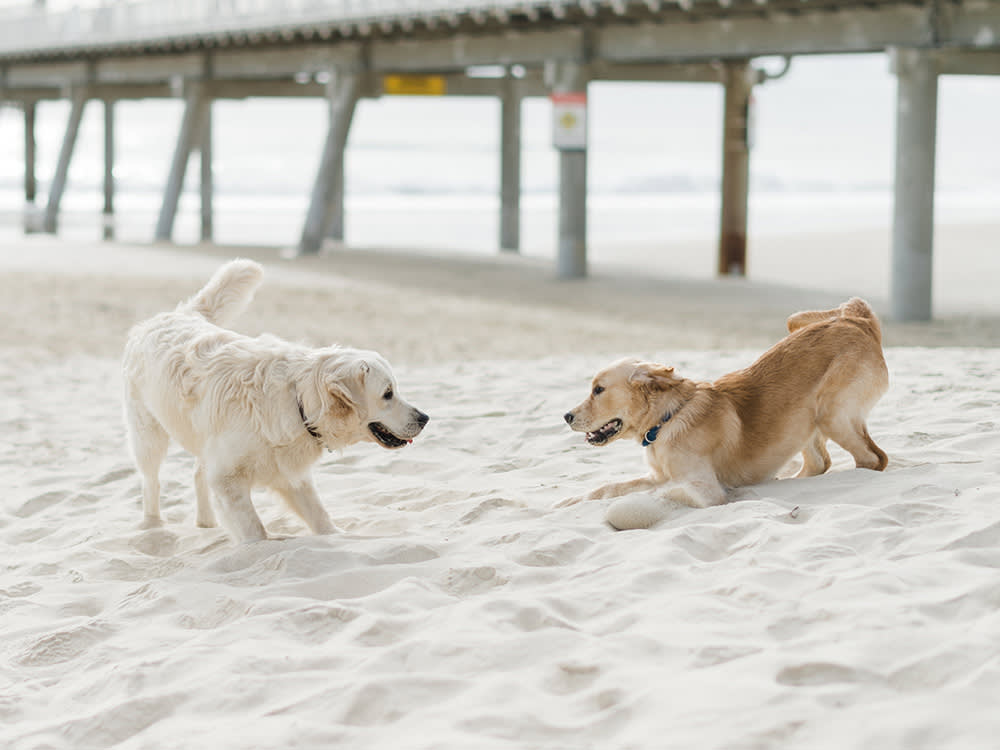
When two dogs scuffle and then, minutes later, lie down companionably a few feet apart, it is almost impossible not to narrate it the way we would a human spat: they fought, they cooled off, they forgave each other. It is a comforting story. It is also probably the wrong one, and getting it right is not pedantry. It changes how you should manage a household where dogs sometimes clash.
What dogs do after a fight is real, and it is sophisticated. But it is not an apology, and it does not work the way our forgiveness does. It is closer to a quick, instinctive cost-benefit calculation, and once you see it that way, a lot of confusing multi-dog behavior snaps into focus.
Why a social animal bothers to make up at all
Start with the puzzle. Dogs are social animals, wired to cooperate and to keep conflict to a minimum, because group living delivers food, safety, and warmth that a lone animal cannot match. So a fight is expensive: it risks injury and frays a bond the dog actually needs. That gives a dog real motivation to patch things up. The behavior even has a technical name, reconciliation, and it has been documented across many species, mostly primates. Researchers have long argued about how closely these animal behaviors map onto human concepts like forgiveness and apology, and dogs are a relatively new addition to that debate.
There is even a version of this people swear they have seen at home: a dog who nips a person, then slinks back looking “sorry,” as if pleading to be let off the hook. Plenty of behaviorists have observed the same thing. But seeing it and explaining it are different jobs.
The dog-park experiment, and the three theories it tested
To find out what is really going on between dogs, a team at Butler University did something simple and clever: they watched.
Over eight months, researchers observed 177 dogs interacting at a two-acre dog park. Crucially, most of these dogs were strangers or only passing acquaintances, not longtime friends, which strips out the easy explanation that dogs only make up with their buddies. From all that watching, the team isolated 14 minor fights, scuffles with no injuries, and used them to test three competing reasons a dog might reconcile.
Theory one: restoring the relationship. Maybe dogs make up to repair a valuable bond, the way you would smooth things over with a friend you depend on.
Theory two: sorting out status. Maybe reconciliation re-establishes the social order, with the lower-ranking dog acting deferentially to settle who stands where.
Theory three: reducing stress. Maybe making up simply lowers the anxiety and uncertainty hanging over the threat of another fight, and that drop in stress is the reward.
The answer points away from “forgiveness”
Only one theory survived contact with the data, and it is the least sentimental of the three.
What the dogs did lined up with plain stress relief: they wanted certainty back, not absolution. Here is the tell that rules out the other two: both the victim and the aggressor showed reconciliation behaviors toward each other afterward, and the pair were likelier to stick close once the dust settled, regardless of whether they had any prior relationship to “restore” and regardless of who supposedly outranked whom. If this were about repairing a friendship, strangers would not bother. If it were about status, the deference would run one direction. Instead, both dogs worked to dial the tension down, because the unresolved tension itself was the thing that felt bad.
That is why “forgiveness” is the wrong word. Forgiveness, as we use it, is about the past and about character: I am letting go of what you did. What these dogs were doing is about the present and about safety: this situation is over, the threat has passed, let us stop bracing. It is less an apology than a reset.
“People want to hear that their dogs forgave each other, because it sounds like grace. What the behavior actually shows is something more practical and, honestly, more useful to know,” says Dr. Priya Nair, a veterinary behaviorist. “Two dogs settling after a scuffle are not closing the book on it. They are telling each other the immediate danger is over. That is not the same as predicting they will get along tomorrow.”
What this means inside your home
Here is where the distinction earns its keep, because a reset is not a guarantee.
If reconciliation were forgiveness, you could relax after two dogs made up: the conflict would be resolved. But because it is really just stress reduction in the moment, making up tells you almost nothing about the future. Reconciliation lowers the risk of a repeat in that immediate situation. It does not predict the next hour, the next trigger, or the underlying reason the fight happened in the first place. A pair of dogs can reconcile beautifully after every single scuffle and still be a genuinely bad match.
This is why some multi-dog households never quite settle. Researchers have documented dogs in the same family who do not reconcile at all and instead simply separate after every conflict, a clear sign the relationship is not working rather than self-correcting. If your dogs fight, make up, and fight again over the same things, do not read the “making up” as the problem solving itself. Read the pattern. Recurring conflict over food, toys, doorways, or attention is a flag to manage the environment, remove the triggers, and bring in a qualified behaviorist, not a sign to wait for forgiveness to do the work.
So yes, dogs do something after a fight, and it is smarter than a grudge and more grounded than an apology. They take the temperature of the moment and decide the danger has passed. Your job is to notice that they are reading the moment, not the relationship, and to manage the relationship yourself.
References
- Cools, A.K.A., Van Hout, A.J.-M., and Nelissen, M.H.J. “Canine Reconciliation and Third-Party-Initiated Postconflict Affiliation.” Ethology (2008). (Foundational work on reconciliation in domestic dogs.)
- Bauer, E.B. and Smuts, B.B. “Cooperation and competition during dyadic play in domestic dogs, Canis familiaris.” Animal Behaviour (2007).
Dr. Mehta is a board-certified veterinary nutritionist who evaluates pet food formulations, ingredient quality, and the science behind dietary trends. He writes and reviews all nutrition content at The Pet Times, including our food rankings and feeding guides.
Meet our experts ↗Keep reading
 Training"Aggressive" Is the Most Misread Word in Dog Behavior. Here's What Yours MeansDr. Nina Kohl · 6 min
 Training'Stubborn' Isn't a Personality. It's a Failed Diagnosis.Dr. Mara Chen · 8 min
 TrainingYour Dog Is Never Barking at Nothing. You Just Can't Hear It.Dr. Ravi Mehta · 7 min
 TrainingYour Dog Isn't Being Possessive Over That Toy. They're Doing Math.Dr. Amara Solis · 8 min
 TrainingYour Dog Isn't Stubborn. Your House Has Six Sets of Rules.Dr. Priya Nair · 7 min
 TrainingYou Taught Your Dog to Paw at You. Here's How to Untrain It.Dr. Amara Solis · 7 min