


Your Dog Is Never Barking at Nothing. You Just Can't Hear It.
There is almost always something there. The question worth asking is not what they heard, but whether the barking stops when the thing does.

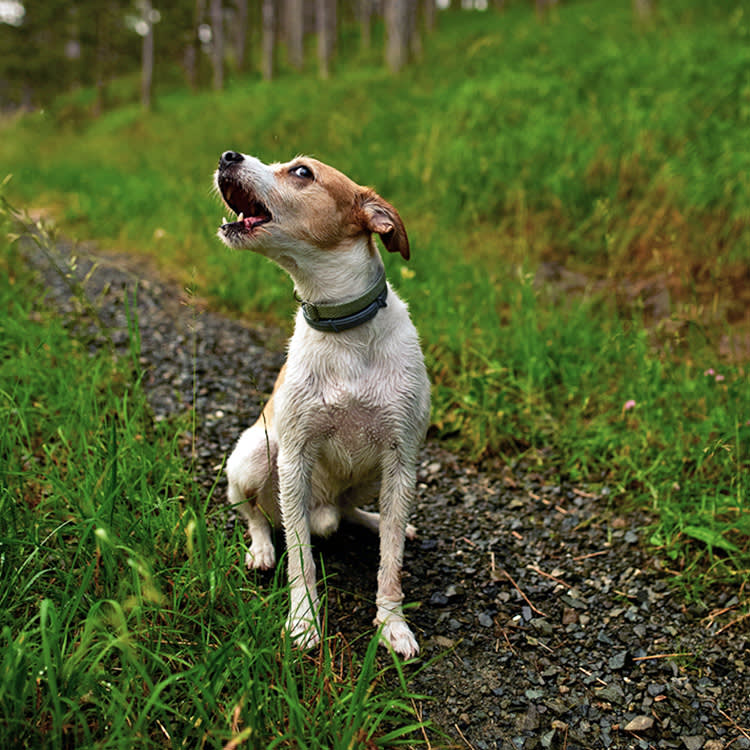
Your dog leaps up, plants themselves at the glass, and unloads at an empty garden. You look. There is nothing there. You start to wonder whether your dog is losing it.
Almost certainly not. Dogs are running better hardware than you are, and “nothing” is a statement about your senses, not theirs. The useful question is not what did they hear. You will usually never know. The question is whether the barking stops when the trigger passes. A dog who barks, checks, and settles is doing their job. A dog who cannot stop, or who is barking at an interior world you have no access to, is telling you something different, and that dog needs help rather than a “quiet” cue.
What is actually out there
Smell. A dog’s nose is orders of magnitude more sensitive than ours, and they smell people coming down the pavement well before they see them. Unfamiliar animals, unfamiliar people, a fox that crossed the garden an hour ago. Dogs bark to announce what their nose found. Some dogs even detect changes in human bodies, which is why a dog will occasionally bark at a person before a seizure or a blood sugar crash.
Sound. Dogs hear frequencies we cannot, and at distances we cannot. A siren far enough away to be inaudible to you. A high-pitched whine from an electronic device. Rodents inside a wall, which, if that is what it is, means your dog is doing you a favor. Thunder is a common one: a dog who hides under the bathroom sink twenty minutes before the first rumble is not psychic, they simply heard it.
Sight, particularly in the dark. Dogs have a reflective layer behind the retina that lets them see in light levels where we are effectively blind, and their pupils open wider than ours. They also detect motion at remarkable distance, which is precisely the trait that makes them useful in police, military, and security work. A dog barking into a dark garden is very often barking at something moving in it.
None of these are pathologies. They are the reason we invited dogs into our homes in the first place.
When it is not the environment at all
Here is where the article turns, because a meaningful share of “barking at nothing” is not about the outside world.
Boredom and understimulation. Barking discharges energy. An under-exercised, under-occupied dog will find a reason. So will a dog who wants your attention and has learned exactly how to get it, which brings us to the ugliest part of the mechanism: if you get up, speak to the dog, or engage every time they bark, you have paid for the barking. The dog is not being manipulative. They are being an excellent student.
Anxiety. A dog who is nervous barks more, and a dog who barks more with no resolution gets more wound up. It feeds itself.
The mailman loop. This one deserves naming because it is the most self-reinforcing pattern in dog behavior. The delivery driver approaches. The dog barks. The driver, having delivered the parcel, leaves. From the dog’s perspective, barking removed the threat, every time, without a single failure. That is a perfect reinforcement schedule, and it is why the barking gets louder rather than quieter over months.
Cognitive decline. And this is the one that gets missed most often.
The senior dog explanation nobody checks
If your dog is old and has started barking at walls, corners, and empty rooms, particularly at night, do not assume they heard something.
Canine cognitive dysfunction is the canine equivalent of dementia, and the numbers are startling. In dogs presumed to have advanced cognitive dysfunction, prevalence rose from about 19 percent in dogs aged 11 to under 13, to 45 percent at 13 to under 15, to 67 percent at 15 to under 17, and to 80 percent in dogs over 17.
And it is almost never diagnosed. In one large dataset, the estimated prevalence of cognitive dysfunction syndrome was 14.2 percent, while only 1.9 percent of cases were actually diagnosed by a veterinarian. Owners assume the signs are just old age. Practices do not routinely screen. So the condition sits in plain sight.
The signs to know: sleeping more in the day and restless at night, disorientation, getting stuck in corners or behind furniture, failing to recognize familiar people, altered social behavior, increased anxiety, and nighttime vocalizing.
It matters because there is something to do about it. Diet, supplements, environmental structure, and medication can all help, and starting earlier is better than starting later. A senior dog barking at a wall at 3am is not being difficult. They may be frightened and lost in their own hallway.
Barking at nothing in a young dog is usually a sensory event you missed. Barking at nothing in a fourteen-year-old, at night, is a neurology question until proven otherwise.
The other medical flags
- A change in the sound of the bark. Hoarse, strained, or weak can indicate a throat or laryngeal problem.
- Barking or growling when approached or touched. A dog in pain does not want contact and will say so. Watch for pacing, panting, lip licking, changes in sleep, or changes in appetite alongside it.
- A dog who stops barking at things that always used to get a reaction. That is as informative as barking more, and it can point at hearing loss or illness.
- Barking with confusion, disorientation, or other odd behavior. That is a vet visit.
What actually reduces it
Excessive barking is not fixed by telling a dog to be quiet. It is fixed by finding out what is driving it and then taking that thing away, which is slower and works.
Identify the trigger. Sit with it for a few days and log when it happens. Barking at 4pm every day is a different problem from barking at random.
Spend the energy first. Physical exercise plus mental work, puzzle feeders, scent games, training sessions, chew time. A dog whose needs are met has less to say.
Teach and pay for silence. Reward the quiet. Teach a “quiet” or “leave it” cue and reinforce it generously. The goal is not a silent dog. It is a dog who alerts, then stops, because you have taught them the second half.
Counter-condition the trigger. Play the sound at low volume, well below the threshold that sets them off, and pay the dog for not reacting. Then raise it slowly over sessions. Background music or a white noise machine can mask outside sounds while you work.
Change the environment. Close the blinds. Move the dog bed away from the front window. Frosted window film on the lower panes eliminates the street-facing patrol shift entirely.
Handle the delivery loop deliberately. Get ahead of the driver’s arrival, put the dog behind a gate, and pay them for staying there. Break the pattern where barking appears to work.
Consider company. For a dog who is alone for long stretches, a daytime walker, daycare, or a companion can address the loneliness that the barking is expressing.
Bark collars. These are controversial for good reason, and they suppress the symptom without touching the cause. If one is ever on the table, treat it as an extreme, last-resort measure, and only under supervision. The credentials to look for in whoever supervises it are CAAB or ACAAB (an applied animal behaviorist) or CPDT (a professional dog trainer who has been certified).
What newer research adds
The most consequential update in this space is the cognitive dysfunction data, because it changes who you should be worried about. The prevalence numbers in older dogs are high enough that “my senior dog barks at nothing” should trigger a screening conversation, not a training plan. And the gap between how common it is and how rarely it is diagnosed, roughly 14 percent estimated versus under 2 percent diagnosed in one large study, means the default assumption in most homes is wrong.
There is a screening tool your vet can run in a normal appointment. It costs nothing to ask.
For everyone else, the reframe holds. Your dog is not barking at nothing. They are barking at the version of the world you cannot perceive, and the work is not to stop them noticing it. It is to teach them that once they have told you, they can stop.
References
- Yarborough, S., et al. “Assessment of Risk Factors in Dogs with Presumptive Advanced Canine Cognitive Dysfunction.” Frontiers in Veterinary Science, vol. 9, 2022. https://doi.org/10.3389/fvets.2022.958488
- “Comparing Standard Screening Questionnaires of Canine Behavior for Assessment of Cognitive Dysfunction.” Frontiers in Veterinary Science, vol. 11, 2024. https://doi.org/10.3389/fvets.2024.1374511
- “Recent Advances in Diagnostic and Therapeutic Strategies for Canine Cognitive Dysfunction.” American Journal of Veterinary Research, 2025. https://avmajournals.avma.org/view/journals/ajvr/86/8/ajvr.25.02.0053.xml
- Merck Veterinary Manual. “Behavioral Problems of Dogs.” https://www.merckvetmanual.com/behavior/normal-social-behavior-and-behavioral-problems-of-domestic-animals/behavioral-problems-of-dogs
Dr. Mehta is a board-certified veterinary nutritionist who evaluates pet food formulations, ingredient quality, and the science behind dietary trends. He writes and reviews all nutrition content at The Pet Times, including our food rankings and feeding guides.
Meet our experts ↗Keep reading
 TrainingYour Dog Isn't Rude. Your Dog Is Overstimulated.Dr. Mara Chen · 6 min
 TrainingYour Dog Isn't Aggressive at the Door. He's Scared, and the Door Makes It Worse.Dr. Mara Chen · 4 min
 TrainingStop Letting Your Dog 'Say Hi' on the LeashDr. Priya Nair · 5 min
 TrainingYour Dog's 'Attention Barking' Is a Conversation. You Taught It the Words.Dr. Amara Solis · 6 min
 TrainingYou Can't Quiet a Bark You Haven't DecodedDr. Lena Park · 7 min
 TrainingThe Stuffed Kong Won't Save You: 7 Lies About Separation AnxietyDr. Amara Solis · 9 min