


"Aggressive" Is the Most Misread Word in Dog Behavior. Here's What Yours Means
Most dogs labeled aggressive are stressed dogs whose quieter signals got missed. Learn to read the warning ladder, catch the early signs, and step in long before a dog ever reaches a bite.

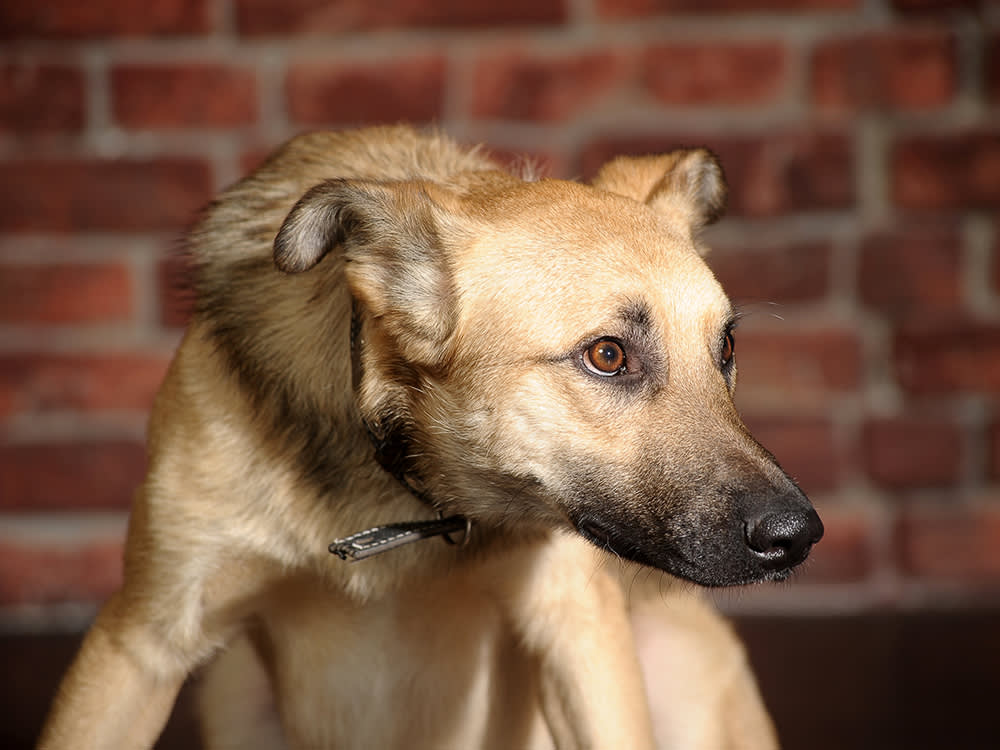
Of every term in dog behavior, “aggressive” gets thrown around the loosest and lands the most wrongly, and that sloppiness costs dogs dearly. I have watched it slapped on a ten-week-old pup mouthing the kids’ ankles in play. I hear it nonstop about dogs doing nothing but barking. “What tells you the barking is aggressive?” I ask. The answer, over and over: well, the dog was barking. Imagine if every time you raised your voice, someone assumed you were about to attack them. That is the bar we hold dogs to, and it is backwards.
Here is the reframe this whole article is built on: most behavior people call aggressive is not aggression at all. It is stress, fear, or plain dog-ness that got misread because the dog’s quieter signals were missed. Real aggression is the last rung on a ladder a dog climbs only after softer requests fail. Learn to read the rungs, especially the bottom ones, and you can defuse almost everything before it ever reaches a snap. So forget memorizing a list of “scary” signs. Learn the sequence instead.
Why dogs warn instead of attack
To read the ladder, you first have to understand why it exists, because the logic explains everything that follows.
Dogs have powerful jaws and could do serious damage at will, but biting is almost never in their interest. Fighting burns huge energy, and a dog can be injured or killed in the process. So evolution gave them something more efficient: a vocabulary of escalating warnings designed to make a threat go away without a fight. A dog would vastly rather you back off than have to bite you. Every growl is, in that sense, a courtesy, an attempt to solve the problem with the least costly tool available.
That is why the single most damaging thing an owner can do is punish a growl. Punish the warning and you do not remove the feeling underneath it; you just teach the dog that warnings get them in trouble. The dog learns to skip the growl and go straight to the bite. A growling dog is a dog still trying to talk. Keep that line of communication open.
The escalation ladder, rung by rung
A dog moving toward a bite generally climbs in a recognizable order, and naming the rungs turns a frightening blur into a decision tool.
From the bottom up, the warnings typically run: a hard, fixed stare; a growl; a bark; a snarl with bared teeth; a snap (a deliberate miss, a bite that pulls up short on purpose); a bite with inhibited force, where the dog “pulls the punch” and uses reduced pressure; and only then, if every warning has been ignored, a bite with full force. A snap is not a failed bite. It is a loud, final warning from a dog with excellent control who is telling you, clearly, that they have nearly run out of options.
One critical caveat: this ladder is highly individual. Some dogs perform the whole sequence. Some use only a couple of rungs. And some, often because earlier warnings were repeatedly punished or ignored, appear to skip the ladder entirely and go straight to a bite. A dog with “no warning” almost always had warnings once; they were just trained out or tuned out. This is exactly why preserving and respecting the lower rungs matters so much.
How to actually read an aggressive posture
When a dog is genuinely threatening rather than stressed or playing, the body organizes itself in a consistent way, and the theme is forward and stiff.
Watch for a forward-leaning stance, a stiff and rigid body, and a tail held above the horizontal line of the back, which may be stiff and may even be wagging (a wag is not proof of friendliness). The ears go up and forward, with cropped ears read at the base. You may see wrinkles or ridges around the eyes and lips, a direct hard stare, and raised hackles, the strip of hair standing up along the back. Bared teeth, a growl, or a bark may accompany all of it.
Now compare that to a dog with friendly intentions, because the contrast is the whole skill. A comfortable dog is loose and curvy, almost wiggly (picture a happy puppy), with soft eyes, a tail held below the horizon and often loosely wagging, relaxed ears, and a gently open mouth. Stiff and forward versus loose and curved. Once you can see that difference, you are reading dogs, not guessing.
The signals almost everyone misses
This is the part that prevents the most trouble, and it is the part the word “aggressive” trains people to overlook entirely.
Long before a dog gets stiff and forward, a stressed dog leaks a quieter set of signals asking for space. Picture walking your leashed dog and a strange leashed dog approaching. Do not assume your dog wants to say hello. Watch for these instead: a previously open mouth that suddenly closes; ears that go back; a sudden flurry of “dandruff” or dander; the tail rising above the horizon; yawning; a quick tongue-flick over the lips; the dog turning fully away from the other dog, or just averting their eyes or head; and a sudden bout of scratching or sniffing the ground that comes out of nowhere. These “displacement” behaviors are a dog saying, plainly, I need some space.
Here is why it matters so much: these stress signals come before the aggression ladder. A dog who is given space at the lip-lick stage never has to climb to the growl, let alone the snap. The owners who get bitten, or whose dogs “suddenly” lash out, are very often the ones who missed this entire layer and only noticed once the dog reached a rung loud enough to scare them.
What to do in the moment
Reading the dog is only useful if you act on it, so here is the simple protocol.
The instant you see the early stress signals, increase distance. Move your dog off the path of the oncoming trigger and let them watch from a comfortable, stress-free remove. How far is far enough? Your dog will tell you. When the stress behaviors fade and you see the face and body visibly soften and loosen, you have found the distance where your dog can cope. Work there, not closer.
If a dog has climbed higher, to a stare, a growl, or a snap, do not punish and do not push through. Calmly create space, end the interaction, and remove the dog from the situation. Thank the growl, in effect, for the information. Then, for a dog who is regularly hitting these rungs, loop in a qualified, reward-based behavior professional, because recurring aggression is a welfare problem for the dog as much as a safety problem for everyone else, and it rarely resolves on its own.
One last thing to hold onto: dog behavior, like ours, is fluid and can shift in a blink with the situation. So in any new context, keep reading the body in real time rather than assuming the dog you knew five minutes ago is the dog in front of you now. Do that, give space when it is asked for, and you will have learned to actually speak dog, which is the only reliable way to keep both your dog and everyone around them safe.
References
- Mariti, C., et al. “Analysis of the intraspecific visual communication in the domestic dog: stress and calming signals.” Journal of Veterinary Behavior (2017).
- Shepherd, K. “Behavioural Medicine for Animals and Veterinary Surgeons” (on the canine “ladder of aggression”). British Small Animal Veterinary Association.
- American Veterinary Society of Animal Behavior. “Position Statement on Punishment.” AVSAB.
Dr. Kohl is a board-certified veterinary dentist with a particular interest in preventive oral care. She reviews all dental health content at The Pet Times and contributes practical guides on home dental routines, professional cleaning, and oral disease prevention.
Meet our experts ↗Keep reading
 TrainingYour Dog Isn't Being Rude. They're Reading a Stranger's ID.Dr. Nina Kohl · 6 min
 TrainingYes, Dogs Get Tired of Barking. Waiting Them Out Still Won't Work.Dr. Nina Kohl · 6 min
 TrainingYour Dog Paws at You Because It Works. You're the One Who Taught ThemDr. Mara Chen · 6 min
 TrainingYou Can't Quiet a Bark You Haven't DecodedDr. Lena Park · 7 min
 TrainingStop Letting Your Dog 'Say Hi' on the LeashDr. Priya Nair · 5 min
 TrainingThe Algorithm Rewards Bad Dog Training. Here Are 10 Tells.Dr. Mara Chen · 7 min