


Your Dog Isn't Being Rude. They're Reading a Stranger's ID.
Crotch-sniffing is mortifying for you and completely logical for your dog. Here's the science behind it, plus a gentle way to redirect the habit.

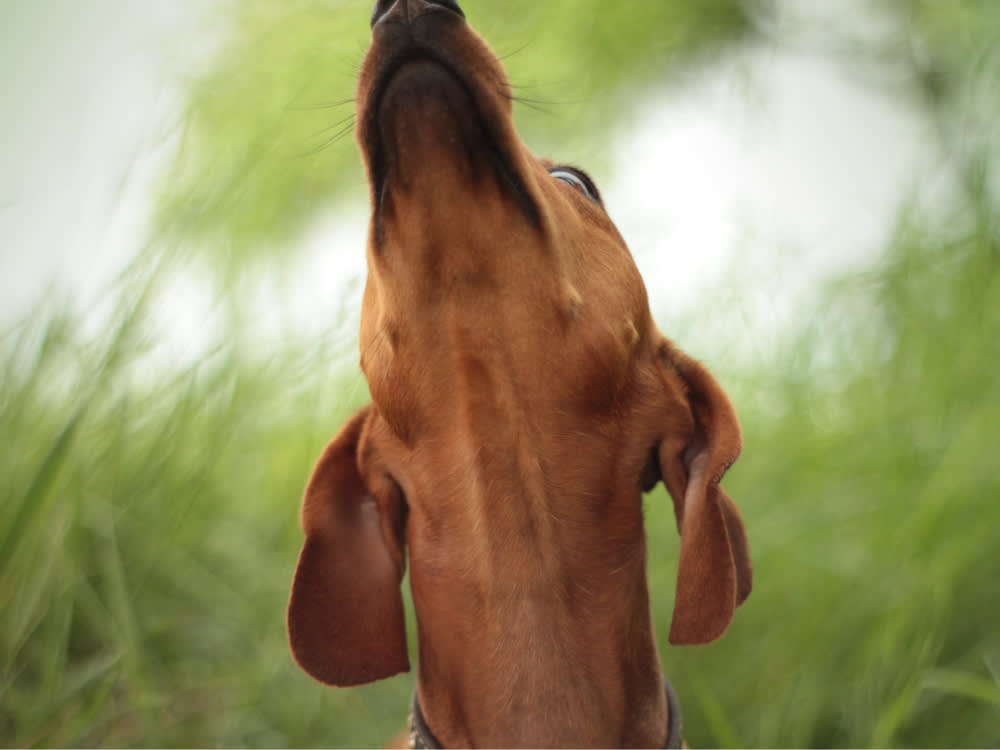
Some dog behaviors are pure charm: the head tilt, the couch-nuzzle, the greeting that makes coming home worth it. And then there’s the one where your dog buries their nose directly into a stranger’s crotch on the sidewalk while you die a little inside. It’s one of the most reliably mortifying things a dog can do in public. It is also, from your dog’s point of view, entirely reasonable, and understanding why is the first step to fixing it.
The instinct to suppress this on the spot is strong, but it helps to start from the right frame. Crotch-sniffing is not a manners problem in your dog’s mind. It’s information-gathering, and it’s about as natural to them as reading a name tag is to us. Your dog is still a dog, however thoroughly they’ve joined the family, and once you know what they’re actually doing, redirecting it gets a lot easier.
A nose built to read the room
To a dog, smell isn’t one sense among several. It’s the main channel, the way vision is for us. The equipment behind that is genuinely staggering. Dogs carry somewhere between 125 and 300 million scent receptors in their noses, against roughly 5 million in ours, and a far larger share of the canine brain is devoted to processing what those receptors pick up. Tucked inside the nose is a structure called the olfactory recess, a maze of airways that lets dogs isolate and analyze odors we can’t detect at all.
They’re also more precise about it than most people realize. Research on canine olfaction has shown dogs can take in and process scent with remarkable subtlety, even handling different information through each nostril, which helps them locate where a smell is coming from. A dog moving through the world on scent is doing something closer to reading than to sniffing.
Why the crotch, specifically
Start with how dogs greet each other, because the crotch habit is a straight translation of it. Dogs have anal glands, small scent-producing sacs on either side of the anus, lined with oil and sweat glands. Every dog’s glands put out a unique odor, and a quick sniff of another dog’s rear delivers a full dossier: sex, rough age, health, mood, general state of being. That’s why the butt-sniff is the canine handshake.
Now apply that to us. Human scent glands are densest around the groin and the armpits, the same places we produce the most telling odors. Most dogs can’t reach an armpit without a running start, so the crotch is simply the nearest, richest source of the exact information they’re looking for. Your dog isn’t being crude. They’re going to the part of you that, in their language, has your name, age, and mood printed on it. They have no idea this breaks a human rule. That part is on us to teach.
Redirecting the habit without shutting it down
Here’s the key mindset: you’re not trying to delete an instinct, you’re offering a more polite outlet for it. You can’t train a dog out of wanting scent information, but you can absolutely teach them a socially acceptable way to get it. The whole strategy is to give the nose a better target, your hand, and reward the switch until it becomes the default.
Each time your dog aims for someone’s crotch, run the same short sequence:
- Cue an interruption. Give a clear instruction paired with something your dog already knows, like “Rover, wait” or “Rover, look at me.” You’re breaking the beeline, not scolding.
- Trade in a hand. Offer a slow, palm-up hand for inspection while gently turning the person away from the target or blocking it. The palm carries its own load of scent glands, and for most dogs it’s enough to satisfy the urge.
- Reward the moment they take it. The second your dog sniffs the hand instead, praise them warmly and follow with a treat. Give them a beat to actually sniff, then deliver the reward, because timing is what teaches the lesson.
For a more insistent dog, add a leash. If they lunge for the crotch and refuse the hand, stand completely still and let them hit the end of the leash on their own, so the only pressure comes from the dog, never from you yanking. Let them settle, walk a small loop, and try the hand again on the return. If they beat you to it, the person can gently turn and ease them off while you regroup, re-present the hand, and reward the better choice.
Consistency does the rest. Every time your dog picks the hand, mark it with a happy “yes” or “good dog” so the message is unmistakable. Most dogs work out within a few months that hand-sniffing earns praise and treats while crotch-sniffing earns a boring redirect, and the polite version quietly becomes the habit.
The easiest place to build all of this is at home, with willing family and friends as practice greeters. A low-pressure setting where you’re not bracing for public embarrassment is exactly where a dog learns fastest, and it’s a far better classroom than a crowded sidewalk with a stranger involved.
What newer research adds
The more scientists study the dog’s nose, the more it looks like a genuine sensory superpower rather than a fun fact. Working-dog research keeps expanding what that nose can reliably detect, from specific medical conditions to trace compounds, which underscores just how much real information a “rude” crotch sniff is actually pulling in. It’s a reminder that the behavior isn’t your dog being nosy for the sake of it. They’re doing exactly what their biology is built to do, and the goal was never to shame the instinct, only to give it better manners.
References
- Kokocińska-Kusiak, A., et al. “Canine Olfaction: Physiology, Behavior, and Possibilities for Practical Applications.” Animals, 2021. https://www.ncbi.nlm.nih.gov/pmc/articles/PMC8228080/
- Craven, B. A., et al. “The fluid dynamics of canine olfaction.” Journal of the Royal Society Interface, 2010. https://royalsocietypublishing.org/doi/10.1098/rsif.2009.0490
- Siniscalchi, M., et al. “Sniffing with the right nostril: lateralization of response to odour stimuli by dogs.” Animal Behaviour, 2011. https://www.sciencedirect.com/science/article/abs/pii/S0003347211002478
Common questions
Why does my dog sniff people's crotches?
That's where human scent glands concentrate the most information. A dog's nose goes to the crotch for the same reason it goes to another dog's rear: it's the fastest way to learn a stranger's sex, age, mood, and health.
Can I train my dog to stop crotch-sniffing?
You can't erase the instinct, but you can redirect it. Teach your dog to sniff an offered hand instead, reward heavily when they choose it, and most dogs switch over within a few months of consistent practice.
Is crotch-sniffing a sign of bad behavior?
No. To a dog it's normal, polite information-gathering. It only reads as rude to humans, so the job is teaching manners, not correcting a flaw.
Dr. Kohl is a board-certified veterinary dentist with a particular interest in preventive oral care. She reviews all dental health content at The Pet Times and contributes practical guides on home dental routines, professional cleaning, and oral disease prevention.
Meet our experts ↗Keep reading
 TrainingEvery Sign of a Smart Dog Is Also a Complaint About ThemDr. Nina Kohl · 8 min
 TrainingYour Dog Isn't Wrecking the Yard. They're Doing a Job. Name It.Dr. Mara Chen · 8 min
 TrainingYour Dog Paws at You Because It Works. You're the One Who Taught ThemDr. Mara Chen · 6 min
 TrainingYour Dog's Joy Sends 86,000 People to the ER Every YearDr. Nina Kohl · 8 min
 TrainingMarking Isn't a Potty Accident. Punishing It Backfires.Dr. Nina Kohl · 6 min
 TrainingYour Dog Nibbles You Like Corn on the Cob. Two Experts Disagree About What to Do.Dr. Nina Kohl · 8 min