


Your Dog Paws at You Because It Works. You're the One Who Taught Them
That insistent paw on your leg or the door isn't bossiness or 'dominance.' It's a habit that pays off every time, and the fix isn't scolding, it's quietly changing what the paw earns.

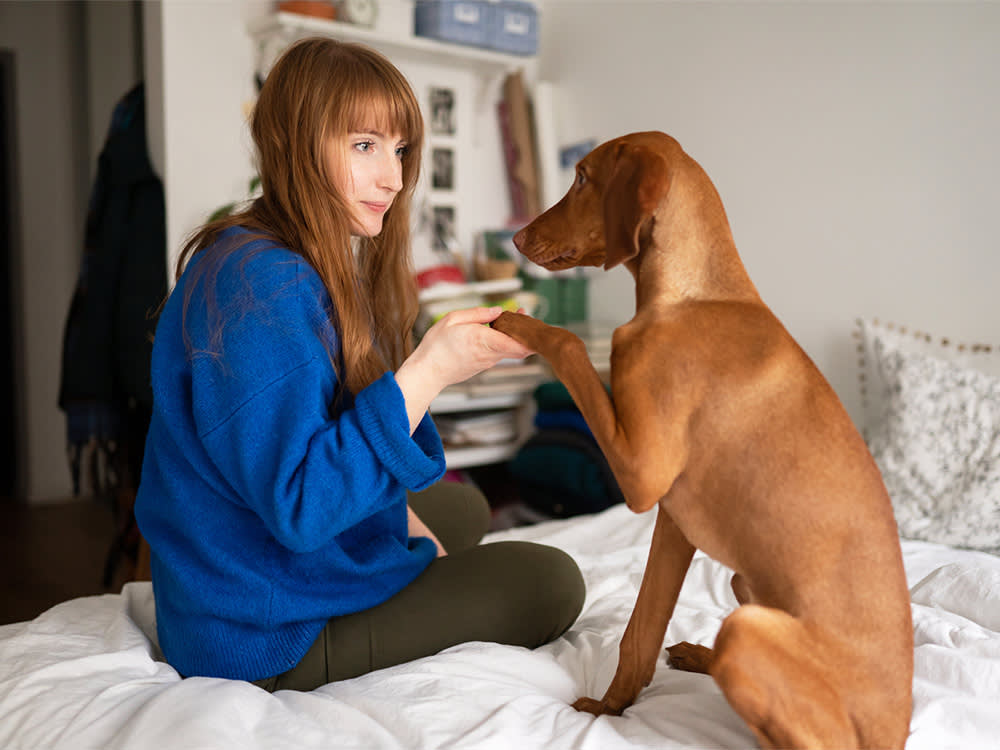
Plenty of dogs have a signature move. A big paw that thumps the door when they want out. A insistent scrape at your arm mid-meeting. A whole-body demand that lands somewhere between charming and destructive, especially when the paw belongs to a large, strong dog and the door is starting to show it. Owners often read this as pushiness, or worse, as a dog “trying to be the boss.”
It’s neither. Pawing is one of the most successful things your dog does, and it’s successful because you, and everyone else in the house, keep rewarding it. That’s not a scolding; it’s good news. A behavior that was taught can be untaught, and once you see the simple loop driving it, the fix is almost mechanical.
Start with the motive, not the paw
Before you can change a behavior, you have to know what your dog is actually after. A paw is just the tool; the goal behind it is the thing to solve. Usually it’s one of two things: attention, or access. Your dog wants you to look at them, or they want the door to open. The paw is simply the move that has delivered those results before.
Picture how it likely began. A dog paws at a door, the door opens, and a lesson lands: mashing this door with my paw gets me outside. Or a dog scratches at the door, everyone leaps up in a flurry to stop the scratching, and the dog learns something almost as good: this makes the humans react and open the door. Either way, the behavior got reinforced and locked into place.
Owners tell me their dog is being demanding, and I get it, but the dog is just being efficient. They found a button that works. Our job isn’t to punish them for pressing it, it’s to disconnect the button from the reward and hand them a better one.
The loop that keeps it going
It helps to break any behavior into three parts. First, the motivator: what does the dog want, and what are they trying to get to or get away from? Second, the behavior itself: what it looks like, how often it happens, how intense it is. Third, and most important, the consequence from the dog’s point of view.
Run pawing through that lens and the trap is obvious. Paw at you: the want is attention, the action is the paw, the payoff is more attention. Paw at the door: the want is outside, the action is the paw, the payoff is the door swinging open. In both cases the payoff matches the want perfectly, which is exactly why the habit sticks. To change it, the consequence has to stop matching the motive. As long as pawing pays, your dog has no reason on earth to quit.
And be careful with the obvious “fixes.” Ignore a big dog pawing you and it’s genuinely hard, so people cave, which teaches persistence. Reach for a bone or toy the second they paw, and you’ve just handed out a reward for pawing. Good intentions, wrong lesson.
First, rule out a real need
Before you treat pawing as a habit to break, make sure your dog isn’t simply telling you something legitimate. If they actually need to go out and no one is paying attention, scratching the door is a completely reasonable thing to do. Get the basics squared away first: a predictable potty schedule, enough exercise, meals on time, and real attention built into the day. A dog whose needs are met is a dog you can fairly ask to stop demanding. If the door-scratching continues anyway, you can also manage the environment in the meantime, blocking access to the door or otherwise preventing the behavior while you retrain it.
Teach the paw out of a job
The core move is to be proactive: instead of only reacting when the paw lands, teach your dog a better way to get what they want.
For attention-pawing, the moment the paw touches you, stand up and calmly leave. Come back, and if they paw again, leave again. Repeat until the pawing stops. When you return and they don’t paw, that’s when they get all the attention and affection you’ve got. The lesson forms quickly: the paw makes the person disappear, but calm brings them back.
For door-pawing, you can use the same logic. When your dog paws the door, remove them from it briefly, a small time-out from the thing they want, then bring them back, maybe on a leash. Ask for a sit or a down, and open the door only once they give it. Now the paw earns the opposite of the door, while sitting earns the door itself.
Notice what’s missing from both: anything scary or painful. You’re not trying to make your dog afraid of the door or of you. You’re teaching a new skill that gives them a calm, reliable path to the things they want. Fear tends to create new problems; a replacement behavior solves the original one.
Make good things flow through you
For a while, it helps to put yourself in the middle of the good stuff on purpose. Ask for a simple behavior, a sit, a down, even a paw shake offered on your cue, before things your dog values: a meal, a spot on the couch, the open door. This isn’t about being the “alpha,” a framing behavior professionals have long since set aside. It’s about being the teacher and the guide. You’re showing your dog, over and over, that there’s a calm, focused, non-demanding way to unlock the world, and that it works even better than the paw ever did.
References
Common questions
Why does my dog paw at me and at doors?
Because it has worked before. Pawing you gets attention; pawing a door gets the door opened. Each success teaches your dog that the paw is an effective tool, so they keep using it.
Is pawing a sign my dog is trying to dominate me?
No. Pawing is a learned attention-getting behavior, not a bid for status. Your dog isn't challenging you; they're using a move that reliably gets a result.
How do I get my dog to stop pawing without scaring them?
Make the paw stop working and teach a calm alternative. Stand up and step away when they paw for attention, and reward stillness or a sit instead. For doors, ask for a sit before you open them. No punishment required.
Dr. Chen is a small-animal veterinarian who leads health and safety coverage at The Pet Times. She writes and reviews the bulk of our illness, condition, and safety content, translating clinical guidance into clear, practical advice owners can act on at home.
Meet our experts ↗Keep reading
 TrainingYour Dog Is Never Barking at Nothing. You Just Can't Hear It.Dr. Ravi Mehta · 7 min
 TrainingYour Puppy's Evening Meltdown Isn't Extra Energy. It's Exhaustion.Dr. Amara Solis · 5 min
 TrainingDogs Don't Forgive After a Fight. What They Do Is SmarterDr. Ravi Mehta · 5 min
 TrainingStop Refereeing the Dog Park by Folklore. Read the Dogs InsteadSasha Ford · 10 min
 TrainingYour Dog Isn't Being Bad. Leash-Biting Is Excitement With Nowhere to Go.Dr. Ravi Mehta · 5 min
 TrainingYour Dog Doesn't Hate Intact Dogs. He Hates Being Surprised.Dr. Lena Park · 6 min