


Dog Zoomies, Decoded: When the Crazy Laps Are Healthy and When They Aren't
Those frantic full-speed laps have a name, a real purpose, and one version worth watching. Here's what zoomies actually are, what sets them off, and how to tell the harmless kind from a red flag.

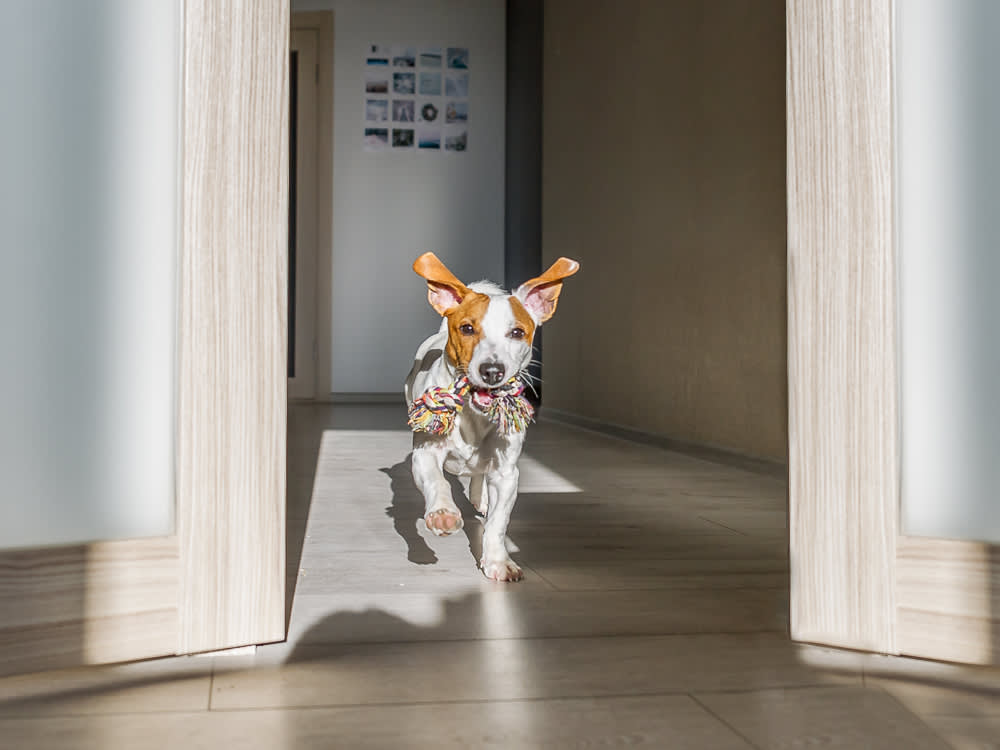
The zoomies have been part of my life far longer than Zoom meetings have. A dog suddenly drops into a play bow, gets a wild gleam in their eye, and then detonates, tearing around the yard in tight loops or rocketing over the coffee table and along the back of the couch. It is one of the most ridiculous and delightful things a dog does.
It is tempting to treat that burst as a behavior problem to be managed, something to shush and shut down. It is almost never that. Zoomies are closer to a pressure valve, a normal and largely healthy way for a dog to dump a surplus of energy or excitement. The useful thing to understand is not how to stop them, but what they are telling you, because the same wild lap can mean “I am a happy, slightly overstimulated dog” or, rarely, something worth a closer look.
What is actually happening
Scientifically, zoomies go by a wonderful name: frenetic random activity periods, or FRAPs. The leading theory is that a FRAP helps an animal discharge built-up arousal, blow off stored energy, and process a flood of excitement or play. The precise neurological function is still a bit of a mystery to researchers, but the pattern is consistent and recognizable across dogs, puppies, and even other species.
In the moment, a zooming dog runs in wide circles, lap after lap, sometimes spinning in place between sprints. The launch is sudden, rear end tucked, eyes bright, body throwing in sharp turns, pivots, and abrupt direction changes. It looks chaotic. It is actually a fairly stereotyped behavior, which is part of why it is so easy to spot.
A FRAP is best understood as emotional overflow. The dog is so full of feeling, usually happy feeling, that the body has to do something with it. In a healthy dog it’s self-limiting. It builds, it crests, and it’s gone in a couple of minutes.
The trigger map
Zoomies tend to erupt at predictable moments, and learning your dog’s pattern helps you stay ahead of them. Common triggers fall into a few buckets:
- Release of confinement: being sprung from a crate, the car, or any kind of restraint, or simply heading outside after a long stretch indoors.
- Social spikes: a favorite person walking through the door, or the sight of another dog.
- Post-event relief: right after a bath, a grooming session, or, yes, a satisfying poop. The common thread is a dog moving from “had to hold it together” to “free.”
- Novel sensory jolts: fresh snow is a famous one, cold and strange and wonderful underfoot.
None of these are problems. They are just the situations where arousal builds fastest and the valve pops.
The version worth watching
Here is the distinction the standard zoomies explainer skips, and the one that actually matters. Almost all zoomies are the good kind. A small slice can look similar but mean something else, and it is worth knowing the difference.
Healthy zoomies are occasional, short (usually under two minutes, rarely past ten), tied to an obvious trigger, and over as quickly as they started. The dog looks loose, bouncy, and happy, then shakes off and moves on. Nothing to do but enjoy the show and keep them safe.
Worth a second look are episodes that do not fit that shape:
- Tail-chasing that won’t stop. A dog who spins after their own tail to the point of fixation may not be zooming at all; relentless, hard-to-interrupt spinning can be a sign of a compulsive behavior rather than a happy FRAP. Mention it to your vet.
- Zoomies that seem to escalate rather than resolve. A healthy burst winds down on its own. One that ramps up, especially with frantic mouthing or an inability to settle afterward, can point to a dog who is genuinely over-threshold and needs help calming, not more stimulation.
- A sudden change in frequency. A previously calm adult dog who starts having intense daily episodes is worth a wellness check, just to rule out discomfort or anxiety driving the energy.
To be clear, the overwhelming majority of zoomies need no intervention whatsoever. This short list is simply the small print, so you know when “adorable chaos” might actually be “tell the vet.”
How to keep them safe (and channel them)
Since you usually cannot, and should not, stop a FRAP mid-flight, the goal is a safe runway rather than a hard stop. A few practical moves:
- Clear the launch zone. The real danger in zoomies is the environment, not the behavior. Keep your dog from zooming near roads, pools, glass tables, or a yard full of hazards. Indoors, rugs on slick floors prevent wipeouts.
- Redirect by running away, not toward. If you genuinely need to move a zooming dog to a safer spot, run away from them so they chase you. Chasing a zooming dog only adds fuel and makes them harder to settle.
- Toss a target. Throwing a toy in the direction you want them to go gives the energy somewhere productive to land.
- Build the off-ramp in advance. The stronger your dog’s recall, the sooner they will peel off and come to you as the burst fades. And getting ahead of predictable triggers with real exercise earlier in the day takes the pressure off the valve in the first place.
A dog with regular outlets, a daily walk, sniff time, play, and some mental work, tends to have shorter, sillier, more occasional zoomies, because the tank is never quite as full. Which is exactly how it should be: a quick, joyful blowout, then back to lounging on the couch they just ran along the back of.
References
- American Veterinary Society of Animal Behavior, resources on normal canine behavior and arousal
- Overall, K.L., “Manual of Clinical Behavioral Medicine for Dogs and Cats,” on compulsive behaviors and differential signs
Dr. Nair is a veterinarian focused on diet and feeding. She covers everyday nutrition, treats, and the many "can they eat this?" questions owners ask, grounding each answer in what is actually safe and sensible for dogs and cats.
Meet our experts ↗Keep reading
 TrainingThat Friendly On-Leash Hello Is Teaching Your Dog to Melt DownDr. Amara Solis · 6 min
 TrainingThe Play Bow Is Your Dog Saying 'I'm Only Joking'Dr. Priya Nair · 6 min
 TrainingYour Puppy Is Talking to You. Here's the Translation.Dr. Nina Kohl · 8 min
 TrainingBig Dogs vs. Small Dogs: Does Size Really Shape Behavior?Claire Sutton · 8 min
 TrainingYour Dog Already Knows Your Name. This Game Makes Them Prove It.Dr. Mara Chen · 6 min
 TrainingThat Study Said Dogs Ignore Your Bad Advice. Newer Research Says the Opposite.Dr. Ravi Mehta · 6 min