


Big Dogs vs. Small Dogs: Does Size Really Shape Behavior?
Do little dogs really have a Napoleon complex? The research suggests size matters less than how we treat dogs. Here's the truth about big and small pups.

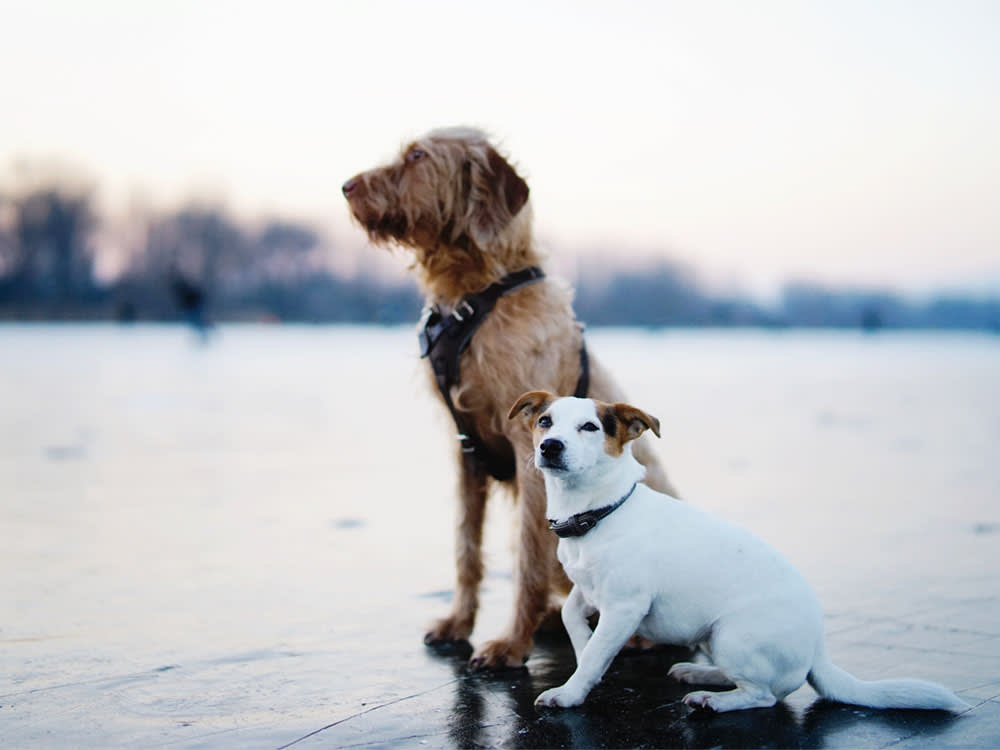
When it comes to dogs, size really does matter. Some people love a pocket-sized pup for the sheer portability, while others want their dog firmly on the XL end of the spectrum. Size-based bias is common too. Anyone with a big dog knows that people sometimes fear them even when they are behaving impeccably, all while a nearby small dog misbehaves without raising any eyebrows.
One of the marvels of domestic dogs is the astonishing range of sizes they come in, all controlled by a surprisingly small number of genes. (For comparison, roughly 200 gene regions affect height in humans.) Since so few genes govern size, the obvious question is: how much does size actually shape behavior?
Are big dogs secretly compensating for something with all that rowdiness? Do small dogs really nurse a superiority complex? Or is the difference mostly in how people behave and what they expect? Here is everything you need to know about dogs, big and small.
Life with big dogs vs. small dogs
A dog’s size has real, practical consequences. A few examples:
Health
Ask anyone with a Great Dane who has diarrhea. The experience is, shall we say, not quite the same as for someone managing a similarly afflicted Maltese.
Mobility
A seven-pound Affenpinscher who doesn’t feel like getting in the car can simply be scooped up and placed inside. The situation gets considerably more complicated when a 185-pound Saint Bernard is the one digging in. Helping a large dog with mobility issues can be physically demanding for the person doing the helping.
Cost
Big dogs tend to cost more across the board, from food, professional grooming, and medication to toys, leashes, collars, and bowls.
Manners
People with little dogs who don’t want them helping themselves to food simply avoid picnicking on the floor and take care not to leave chairs positioned as stepping stones to the table or counter. People with large dogs often discover that nothing lower than the top of the refrigerator is truly off-limits.
Care
With a large dog, accidentally eating something dangerous, like chocolate, is far less likely to turn serious than it is for a small dog, simply because it takes a much bigger dose to reach a toxic level in a larger body.
Weight
A few extra treats that lead to weight gain in a small dog may be no big deal at all for a large one.
Kids
People often worry about big dogs around children, but the bigger risk can run the other way. Even gentle, respectful kids can collide with a small dog and cause an accidental injury. With larger dogs, that is far less of a concern.
Renting
It is easier to rent an apartment with a small dog, since weight limits tend to favor them. Tight living spaces are simpler to share, and getting a small dog in and out of an apartment building, especially during housetraining, is far less of a project.
Are behavioral differences actually about size?
For the most part, the answer is a resounding no. Behavioral differences between dogs are not size-based. Dogs of all sizes love to play chase, fetch, go on walks, run off-leash, meet new people, romp with their best dog friends, train, and eat tasty treats. By the same token, dogs of all sizes can be sound-sensitive, experience separation anxiety, show aggression, jump on people, bark excessively, chew shoes, dig up the garden, or have accidents indoors. They all wag their tails (if they have them) in joy.
And yet there are clearly differences between individual dogs beyond age, sex, and environment. So what gives? It turns out to be a people problem.
People treat small dogs differently
One study examined the connection between size and behavior in detail, asking two key questions: How does a pet parent’s behavior toward dogs of different sizes shape those dogs’ behavior? And how do expectations differ based on size?
The study found significant behavioral differences between large and small dogs, and between the people who own them. Small dogs were reported to be less obedient, slightly more often aggressive or excitable, and more anxious and fearful. People with small dogs also reported being less consistent in their interactions and in enforcing rules than people with larger dogs. Those differences in human behavior may account for the higher rates of disobedience in small dogs.
It’s all about that baby talk
Have you ever noticed how some people treat their small dogs like babies? Babyish features genuinely shape human caretaking behavior. We are evolutionarily hardwired to find big eyes, small size, and proportionally large heads endearing. Psychologists call it the “aww phenomenon.” If babies weren’t so cute, parents might be less inclined to respond to their needs, and the babies would be less likely to thrive.
Dogs seem to trigger the same response, especially small dogs, and even more so breeds with pronounced juvenile features like Cavalier King Charles Spaniels, Chihuahuas, Japanese Chins, Pugs, and Boston Terriers. Since babies raise our levels of oxytocin, nicknamed “the love hormone,” it stands to reason that adorable dogs do the same.
Socialization plays a role too
Large dogs typically get more opportunities for socialization than small ones. When a small dog is carried around rather than walking on their own four paws, they have fewer encounters with people and other dogs, which can limit their ability to cope with both.
Positive experiences with other people and dogs during puppyhood are the best foundation for good manners. But small dogs are frequently picked up or otherwise physically managed, which can lead to more negative experiences. Without enough positive ones, dogs of any size will run into social challenges.
Two research studies found that small dogs receive less formal training than large dogs. People also play fetch more often and do more tugging and nose work with big dogs, and are more likely to take them running or biking.
Encouraging the misbehavior
Plenty of pet parents have the same rules for dogs of any size, but what large and small dogs are actually allowed to get away with often differs sharply. Small dogs are more likely to be welcomed into our beds and onto our laps. A 25-pound dog jumping or sitting on you is one thing. A 100-pound dog doing the same is another entirely. Behaviors written off as a nuisance in a small dog can be deemed antisocial in a large one. Even aggression and other serious behavioral issues are more likely to be tolerated in small dogs.
Some pet parents, for example, encourage little dogs to jump up on people and climb on the furniture, while rarely inviting big dogs to do either. Large dogs are more likely to be euthanized for aggression, though another study found that the average “biter” tended to be a smaller dog. A lot of that comes down to perceived threat. While dogs of both sizes can be equally aggressive, size can influence the fear response.
And then there’s breeding
In some ways, size does correlate with breed characteristics. Many small dogs are terriers and earth dogs, types deliberately developed to be tenacious, curious, and inclined to dig and explore. When dogs are bred for those traits, the resulting behavior has far more to do with genetics than with size.
One study found that small dogs were more likely than large dogs to come from pet stores, which generally source their “stock” from puppy mills. Given that puppy mills are notorious for environmental deprivation and risky breeding practices, it is perhaps no surprise that small dogs end up burdened with more problematic behavior.
In the end, a dog’s behavior is what makes them such a wonderful companion and friend. So when it comes to our pets, size really doesn’t matter. What matters are the experiences you share, the good, the bad, and the shoe-chewing ugly. It’s always big love, no matter the size of the dog.
What newer research adds: it’s height and head shape
Bigger studies have since backed up the basic idea. One of the largest dog-behavior projects ever done, the Dog Aging Project’s analysis of more than 47,000 dogs using a shortened C-BARQ questionnaire, sorted reported behavior into four domains (fear, attention/excitability, aggression, and trainability) and found that smaller dogs, those under about 20 pounds, scored as more fearful, more attention-seeking, and more aggression-prone than larger dogs, while bigger dogs scored as more trainable.
But there is a wrinkle the size debate usually misses, and it is the genuinely interesting part. A landmark study by Paul McGreevy and colleagues found that dog behavior co-varies not just with height and bodyweight but with skull shape. Holding size constant, shorter-skulled (more flat-faced) dogs and taller dogs showed distinct behavioral tendencies, meaning “small dog behavior” is partly confounded with the fact that many toy breeds are also brachycephalic. Size is one axis; the shape of the head is another, and they get tangled together in the breeds we think of as “little dogs.”
And the most useful finding is still why, and it is good news for small-dog owners. A large share of the gap traces back to how we treat them, not to their size or their skulls. Owners of small dogs, on average, play with, train, and house-train them less than owners of big dogs. So a chunk of “small dog behavior” looks less like destiny and more like a training gap you can actually close. Treat a small dog the way you would train a big one, give it the same socialization, the same rules, the same patient repetitions, and a lot of those differences shrink.
References
- Stone, H.R., McGreevy, P.D., et al. “Associations Between Domestic-Dog Morphology and Behaviour: Dog Behaviour Co-Varies with Height, Bodyweight and Skull Shape.” PLOS ONE, vol. 9, no. 1, 2014
- Dog Aging Project: largest-ever study of dog behavior across 47,000+ dogs (2020–2023) — summary
- Arhant, C., et al. “Behaviour of Smaller and Larger Dogs: Effects of Training Methods, Inconsistency of Owner Behaviour and Level of Engagement in Activities with the Dog.” Applied Animal Behaviour Science, vol. 123, 2010
- Guy, N.C., et al. “A Case Series of Biting Dogs: Characteristics of the Dogs, Their Behaviour, and Their Victims.” Applied Animal Behaviour Science, vol. 74, 2001
- McGreevy, P.D., et al. “A Survey of Dog Ownership in Suburban Australia: Conditions and Behaviour Problems.” Applied Animal Behaviour Science
Claire Sutton writes about life with pets, from the first days home to the small daily routines that make a household work. Her reporting spans people-and-pet relationships, training basics, and the practical side of bringing a new animal into the family.
Meet our experts ↗Keep reading
 TrainingA Good Dog Greeting Lasts 6 Seconds. Stop Forcing the Rest.Dr. Amara Solis · 7 min
 TrainingYour Dog Doesn't Love the Squeak. They Love Making It Stop.Dr. Ravi Mehta · 7 min
 TrainingYour Dog Isn't Stalling Before They Poop. They May Be Checking a Compass.Sasha Ford · 8 min
 TrainingA Laser Pointer Isn't a Toy. It's a Job Your Dog Can Never Finish.Dr. Nina Kohl · 7 min
 TrainingYour Dog Isn't Annoyed by the Siren. There's a Wolf Answering It.Dr. Mara Chen · 6 min
 TrainingYour Dog Poops on Hills for a Reason (and It Isn't the View)Dr. Nina Kohl · 6 min