


Your Dog Isn't Stalling Before They Poop. They May Be Checking a Compass.
Ten minutes of circling and sniffing looks like dawdling. It is a survey: who was here, is it safe, and, according to one very strange study, which way is north.

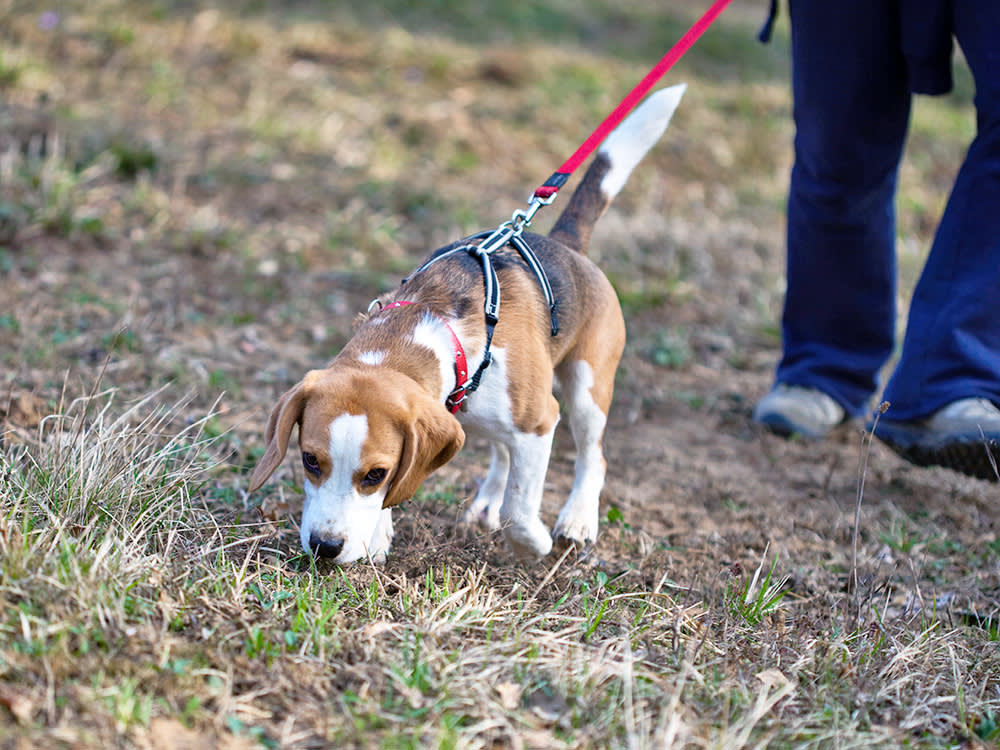
It is raining. You are in socks and shoes with a bag in your hand, and your dog is on their fourth lap of the same three square metres of grass, nose down, in no apparent hurry.
The thing that would make this bearable is understanding that your dog is not stalling. They are running a survey, and it has at least four variables in it. One of those variables, according to a genuinely strange piece of published research, may be the Earth’s magnetic field.
Let’s do the boring ones first, and then the compass.
What the nose is actually doing
The equipment justifies the delay. Humans carry roughly five million scent receptors. Dogs carry somewhere between 100 million and 300 million, depending on breed. Trainers like to translate that into a dilution figure: a single spoonful of something sweet, stirred into a competition swimming pool, and the dog still finds it.
That is not a better version of your nose. It is a different sense, running in a different dimension, and it delivers a kind of information you have no access to at all. Nose down in the grass, what your dog is reading is time. Scents decay at predictable rates, so a patch of grass is not a single message; it is a stack of them, layered by how long ago each was left. Who came through. How recently. Which direction they went.
Now: the pre-poop sniff, specifically.
1. They are choosing where to publish
Dogs defecate to relieve themselves and, simultaneously, to communicate. Feces and urine are a signature, and where you leave your signature matters. A message on an unused corner of grass reaches nobody. A message on a well-trafficked lamppost strip reaches everybody who passes.
So the circling is, in part, site selection for maximum readership. This is why dogs return obsessively to the same spots, and why some will walk past twenty perfectly good patches of grass to reach the one they always use.
2. They are reading before they write
Before contributing, your dog is reading the existing thread.
The scents underfoot carry a startling amount of information about the animals who left them: species, sex, reproductive status, health, stress, familiarity. A dog sniffing a patch of grass is finding out who has been here, whether any of them are known, whether any prey animals are nearby, and whether it is a good idea to add their own message to the pile or better to move on and stay quiet.
Sometimes the answer is don’t post here. That is a decision, and it takes information to make.
3. They are checking whether it is safe
This is the one owners forget, and it is probably the most important.
Defecating is a moment of maximum vulnerability. The posture is committed, the animal is slow to move, the attention is inward. In an environment with predators, that is the worst possible time to be surprised. Domestic dogs live in a world without predators, but they are running hardware that does not know that.
So the sniff is also a perimeter check. Scan the surroundings, confirm nothing large and interested is nearby, and only then let your guard down. A dog who catches something worrying will break off and move.
This is also why context changes everything. A new place, a strong scent, a nearby dog, or an unfamiliar noise all lengthen the search, because the safety check has more to process.
4. They are just picky
Some dogs have preferences and they are not embarrassed about it. Grass over concrete. Sun-warmed over damp. A soft surface over a hard one. Clear of anything unpleasant. The sniffing routine is partly a quality assessment, and if the ground does not pass, they will keep looking.
The one everyone gets wrong: they are shy
Here is the version that turns an annoyance into an act of empathy.
Dogs can be genuinely inhibited about pooping, and the cause is usually us. A dog who has been rushed, yanked mid-squat, startled, or, worst of all, punished during house-training has learned that this act is associated with something bad happening. Sniffing then becomes a delay tactic, an anxious loop that puts off the moment.
It shows up most in young dogs, recently adopted dogs, and dogs in unfamiliar surroundings. And it is entirely self-reinforcing: the more you sigh and tug at the leash, the more your dog learns that this is a fraught moment, and the longer the ritual gets.
If you have ever wondered why your dog will not go while you are standing over them staring, that is why.
And then there is the compass
In 2013, a group of researchers published a study in Frontiers in Zoology that is one of the more delightful things in the canine literature.
Over two years, they collected 1,893 observations of defecation and 5,582 of urination across 70 dogs from 37 breeds, deliberately in open fields where trees, buildings, and other visual cues could not bias the dogs’ orientation. Then they compared each dog’s body alignment against the Earth’s magnetic field.
The finding: dogs preferred to align their bodies along the north-south axis while defecating.
And the detail that makes it credible rather than a fluke: the preference only held when the magnetic field was calm. When the field was unsettled, geomagnetic conditions above a low threshold on the Kp index, the alignment disappeared entirely. That is exactly the pattern you would expect if the dogs were sensing something real about the field, and it is a hard result to produce by accident. (There was also a sex difference: both sexes aligned north-south when defecating, but only females showed the preference when urinating.)
Now the caveats, honestly. This is one study. It has not been extensively replicated. What magnetoreception in dogs would be for, and what the mechanism would be, remains open. Nobody has demonstrated that this is what your dog is doing during the ten-minute grass patrol.
But it is published, the methodology was careful, and it raises the possibility that some part of that maddening pre-poop routine is a variable you cannot perceive at all, and that your dog is not indecisive so much as waiting for the reading to settle.
What to actually do about it
- Be patient, and stop pulling. Rushing an anxious dog makes an anxious dog, and an anxious dog takes longer. The leash tug is the least effective tool you own here.
- Give them a spot with a history. If you need this to move faster, go to a place your dog has used before. Familiar ground has already passed the safety check.
- Be consistent about timing. Same times, every day. Predictable routines produce relaxed dogs, and relaxed dogs poop.
- Praise, calmly, and do not scold. Whatever your feelings about the rain, keep your voice warm. Your dog is reading you the entire time.
- Exercise first. Some dogs need to move before their system will cooperate. A short walk or a quick game before the potty break can shorten the whole business considerably.
- And here is the fix nobody uses: keep walking afterward. A huge number of dogs stretch out the sniffing because they have learned that pooping ends the walk. They are not being difficult; they are being rational. Break the association. Poop, then continue the walk for another five or ten minutes of pure sniffing for its own sake. Within a couple of weeks, many dogs get dramatically faster, because finishing no longer costs them anything.
That last one is the whole article in miniature. The behavior you are frustrated by is usually the behavior you built.
What newer research adds
The bigger shift, beyond the magnetic curiosity, is how the profession now thinks about sniffing itself.
Sniffing is no longer treated as a delay between the useful parts of a walk. It is understood as the dog’s primary way of engaging with the world, and there is a growing body of work on scent work and nosework as enrichment, with evidence that letting dogs use their noses has measurable effects on their emotional state and optimism. A walk where the dog is dragged past every interesting smell is, from the dog’s side, a walk with the volume off.
Which reframes the ten minutes on the grass. It is not lost time in your day. It is most of the point of the outing, for them. The poop is incidental.
References
- Hart, V., Nováková, P., Malkemper, E. P., et al. (2013). Dogs are sensitive to small variations of the Earth’s magnetic field. Frontiers in Zoology.
- Craven, B. A., Paterson, E. G., & Settles, G. S. (2010). The fluid dynamics of canine olfaction. Journal of the Royal Society Interface.
- Duranton, C., & Horowitz, A. (2019). Let me sniff! Nosework induces positive judgment bias in pet dogs. Applied Animal Behaviour Science.
- Bekoff, M. (2001). Observations of scent-marking and discriminating self from others by a domestic dog (Canis familiaris). Behavioural Processes.
Common questions
Why does my dog sniff so much before pooping?
They are gathering information. Who has been here, what animals are nearby, whether the spot is safe, and whether it is a good place to leave a message of their own. Defecation is a communication event, not just a bodily one.
Is it normal for a dog to take ten minutes to find a spot?
Completely. Some dogs are quick, some are meticulous. The length of the search is a personality trait, not a symptom, unless it comes with straining or distress.
Do dogs really poop facing north?
A 2013 study found dogs preferred to align along the north-south axis when defecating, but only when the Earth's magnetic field was calm. It is a real published finding and it has not been widely replicated. Treat it as fascinating rather than settled.
How can I speed up my dog's pre-poop routine?
Do not rush them, which usually makes it worse. Go to a familiar spot, keep the timing consistent, and, if your dog stalls because pooping ends the walk, keep walking afterward so it stops being the end.
Sasha Ford is a certified cat behaviour consultant who has worked with shelters, catteries, and private clients across the country. They review all feline behaviour content at The Pet Times, with expertise in multi-cat households, indoor enrichment, and stress-related disorders.
Meet our experts ↗Keep reading
 TrainingThe One Thing Your Dog's Breed Is Quietly Begging You ForJordan Ellis · 7 min
 TrainingYour Dog Isn't Ignoring the TV. They're Seeing a Different Show.Dr. Ravi Mehta · 8 min
 TrainingThe Walk Isn't Cardio. 9 Myths That Ruin It.Dr. Nina Kohl · 8 min
 TrainingStop Steering. The Walk Is the One Thing Your Dog Should Get to Decide.Dr. Lena Park · 7 min
 LivingMost Dog Fights Happen at Home. Pick the Second Dog Accordingly.Dr. Mara Chen · 7 min
 LivingYour Dog Doesn't Care About Your Square Footage. It Cares About You.Marcus Webb · 9 min