


Your Dog Doesn't Care About Your Square Footage. It Cares About You.
Rescues demand fenced yards. Owners agonize over apartments versus houses. But talk to the trainers who place dogs into every kind of home, and the same answer keeps surfacing: where you live matters far less than what you do once you're there.

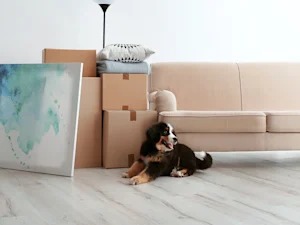
There is a persistent belief, baked into rescue applications and dinner-party opinions alike, that a good dog home has a fence, a yard, and room to run. The data even nods along: dog ownership skews toward people who own their homes rather than rent them, and toward the countryside over the suburbs and the city. So the environment clearly does something.
The trap is assuming it does the most important thing. Spend time with trainers who place and rehabilitate dogs across apartments, farms, high-rises, and, yes, converted vans, and a different conclusion emerges. Environment shapes how easy pet parenting is. It does not decide whether a dog thrives. That comes down to the person, not the property.
Some homes just make the job easier
You cannot rank environments as universally better or worse, because every dog, home, and lifestyle is different. What you can say is that your immediate setup changes the specific ways caring for a dog is easy or hard.
The environments where I see dogs struggle aren’t the small ones. They’re the ones that fight the dog’s actual personality. A dog who craves novelty and social contact can stall out in a quiet suburban routine, and a dog who can’t regulate its own arousal can come apart in a busy city. The square footage is almost never the real variable.
The useful move is not to find the “best” environment. It is to ask honest questions about the fit between your home and your particular dog.
How hard is a bathroom break?
What a yard really buys you is friction removed from the day. New-puppy owners who have one describe it as an unfair advantage: crack the door every hour and you’re done. Apartment life turns each of those same trips into a small production, leash, elevator or stairs, hallway, street, and back again.
That gap matters most for dogs with specific needs. A senior dog who struggles with stairs is poorly served by a sixth-floor walkup. A dog with a condition that means frequent bathroom trips is a bad match for the thirty-fifth floor of a high-rise. And for a reactive dog, one who barks, lunges, or growls at other dogs, a yard means never rounding a corner into a neighbor’s dog while you are still half-asleep. Tight, shared spaces raise the degree of difficulty even for otherwise social dogs.
Does your dog get real quiet?
Dogs evolved from animals suited to very different surroundings than a modern building, so it is no surprise that constant stimulation can wear on them. A home where something is always happening, interesting or frightening, can leave a dog unable to fully power down. And a dog who never truly rests has less capacity to handle the next day’s demands.
In loud, high-traffic areas, some dogs visibly buckle: they pancake and refuse to walk, bark at every passing bicycle, or flinch when a bus roars by. The good news, from trainers who do this work, is that most of these dogs can be gradually acclimated, slowly built up to tolerate and then ignore the chaos. Only rarely does a dog genuinely need to be relocated to a quieter setting, far less often than people fear.
Can they burn energy easily?
Running, sniffing, digging, chasing, this is enrichment, and some homes come with it built in. A park at the end of the street buys you calmer walks and more of them; a dog whose nearest usable grass is four blocks and two intersections away gets fewer, and each one starts with a slog.
But do not confuse enrichment with acreage. Neither exercise nor closeness has ever depended on owning grass. Both are perfectly available on a walk that holds your dog’s interest, in five minutes of training on a kitchen floor, or on a park bench where the work is simply staying calm while the world goes by. A dog does not need land. It needs a person willing to create the outlets.
Is there a safe spot to retreat?
The size of your home matters less than what happens inside it. Interior space becomes a real factor mainly when a dog is wrestling with anxiety and needs somewhere to decompress, or when the home genuinely cannot accommodate movement, and even a seventy-square-foot van has housed happy dogs. Most dogs spend their indoor hours napping in one or two favorite spots. For that, you need roughly the footprint of a dog bed.
Is veterinary care reachable?
This one is easy to overlook until it is urgent. In remote or unsettled living situations, care can be genuinely hard to reach, some clinics are not taking new patients, and some areas have no vet for many miles. It is not only a problem for people living on the road. Research has documented real geographic gaps in where veterinary staff practice, and some rural regions, along with under-served corners of cities without good transit, function as “care deserts” with few or no accessible services. If you are choosing where to live with a dog, proximity to affordable care belongs on the list.
Dedicated owners make it work anywhere
Ask the people who place dogs into every conceivable home, and they converge on the same point: environment is not the thing that matters most. Some setups make parenting easier, but a full life is available in apartments, houses, campers, and everything between.
Each dog is an individual with its own needs, preferences, and fears, and most can acclimate to wherever they land when given time to decompress and adjust. That is why experienced rescues rarely reject an interested adopter over a single detail like a missing fence. They are trained to spot genuine red flags, and otherwise to look for reasons to say yes.
The overlooked upside of a crowded home
City living even carries an advantage people miss. Avoiding behavior problems is often easier in a house, no stairs to negotiate, easy access to the outdoors, more room to separate dogs who are in conflict. But dense environments offer something houses do not: constant, structured socialization.
Suburbia can quietly isolate a dog, making it easy to fall into a small loop of the same faces and routes. The city allows no such drift. Every bit of space is shared space, so you go find it; every walk is a crowd, so you learn to speak up for your dog inside one; novelty arrives whether you scheduled it or not. Handled with care, that produces strikingly adaptable animals, dogs who can sit through a farmers market, a restaurant patio, or a jammed sidewalk without coming apart.
How to give your dog what it needs, wherever you live
A healthy, fulfilled dog is not a checklist you complete. It is a matter of noticing how your particular dog responds to its routine and environment, and adjusting. A few principles carry across every home.
Get out of the house. Your walls should not be the only world your dog knows. A dog’s nervous system is built to go out and gather new sensory information, which makes novelty less of a luxury than a requirement for a contented animal. So cycle the parks. Take the other route. Retire a game and introduce a different one. Variety is the whole trick, and it works identically in a downtown one-bedroom and on ten rural acres. Bonus: a dog who explores and socializes is a tired, focused dog at home.
Prioritize the brain, not just the legs. Hour upon hour of physical exercise is usually the less efficient lever; working the mind does more with less. A dog still bouncing off the walls after a long walk is rarely under-exercised. That dog is under-challenged, and another mile won’t touch it. Sniffing games, puzzle feeding, and short training sessions satisfy in a way that raw distance cannot.
“People think a tired dog is a well-exercised dog, and that’s only half true,” Webb says. “The dogs I see doing best are the ones whose owners give them a job to think about, a scent to work, a problem to solve, not just a route to jog. Ten minutes of nose work can settle a dog that a two-mile walk didn’t touch.”
Safe off-leash time helps too, especially for dogs living in stressful surroundings, whether at a private rentable dog park, on a legal off-leash trail, or, for the right dog, a traditional dog park. When full freedom is not possible, a sturdy long line, not a flimsy string of a retractable, gives a dog room to roam within limits.
And do not shortchange rest. Build plenty of sleep and downtime into the routine. Dogs need far more of it than most people assume.
Keep health front of mind. Finding a vet you trust is worth the effort no matter where you live. Lean toward preventive care, which in practice means an annual exam with bloodwork even for a dog who appears perfectly well, because that is how a murmur, a mass, or the early failure of a kidney or liver gets found while it is still quiet.
Where you live matters less than what you do there
So: is your address something your dog has an opinion about? Barring a supremely unflappable animal, yes, a little. Put a quiet dog in a loud building, or a sociable one somewhere that isolates them, and the animal registers the mismatch. It is simply not the thing they weigh most heavily.
The relationship outweighs it, and not by a small margin. Give a dog a person who shows up and keeps giving them something to do, and the square footage stops mattering; that dog will out-thrive one who has a half-acre of lawn and nobody watching. Bringing a dog home was never a question of assembling the ideal setup. It is a question of meeting a specific animal’s needs with the means you actually have. And a life with some rough edges, offered by someone who came to a shelter to find them, is not remotely the same thing as no life at all.
The address matters far less than what happens inside the routine you build around it. Put your energy into the walks, the training, and the time together, not the square footage.
What newer research adds
The “care desert” problem has moved from anecdote to documented trend. Veterinary workforce analyses in recent years point to a widening access gap, driven both by uneven geographic distribution of practitioners and by a national shortage of veterinarians relative to a pet population that grew sharply during and after the pandemic. Rural counties and lower-income urban neighborhoods are the hardest hit, which means “how far is the nearest vet” is a more consequential question for a dog’s welfare than it was a decade ago.
The practical takeaway has not changed, only sharpened. If you are weighing where to live with a dog, factor in realistic access to routine and emergency care, and, wherever you land, build a relationship with a clinic before you need one urgently. Telemedicine has expanded and can help triage non-emergencies, but it is a supplement to a local vet, not a replacement.
References
- American Veterinary Medical Association. AVMA Pet Ownership and Demographics Sourcebook. https://www.avma.org/resources-tools/reports-statistics/pet-ownership-and-demographics-sourcebook
- Mars Veterinary Health. “Tackling the Veterinary Professional Shortage.” https://www.marsveterinary.com
- Salt, C., et al. “Spatial Access to Veterinary Care in the United States.” Journal of Shelter Medicine and Community Animal Health. https://jsmcah.org
Marcus Webb writes about the gear, gadgets, and everyday choices that make life with a pet easier. His coverage runs from product picks to training and the causes worth paying attention to, always with an eye on what actually earns a place in your home.
Meet our experts ↗Keep reading
 TrainingTug-of-War Won't Make Your Dog Aggressive. Playing It Wrong Might.Dr. Nina Kohl · 9 min
 TrainingYour Dog Isn't Being Difficult on Walks. They're One of These 4 Types.Dr. Nina Kohl · 5 min
 TrainingYour Dog's Toy Stash Is Adorable. The Growl Over It Isn't.Marcus Webb · 7 min
 LivingYour Dog Has Two Beds Because They Have Two Kinds of SleepDr. Ravi Mehta · 7 min
 TrainingYour Dog Isn't Ignoring the TV. They're Seeing a Different Show.Dr. Ravi Mehta · 8 min
 TrainingYour Dog Isn't Stalling Before They Poop. They May Be Checking a Compass.Sasha Ford · 8 min