


Tug-of-War Won't Make Your Dog Aggressive. Playing It Wrong Might.
The old warning that tug creates a pushy, dominant dog is backwards. Tug is one of the best games you can play, as long as you run it with a few simple rules. Here's how to play it right.

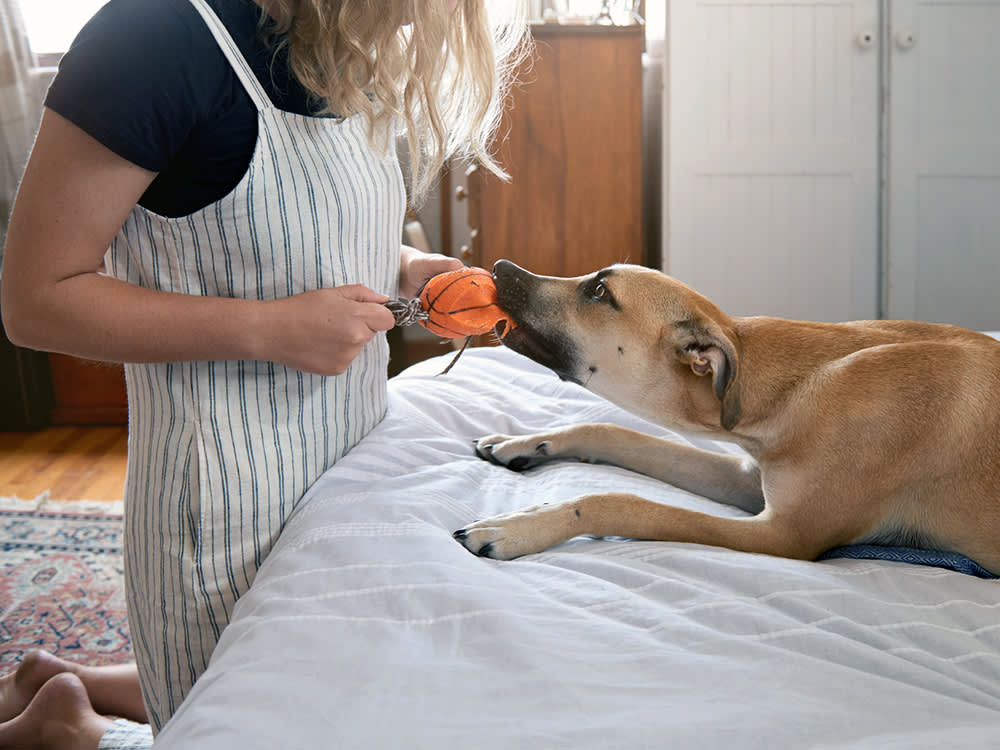
Somewhere along the way, tug-of-war picked up a bad reputation. Plenty of dog owners still believe that a hard game of tug teaches a dog to challenge people, that letting the dog “win” hands them the upper hand in the household, and that the whole thing feeds aggression. It is one of the stickiest myths in dog behavior, and it has cost a lot of dogs one of the best games available to them.
Here is the thesis worth holding onto: tug is not the problem, and it was never going to make your dog aggressive. What actually causes trouble is a tug game with no rules, played with a dog who is already spiraling into over-arousal and never taught how to stop. Fix the structure and tug becomes exactly what behavior science says it is, a fast, satisfying, bond-building workout you can run in a hallway. So this piece is less “should you play tug” (you should) and more “how to play it so it works for both of you.”
Why the game is so good for dogs in the first place
Most dogs do not need to be taught tug. Puppies still tripping over their own paws will grab one end of a toy and pull, because grabbing and pulling is wired deep into how dogs interact with the world. That instinct is the whole reason the game lands so well: it lets a dog do something intensely natural, with you, in a way you can shape and reward.
It is also remarkably efficient exercise. A few solid minutes of tug is physically taxing in a way that a slow walk around the block is not, which is a gift on the days it is too hot, too cold, or too wet to be outside for long. Better still, that burst of high-intensity effort tends to leave dogs calmer afterward, not wound up, provided the game ends on your terms rather than fizzling into chaos. The simplicity is part of the appeal. You need one toy, a few feet of space, and no special skill.
Getting a hesitant dog to play
Not every dog is an instant convert. Some are unsure about clamping down on an object a person is holding, especially softer or more timid dogs. The trick is to lower the stakes and let the dog make the first move.
Drop into a loose play bow of your own, bending at the knees and leaning forward, then drag a long toy along the floor in slow, wavy lines to trip the chase instinct. Keep it low and unhurried. When your dog noses or mouths the toy, praise them warmly and let them take hold without any resistance from you. Once they are gripping, add the faintest bit of counter-pressure, just enough that hanging on feels good, and build from there. As their confidence grows, so can the force, until you are trading real pulls. A lot of committed tug players started out as skeptics who were coaxed in exactly this way.
If gentle dragging does nothing, you can build the behavior the way you would teach any trick, rewarding tiny steps toward the goal. Treat your dog for looking at the toy, then for touching it, then for holding it, then for pulling while you hold the other end, raising the bar a little each time. Some dogs will only ever play in this deliberate, mechanical way, and that is completely fine. Others discover partway through that the game itself is the reward and start initiating on their own.
The one legitimate warning: over-arousal, not dominance
The real risk in tug has nothing to do with rank or dominance. It is arousal. A subset of dogs get so revved up that they start grabbing at sleeves, launching upward, or throwing their weight into people. That is not a dog trying to run the house; it is a dog who has lost the thread of self-control in the heat of the moment, and it is your job to keep the temperature down.
A few adjustments do most of the work. Pick a toy that does not send your dog into orbit the second it appears. Play at the calmer parts of the day, such as midday or after a long walk, rather than at peak zoomie hour. Pull the toy in slow, steady lines kept low and parallel to the ground, avoiding the jerky, upward whipping motion that cranks excitement higher. And build in frequent short pauses, five to fifteen seconds of stillness, to interrupt the climb before it tips over. Those breaks are where the self-control actually gets practiced.
People still worry that a hard game of tug will teach their dog to boss them around, and it just doesn’t work that way. What tug actually trains, if you run it well, is the ability to get excited and then settle back down on cue. That switch, from amped up to calm, is a life skill. I’d rather a dog rehearse it over a rope toy with me than have to find it for the first time at the vet’s office.
Protecting your hands from a “creeper”
Some dogs, especially teething puppies, gradually walk their mouth up the toy toward your fingers. It is one of the faster ways to drain the fun out of the game, and safety comes first. You have a few options.
Reach for a genuinely long toy, so a dog has a lot of real estate to travel before their teeth get anywhere near your hand. Or reset the grip mid-game: as your dog creeps up your end, drop it and grab the far end they started on, effectively swapping ends. It takes a little coordination and there will be a few clumsy collisions while you learn the timing, but it becomes second nature quickly. A third option is to keep a second identical toy and switch between the two whenever teeth start migrating. And if none of that helps on a given day, simply end the game the moment their mouth begins to travel. Most dogs figure out fast that creeping up the toy is what stops the fun, and they start staying put.
Keeping interest up, and ending on a good note
If your dog loses steam before you do, make the game more compelling. Use their single favorite toy, ideally a thick rope a couple of inches across and at least two feet long, with a knot at each end for grip. Fold in a bit of fetch: throw the toy, reward the return with a round of tug, then throw again before interest fades, and vary the ratio of throws to tugs so the game stays unpredictable. Unpredictability is what keeps many dogs playing longer.
Ending well matters as much as starting well, because the dogs who love tug most can take it hard when it stops. Teach a wind-down cue, so that “all done” reliably means a few more seconds and then the game is over. That heads-up helps a dog cope instead of feeling blindsided. Follow the finish with something else they enjoy, a short training game, a walk, a bit of gentle attention, so the end of tug predicts more good things rather than a letdown. And here is the fix for the one research-backed caveat, that the pushiest players may nag you for attention if they always keep the toy: when the game is over, put the toy up out of reach. That is the whole solution.
What newer research adds
The science on play has kept moving, and it keeps landing in tug’s favor. Recent work on dog play behavior reinforces that games like tug are genuinely good for the dog-human relationship rather than a threat to it, and researchers increasingly frame play as a tool for building cooperation and reading a dog’s emotional state, not a contest over who is in charge.
There is also a growing appreciation of how much the ability to calm down after excitement matters for a dog’s day-to-day wellbeing. Trainers and behavior researchers now talk about arousal regulation, the skill of ramping up and then settling, as something you can deliberately practice, and a structured tug game with clear start and stop cues is one of the cleanest ways to rehearse it at home. In other words, the modern take is not just that tug is safe. It is that, played with rules, tug is quietly useful.
None of this means tug is mandatory. Some dogs simply are not interested, and there is no need to force it. But if your dog loves to grab and pull, you can play with a clear conscience. Let the games begin.
References
- Rooney, N. J., & Bradshaw, J. W. S. (2003). Links between play and dominance and attachment dimensions of dog-human relationships. Journal of Applied Animal Welfare Science, 6(2), 67-94.
- Rooney, N. J., Bradshaw, J. W. S., & Robinson, I. H. (2000). A comparison of dog-dog and dog-human play behaviour. Applied Animal Behaviour Science, 66(3), 235-248.
- American Kennel Club. “Is Playing Tug-of-War Bad for My Dog?” akc.org.
- Sommese, A., et al. (2022). Play behavior in dogs and its role in the dog-human bond. Animal Cognition (review of canine play research).
Common questions
Will letting my dog win at tug make them dominant?
No. Letting a dog win the toy does not make them think they outrank you. The one real caveat from the research is that a few very play-driven dogs may pester you more for attention if they always keep the toy, which you fix simply by putting the toy away when the game ends.
Is tug bad for a teething puppy?
Tug is fine for most puppies as long as you keep the pressure gentle and let them do most of the pulling. Skip it during the days a wobbly tooth is actively loose, and never yank against a puppy's mouth.
How do I get my dog to let go of the tug toy?
Trade, don't wrestle. Say a cue like 'drop,' hold a treat to their nose, and reward the release, or keep a second identical toy to make the one in your hand boring. Repeated a few times, the release becomes automatic.
Dr. Kohl is a board-certified veterinary dentist with a particular interest in preventive oral care. She reviews all dental health content at The Pet Times and contributes practical guides on home dental routines, professional cleaning, and oral disease prevention.
Meet our experts ↗Keep reading
 TrainingMore Dogs Isn't More Chaos, If You Know What Actually Starts the FightsDr. Mara Chen · 7 min
 LivingA Wolfdog Is Not a Fluffier Husky. Nobody Can Tell You What You Actually Own.Dr. Ravi Mehta · 8 min
 TrainingYour Dog Doesn't Miss You the Way You Think. It's Better.Dr. Nina Kohl · 6 min
 TrainingSending Your Dog to Its Crate as Punishment Ruins the One Room That's TheirsDr. Amara Solis · 7 min
 TrainingA Tired Dog Isn't the Goal. A Fulfilled One Is.Dr. Mara Chen · 8 min
 LivingHis Dog Walks Into the Office at 5 P.M. and Ends the WorkdayJames Okafor · 6 min