


A Tired Dog Isn't the Goal. A Fulfilled One Is.
Enrichment isn't about draining your dog's battery. It's about giving them permission to sniff, forage, chew, and problem-solve the way their brain was built to. Here's how to actually do it.

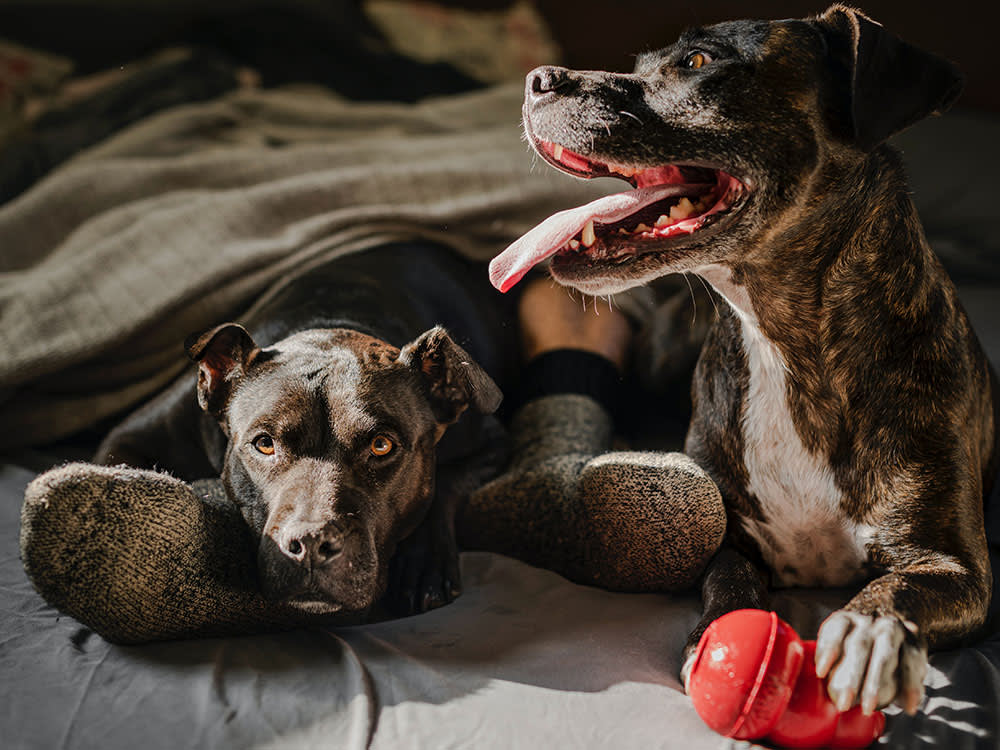
Somewhere along the way, “a tired dog is a good dog” became the whole philosophy of dog care. Walk them until they collapse, throw the ball until their tongue drags, and a calm evening is your reward. It works, sort of. But exhaustion is not the same thing as contentment, and a dog who is only ever run into the ground is missing most of what actually makes a dog’s life feel like a dog’s life.
That is the real point of enrichment, and it is bigger than a puzzle toy. Enrichment means arranging your dog’s day so they get to do the things a dog is wired to do — sniff, forage, chew, chase, solve, and choose. Physical tiredness is a side effect of doing it well. It is not the target.
What enrichment actually means
Most definitions sell it short. You will hear that enrichment is “toys and games to keep dogs busy,” which makes it sound like a boredom cure. The better framing comes from behaviorists who study animals in zoos, shelters, and living rooms alike: enrichment is about recreating, as best we can, the conditions an animal would encounter in the wild, so it can act on its own instincts in healthy ways.
For a dog, those instincts are not mysterious. Dogs are built to use their noses, to work for food instead of finding it in a bowl, to chew, to dig, to problem-solve, to play socially, and to rest deeply afterward. A life with none of those outlets is understimulated, and understimulation is where most “bad” behavior actually begins. The dog who shreds the couch, barks at nothing, and paces the hallway is usually not spiteful. They are a bored, capable animal with a job description and no job.
When an owner tells me their dog is ‘hyper’ or ‘destructive,’ my first question is never about exercise. It’s about outlets. A dog who has run five miles but never once used their nose or worked for a meal is physically tired and mentally starving. Fix the second thing and the first problem often shrinks on its own.
Start with the nose, because that’s where the payoff is
If you only add one category of enrichment, make it scent. A dog experiences the world primarily through smell, and letting them use that sense is both deeply satisfying and genuinely tiring in a way running rarely is.
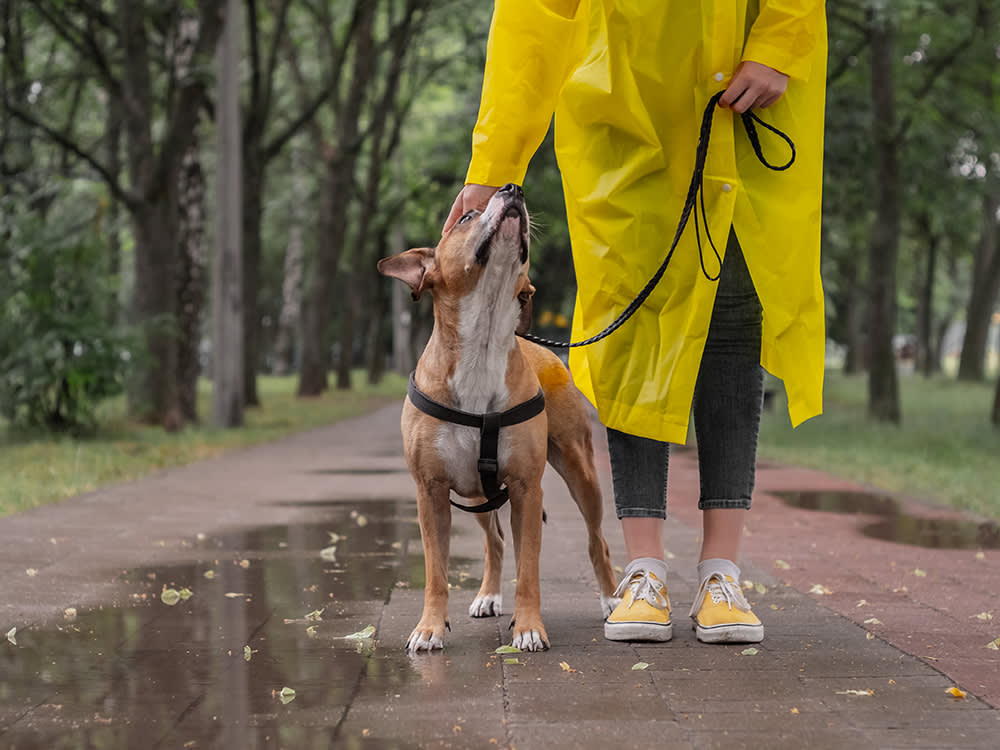
The simplest version costs nothing: on your next walk, stop steering. Let your dog set the pace and follow their nose from mailbox to fence post to tree, lingering as long as they want. Trainers sometimes call this a “sniffari,” and it flips the usual dynamic where the walk is about your route and your mile count. For twenty minutes, the dog is in charge of where the interesting information is.
At home, you can hide a portion of their kibble around a room and let them hunt it down, scatter treats into a snuffle mat, or teach the beginnings of formal scent work, where a dog learns to find a specific hidden odor. Scenting taxes the brain hard. A dog who has spent fifteen focused minutes searching is often more settled than one who did a long, brisk march.
Make them work for food
Dogs did not evolve to have dinner appear, fully solved, in a stainless bowl. Making them earn some of it is one of the easiest wins in the whole enrichment toolkit.
A stuffed rubber Kong is the classic: pack the hollow center with kibble and something sticky like dog-safe peanut butter, freeze it, and you have turned a two-minute meal into a half-hour project. Treat-dispensing toys and puzzle feeders do the same with a problem-solving twist, releasing food a piece at a time as the dog nudges, paws, and figures out the mechanism. The chewing and licking involved are calming in themselves, releasing the feel-good chemistry that leaves a dog happy and pleasantly worn out. Rotate a few of these so the challenge stays novel rather than routine.
Let the predator play
A lot of what we call “play” is really predatory behavior with the volume turned down to a safe, fun level, and dogs need it.
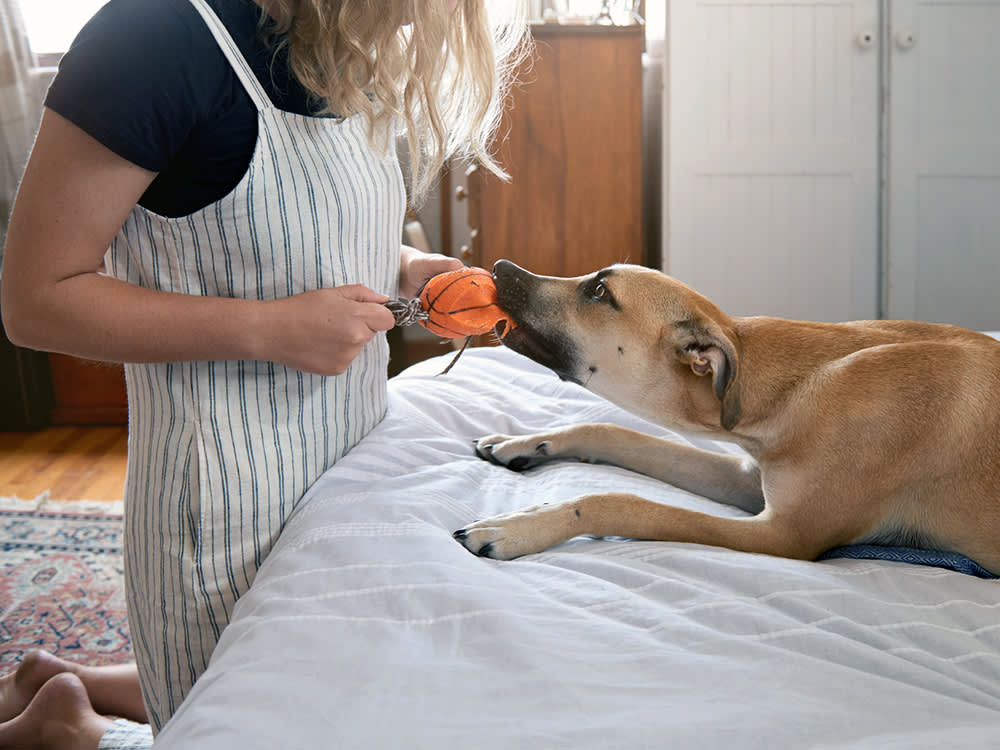
Tug is not the aggression-builder it is rumored to be. Done with rules — a clear “take it” and “drop it,” and a game that stops if teeth find skin — it is fantastic exercise and a lesson in impulse control and cooperation all at once.
Fetch scratches the chase-and-retrieve itch, though for some dogs the retrieve half has to be taught rather than assumed. Flirt poles, lure coursing, and a good chase-and-wrestle session with a well-matched dog friend all tap the same wiring. The common thread is that the dog gets to run a whole instinctive sequence — spot, stalk, chase, grab — instead of just burning calories.
Give the brain a real problem
Dogs are problem-solvers, and a mind that never gets a puzzle looks for its own, usually in your trash can.
Trick training is enrichment disguised as showing off. Teaching a spin, a “go to bed,” or a chin rest gives a dog focused mental work and builds confidence, and it costs nothing but a handful of treats and ten minutes. Training games that switch quickly between excitement and self-control keep a dog thinking on their feet. And for dogs who crave a bigger job, dog sports deliver: agility suits nearly any dog regardless of size or age and combines body and brain, while herding or treibball (herding a set of large exercise balls into a goal) gives working breeds a legitimate outlet for the urge to move things around.
Don’t forget chewing, digging, and rest
Some of the most important enrichment looks like the “problem” behaviors owners try to stamp out. Dogs have a real need to chew and, for many, to dig. The goal is not to eliminate those urges but to give them a legal address: a rotation of appropriate chews, or a sanctioned digging box in the yard filled with sand and buried toys, channels the instinct instead of fighting it.
And rest counts too. A dog with a quiet, safe place to retreat — a covered crate, a bed in a low-traffic corner — is a dog who can actually decompress in a busy household. Deep sleep is not the absence of enrichment. It is what a well-enriched day makes possible.
The tips that make it all work
A few principles separate real enrichment from a bin of ignored toys.
It is individual. Every dog has their own tastes. A terrier may be obsessed with a squeaky, high-drive chase game while an older hound wants nothing more than a long, slow sniff. Watch what your specific dog leans into and give them more of that, rather than forcing a menu that suits the internet’s idea of a dog.
Choice is the secret ingredient. Enrichment is not only about activities; it is about letting a dog have some say. Which way to turn on the walk, whether to approach a stranger or hang back, what to sniff and for how long — these small choices give a dog a sense of control over their world, and control is a powerful buffer against stress, frustration, and anxiety.
Variety beats intensity. Not every dog needs a two-hour hike. Some thrive on short, gentle bouts of activity spread through the day; a mix of a sniff walk, a food puzzle, and five minutes of trick training will do more for most dogs than one grueling session. Think of it as a rotating menu, not a single daily grind.
Enough, not unlimited. Channeling instincts is the goal, not indulging them without limit. A dog who digs up the entire garden or barks for hours is not being enriched; they may be distressed. The aim is enjoyable, appropriate outlets, offered on purpose.
What newer research adds
There is now real science behind the idea that sniffing does a dog good. A well-known 2019 study by researchers Charlotte Duranton and Alexandra Horowitz found that dogs given more chances to use their noses — allowed to nose-work rather than heel — became measurably more “optimistic” on a standard behavior test, a sign of a better underlying mood. In plain terms, letting a dog sniff appears to make them feel better about the world, not just tire them out.
More recent work on canine scent work and welfare points the same direction: structured nose activities are being studied as a low-cost way to lower stress and build confidence in anxious and shelter dogs. None of this asks you to buy anything special. It mostly asks you to slow down on the walk and let your dog be the expert for a while.
The takeaway
Enrichment is not a product you purchase or a box you check after the walk. It is a shift in how you think about your dog’s day — from “how do I wear them out?” to “did they get to be a dog today?” Answer that second question well, most days, and the tired, content dog on the couch takes care of itself.
References
- Bender, A., & Strong, E. Canine Enrichment for the Real World. Dogwise Publishing.
- Duranton, C., & Horowitz, A. (2019). Let me sniff! Nosework induces positive judgment bias in pet dogs. Applied Animal Behaviour Science, 211, 61–66. https://doi.org/10.1016/j.applanim.2018.12.009
- American Veterinary Society of Animal Behavior. Position statements on enrichment and welfare. https://avsab.org/resources/position-statements/
Dr. Chen is a small-animal veterinarian who leads health and safety coverage at The Pet Times. She writes and reviews the bulk of our illness, condition, and safety content, translating clinical guidance into clear, practical advice owners can act on at home.
Meet our experts ↗Keep reading
 TrainingMost Dog-Park Advice Is Half True. These Are the Signals That Actually MatterDr. Nina Kohl · 10 min
 TrainingTug-of-War Won't Make Your Dog Aggressive. Playing It Wrong Might.Dr. Nina Kohl · 9 min
 TrainingYou Can't Force a Dog Friendship. But 6 Things Stack the DeckDr. Ravi Mehta · 5 min
 TrainingMore Dogs Isn't More Chaos, If You Know What Actually Starts the FightsDr. Mara Chen · 7 min
 TrainingYour Dog Isn't Being Difficult on Walks. They're One of These 4 Types.Dr. Nina Kohl · 5 min
 TrainingYour Dog Doesn't Miss You the Way You Think. It's Better.Dr. Nina Kohl · 6 min