


The Play Bow Is Your Dog Saying 'I'm Only Joking'
Front legs down, rump in the air, tail going: it looks like a stretch, but the bow is one of the most sophisticated things your dog says all day. It's punctuation, and it can also, rarely, be a medical red flag.

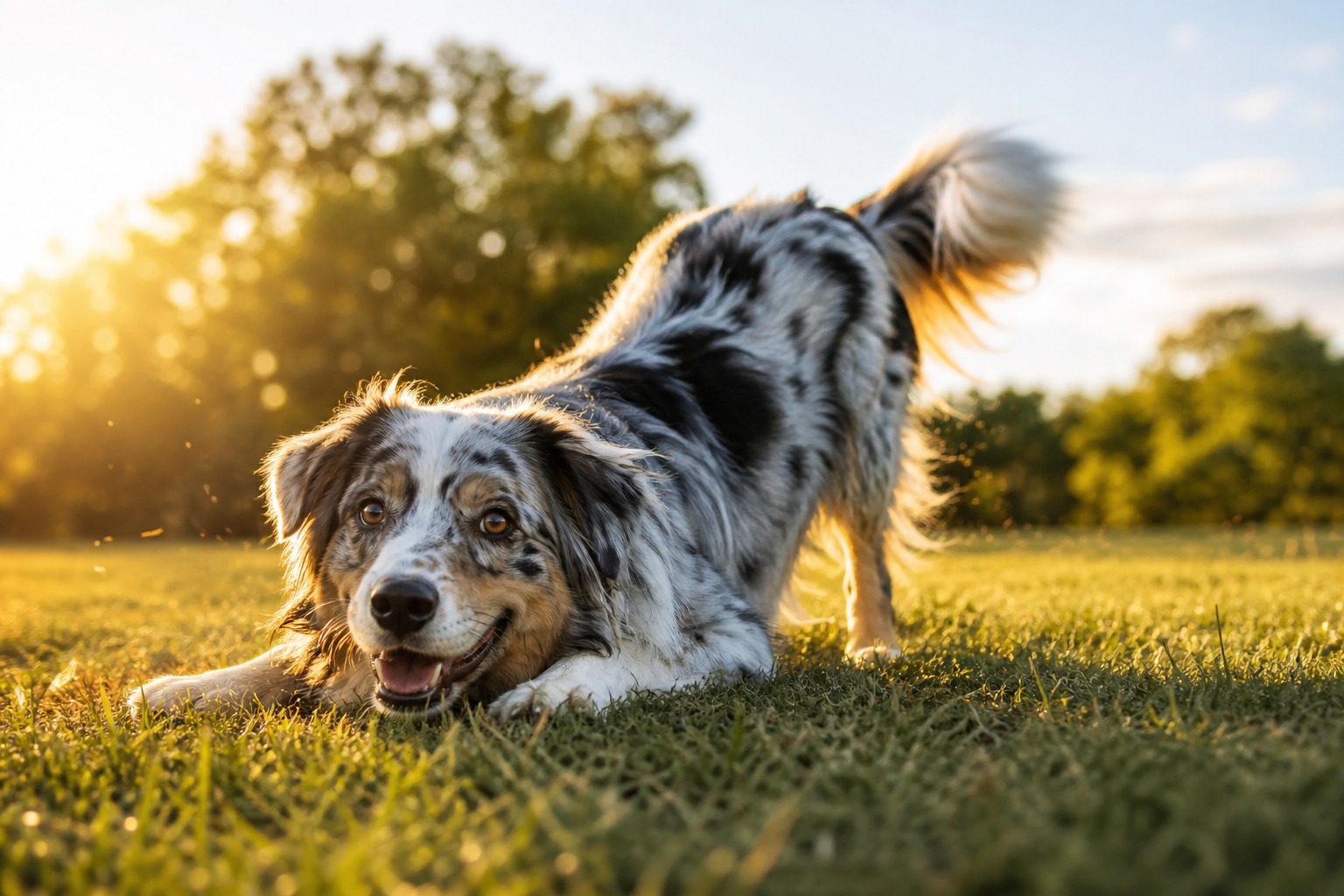
Your dog drops their chest to the floor, leaves their back end up, tail whipping, eyes locked on you, and waits. It reads like a yoga pose, and people wave it off as a cute stretch. That undersells what’s actually happening. The play bow is one of the clearest, most deliberate signals in a dog’s whole vocabulary, and the reason it matters is that dogs use it as punctuation: a way of framing everything that comes next as “this is a game, not a fight.” Understanding that one idea changes how you read your dog, and, in rare cases, tips you off that something is wrong.
Bow versus stretch: they really are different
People aren’t wrong that dogs stretch, and that a wake-up stretch can look bow-adjacent, the “greeting stretch” a dog does after their fourth nap of the day is a slow, loose loosening of the muscles. But a true bow has intention behind it. It’s dynamic, often quick and springy, and it’s aimed at someone. The tell is energy and direction: a stretch is a dog talking to their own stiff body, a bow is a dog talking to you. Slouching on the couch versus bouncing on your toes.
The reasons your dog bows
The original and most common meaning is a genuine invitation, but the same shape shows up in a few other contexts. Here are six.
1. The play bow. This is the classic: “Let’s go.” Your dog throws it at people and other dogs to kick off fetch, chase, tug, or a zoomie session. It’s the canine version of “wanna hang out?” Dogs who bow readily tend to be good social communicators, because the bow is how they negotiate play with others.
2. A metacommunication reset. This is the part most explanations skip, and it’s the most interesting. Ethologists who study dog play have shown the bow does double duty: dogs use it to start play and to repair it mid-game. After a bite lands too hard or a tackle gets too rough, a dog will often bow again, in effect saying “sorry, still just playing, don’t take that seriously.” It’s a signal about other signals, which is a genuinely advanced piece of social wiring, and it’s why well-socialized dogs can wrestle like maniacs without it tipping into a real fight.
3. Deference. Sometimes a bow is a soft, low-key show of trust and peaceful intent, subdued, with gentle eyes and a relaxed tail. Your dog is acknowledging you and signaling they feel safe.
4. Mimicry. Dogs are keen imitators, especially when copying you earns a smile or a scratch. A dog who bows while you stretch or work out may simply be joining in, whether or not they understand why you’re doing lunges in the living room.
5. A greeting. Come home after a long day and the bow can be part of the welcome parade, tail going, panting grin, happy bounce. They’re genuinely delighted you exist.
6. Pain or discomfort. Not every bow is joyful, and this is the one to take seriously. A dog may hold a bow-like posture to stretch out a hurting abdomen, a stance sometimes called the “prayer position.” It can point to bloating, digestive pain, or another problem, and in some cases, like bloat, it’s an emergency. The difference is energy and duration: a pain bow is held, flat, and joyless, with none of the wag-and-spring of a play invite.
How to read it, and how to respond
Your move depends entirely on the body language wrapped around the bow.
When it’s playful, take the invitation. Grab a toy, get down on their level, play fetch or tug or chase. Meeting a play bow builds your bond and burns off the physical and mental energy your dog is asking to spend.
When it’s deferent, answer with calm reassurance, a gentle hand and a soft voice, so they know they’re safe.
When it’s mimicry, reward the effort with a smile, eye contact, and a little affection.
When it’s a greeting, lean into it. Your dog lives for the moment you walk in, so make the hello count.
When it looks like pain, stop and pay attention. If the bow is unusual, held, repeated, or paired with lethargy, whining, a distended or hard belly, unproductive retching, or restlessness, call your veterinarian, and don’t wait if you suspect bloat.
The play bow is the closest thing dogs have to air quotes. It’s how they tell a friend ‘the growling and the chomping you’re about to see are all in good fun.’ The flip side is that a bow with none of that bounce, one your dog keeps sinking into with a tense body, is a posture I want to see, because a dog stretching a painful belly can be telling you their afternoon just became an emergency.
What newer research adds
The idea that a bow is more than an invitation comes out of decades of play research. When behavioral scientists slowed down footage of dogs and their wild relatives at play, they found bows clustered at very particular moments: right before play starts, and right after something risky, like a hard bite or a role reversal where the “winner” suddenly plays the loser. That timing is the giveaway. The bow isn’t random punctuation, it’s a dog actively managing the honesty of the game, reassuring a partner that aggressive-looking moves aren’t real aggression. So the next time your dog bows and then body-slams another dog, you’re not watching chaos. You’re watching two animals who agreed on the rules first.
The bottom line
A happy bow, bright eyes, wagging tail, springy body, is about as clear a love letter as your dog can write: come play, I trust you, I’m thrilled you’re here. Learn to separate it from the rare, joyless, held version that signals pain, and you’ll not only respond to your dog better, you’ll catch the one kind of bow that needs a vet instead of a tug toy.
References
- Bekoff, Marc. “Play Signals as Punctuation: The Structure of Social Play in Canids.” Behaviour, vol. 132, no. 5–6, 1995, pp. 419–429. https://doi.org/10.1163/156853995X00649
- Byosiere, Sarah-Elizabeth, et al. “Investigating the Function of Play Bows in Adult Pet Dogs.” Behavioural Processes, vol. 125, 2016, pp. 106–113. https://doi.org/10.1016/j.beproc.2016.02.007
- American Kennel Club. “Understanding Dog Body Language.” akc.org. Accessed July 2026.
- American College of Veterinary Surgeons. “Gastric Dilatation-Volvulus (Bloat).” acvs.org. Accessed July 2026.
Common questions
Why does my dog bow when I walk toward them?
Most often it's an invitation to play or a burst of excitement, especially if it comes with a wagging tail, bright eyes, and a bouncy body. Read the rest of the body language to be sure it's the happy version and not a tense, rigid posture.
What does it mean when a dog bows their head to you?
A lowered head can signal deference, affection, or a bid for attention like a scratch. As always, the surrounding body language and the situation tell you which one you're getting.
How do I know if a bow means my dog is in pain?
A pain-related bow looks different from a play bow: it's held longer, the energy is flat rather than bouncy, and there's no wagging or play face. If your dog repeatedly drops into a bow with no playful follow-through, especially with lethargy, whining, a hard belly, or retching, treat it as a possible medical emergency and call your vet.
Dr. Nair is a veterinarian focused on diet and feeding. She covers everyday nutrition, treats, and the many "can they eat this?" questions owners ask, grounding each answer in what is actually safe and sensible for dogs and cats.
Meet our experts ↗Keep reading
 TrainingYour Dog Doesn't Hate Intact Dogs. He Hates Being Surprised.Dr. Lena Park · 6 min
 TrainingNo, Your Dog Isn't Trying to Soothe Your Crying BabyDr. Lena Park · 4 min
 Health & Wellness'Is My Dog Depressed?' Skips the Question That Matters MoreDr. Amara Solis · 7 min
 TrainingRead the Human First: How to Greet a Dog You've Never MetMarcus Webb · 9 min
 TrainingEvery Dog Trainer Says They're 'Humane.' Here's How to Read Past ItDr. Amara Solis · 5 min
 TrainingYour Dog Can Smell You From a Block AwayDr. Ravi Mehta · 6 min