


Read the Human First: How to Greet a Dog You've Never Met
The trick to meeting a strange dog safely isn't reading the dog. It's reading the person holding the leash, asking the right question, and running a simple consent test before you ever reach out.

The instinct is almost impossible to fight. You spot a dog trotting down the sidewalk, ears up, tongue out, and your whole body leans toward it. Your voice climbs an octave. Your hand drifts out, fingers already curling into a phantom scratch behind the ear. If you love dogs and do not have one of your own, this happens to you several times a day, and resisting it can feel like fighting gravity.
Here is the reframe that keeps everyone safe and makes the encounter better: the most important read you make has nothing to do with the dog. It is the human on the other end of the leash. The dog cannot tell you whether it has a bite history, whether it is mid-training, whether it was adopted last week and is terrified of strangers, or whether it is recovering from surgery. The person can. Get good at reading the human first, and the dog part mostly takes care of itself.
That is the opposite of how most people approach it. They lock eyes with the dog, beeline straight in, and treat the owner as an afterthought, if they acknowledge them at all. It is also why so many of these moments go sideways. A dog that looks friendly from ten feet can react very differently up close, and you have no way to predict it from the outside.
Why the human is your only reliable source
Dogs are individuals with histories you cannot see. The single biggest mistake confident dog lovers make is assuming their own experience transfers to a stranger’s animal.
The first line of defense around any dog is the person attached to it. Assume you know nothing about this particular dog, because you don’t. The expert standing right there is the owner, and even they will tell you the dog is going to do what the dog is going to do, not what anybody wants it to do.
So before you interact at all, look at the person. Do they meet your eye? When you smile, do they smile back? Someone scowling, scrolling their phone, wearing earbuds, or visibly hurrying is telling you to keep walking, and you should, no matter how much the dog seems to want to say hi. Communication does not have to be verbal. A lot of it is just paying attention.
Ask a better question than “Can I pet your dog?”
Once you have the person’s attention, the words you choose matter more than people realize.
“Most people ask, ‘Can I pet your dog?’” Webb says. “The question that actually gets you useful information is, ‘Is your dog going to be okay if I approach?’ Because the honest answer might be, ‘You can come closer, but please don’t reach for her.’ That distinction protects you and the dog, and the only person on Earth who can give it to you is the one holding the leash.”
Then comes the part people skip: wait for the answer. A startling number of strangers ask permission while already crouching and reaching, which is not really asking. Stop your feet and your hands until you hear a real yes.
And if the answer is no, let it go. Reactive dogs, dogs in training, dogs whose owners are simply in a hurry, all of them are legitimate. “I genuinely don’t mind people asking,” one longtime reactive-dog owner told us, “as long as they respect the no.” No explanation is owed, and asking for one puts the owner on the defensive.
The approach itself: slow, sideways, and low
Say you get the green light. The way you move now is everything.
Go slowly. Some dogs need a beat to warm up to a new person, and a fast, direct approach is exactly what tips a nervous dog over the edge. Plenty of perfectly sweet dogs have snapped at someone who rushed in without warning. Speed reads as pressure.
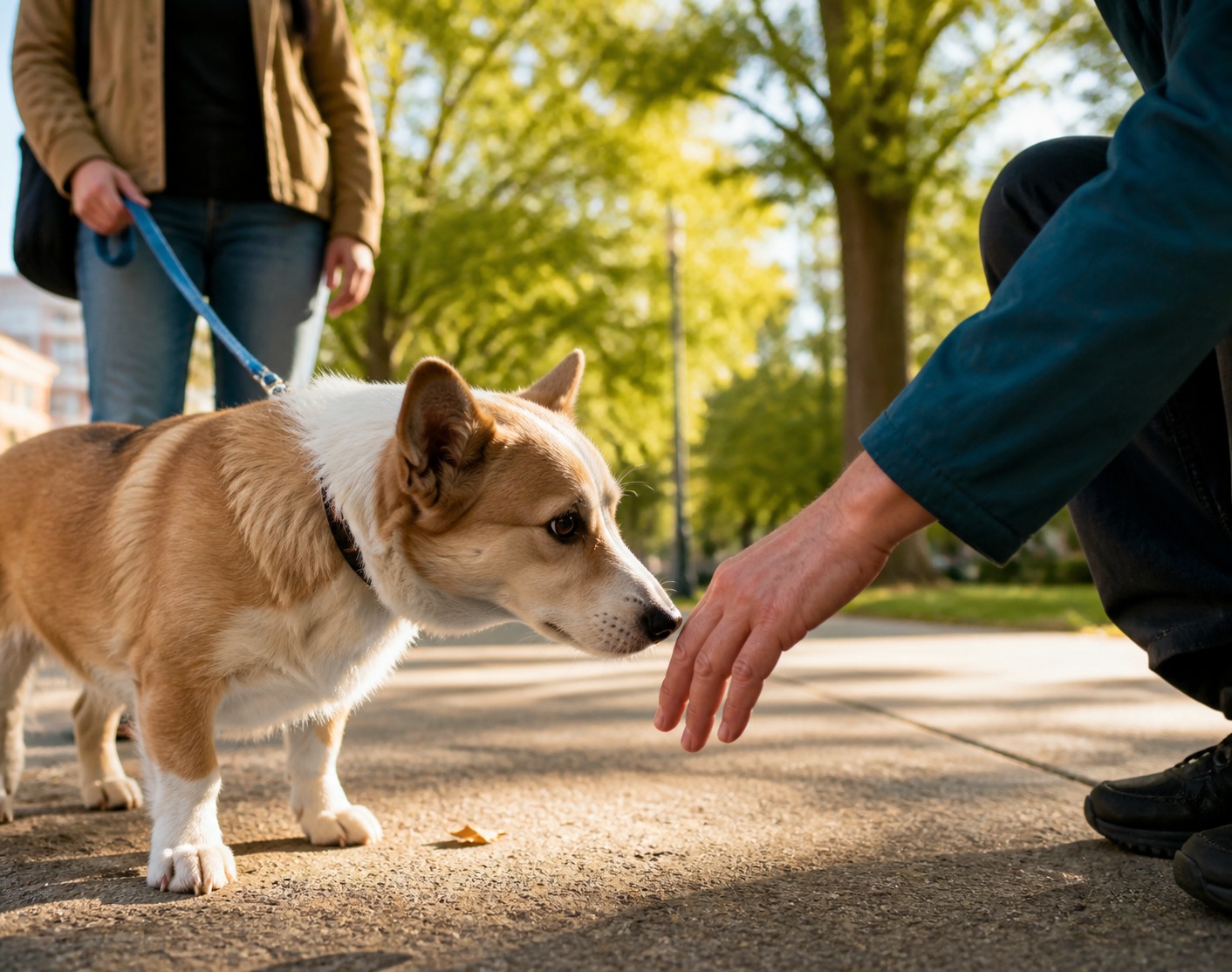
Approach from the side rather than head-on. Walking straight at a dog, shoulders square, eyes locked, is confrontational body language in their world. Angling your body and your gaze off to the side is the canine equivalent of a relaxed hello.
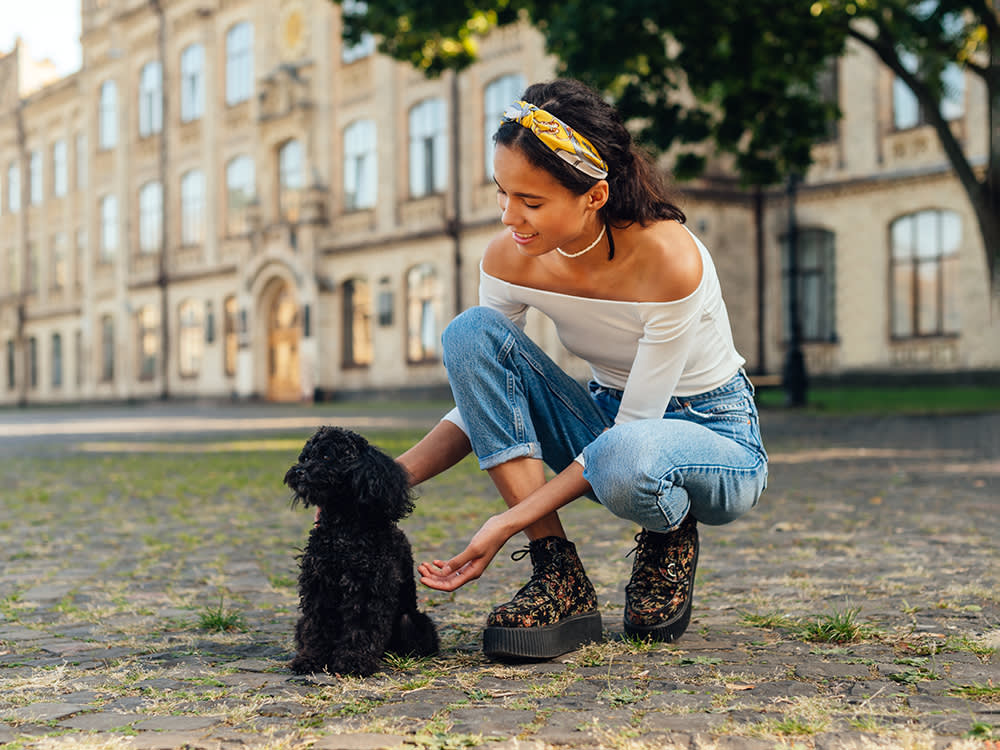
When you get there, crouch, do not bend over. “Looming over a dog stresses them out,” Webb says. “We are enormous compared to them, and anything coming down from above their head is more threatening than something at their level. Getting low also hands them control. They can back away from you. Lean over the top of them and they’ve got nowhere to go.”
Stay out of the dog’s face even once you are down at their level. Let them close the last bit of distance themselves. Offer the side of your hand, held low and still, and let them choose to sniff. They may want to investigate more than your hand, which is normal. Reading the world through scent is how dogs gather information about everything, including you.
The three-second consent test
Here is the single most useful technique in this whole piece, and one the source of most “the dog seemed fine and then bit me” stories never bother with. Petting is not a one-time yes. It is an ongoing question you keep re-asking.
Pet the dog gently for about three seconds, then stop and take your hand back. Watch what the dog does. If they lean into you, nudge your hand, or step closer, that is an enthusiastic “keep going.” If they turn their head away, go still, lick their lips, or drift off, that is a polite “I’m done,” and you honor it. Trainers call this a consent test, and it works because it gives the dog a vote at every step instead of just at the start.
This matters because the early seconds of an interaction are when a dog is most tolerant. “Three seconds is often plenty before a dog gets overwhelmed,” Webb says. “When in doubt, keep it short.” Overstaying your welcome is how a tolerable greeting curdles into a stressful one.
The body-language signals that mean stop
Even if the owner swears the dog is friendly, trust what the dog’s body is telling you in the moment. Dogs are constantly broadcasting their comfort level, and the signals are easy to learn once you know to look:
- Stiffening or freezing in place
- A hard, fixed stare, or the opposite, pointedly looking away
- “Whale eye,” where you can see the whites at the corners
- Yawning or lip-licking when there is no food or sleepiness to explain it
- Suddenly stopping to scratch or sniff the ground (a stress displacement)
- Growling or barking
Any of these means back off, and growling in particular is a gift, not a threat. It is the dog warning you clearly instead of skipping straight to a snap. Punishing or ignoring it teaches the dog that warnings do not work, which is how you create a dog that bites without notice.
Don’ts that trip up even experienced dog people
A few hard rules separate the welcome stranger from the one who causes a scene:
Don’t lead with “I grew up with dogs.” Your résumé is irrelevant to this dog. One owner described a stranger marching toward her clearly nervous dogs while announcing, “I have six dogs, so I have experience,” right up until one of the dogs slipped its collar. Experience with other dogs is not permission with this one.
Don’t give the dog cues. You do not know its training, and “sit” from a stranger can undercut whatever the owner is working on. Most pet parents also find it presumptuous. If the dog’s behavior bothers you, just walk away.
Don’t approach an off-leash or unattended dog at all. “A loose dog is missing that first line of defense, its person,” Webb says. “Even a friendly-looking one. Be too cautious rather than not cautious enough, especially around kids or older adults.”
Don’t hand over treats without asking. The dog may have allergies, a prescription diet, or a weight plan, and the owner may have their own treats they would rather you use. Ask first, every time.
If you’re the one holding the leash
The same logic runs in reverse. If you do not want strangers approaching your dog, especially a reactive or recently adopted one, you do not have to rely on reading every passerby. Signal it. A harness, leash sleeve, or bandana reading “Do Not Pet,” “Nervous,” or “In Training” heads off most unwanted interactions before they start, and the international “yellow ribbon” on a leash has become a quiet, growing shorthand for “give us space.” You are not doing it for the humans. You are doing it for your dog.
Even if you welcome strangers, check in with your dog first, and skip the obedience performance. “Don’t make your dog sit or do tricks to meet someone new,” Webb says. “If they are a polished obedience dog, fine. But asking for control in the presence of an exciting stranger usually just piles on stress and confusion.” Let the greeting unfold on the dog’s terms. Carry treats and offer them to friendly strangers so the dog builds a positive association, and use those moments to reinforce calm behavior in real time.
The throughline, whichever end of the leash you are on, is humility. Dog lovers: do not expect every dog to want you. Dog parents: do not try to script every encounter. The dog sets the terms. Your only job is to read the room, ask the right question, and let a three-second test tell you the rest.
References
- Morrill, Kathleen, et al. “Ancestry-Inclusive Dog Genomics Challenges Popular Breed Stereotypes.” Science, vol. 376, no. 6592, 29 April 2022. https://www.science.org/doi/10.1126/science.abk0639
- “Position Statement on Canine Body Language and Bite Prevention.” American Veterinary Society of Animal Behavior. https://avsab.org/resources/position-statements/
- “Dog Bite Prevention.” American Veterinary Medical Association. https://www.avma.org/resources-tools/pet-owners/dog-bite-prevention
Marcus Webb writes about the gear, gadgets, and everyday choices that make life with a pet easier. His coverage runs from product picks to training and the causes worth paying attention to, always with an eye on what actually earns a place in your home.
Meet our experts ↗Keep reading
 TrainingYour Dog Pictures the Ball When You Say 'Ball.' There's Now Proof.Dr. Ravi Mehta · 5 min
 TrainingYour Dog Doesn't Love the Word. It Loves the Promise.Dr. Nina Kohl · 7 min
 TrainingTeaching Your Dog 'Shake' Does Something Bigger Than You ThinkDr. Mara Chen · 5 min
 TrainingNo Dog Is "Untrainable." Some People Just Quit.Dr. Nina Kohl · 8 min
 TrainingYour Dog Already Knows Your Name. This Game Makes Them Prove It.Dr. Mara Chen · 6 min
 TrainingNever Introduce Two Dogs Face-to-FaceDr. Mara Chen · 7 min