


Your Dog Pictures the Ball When You Say 'Ball.' There's Now Proof.
Brain-wave recordings show dogs don't just react to a familiar word, they call up a mental image of the actual object. What that means for how you talk to your dog.

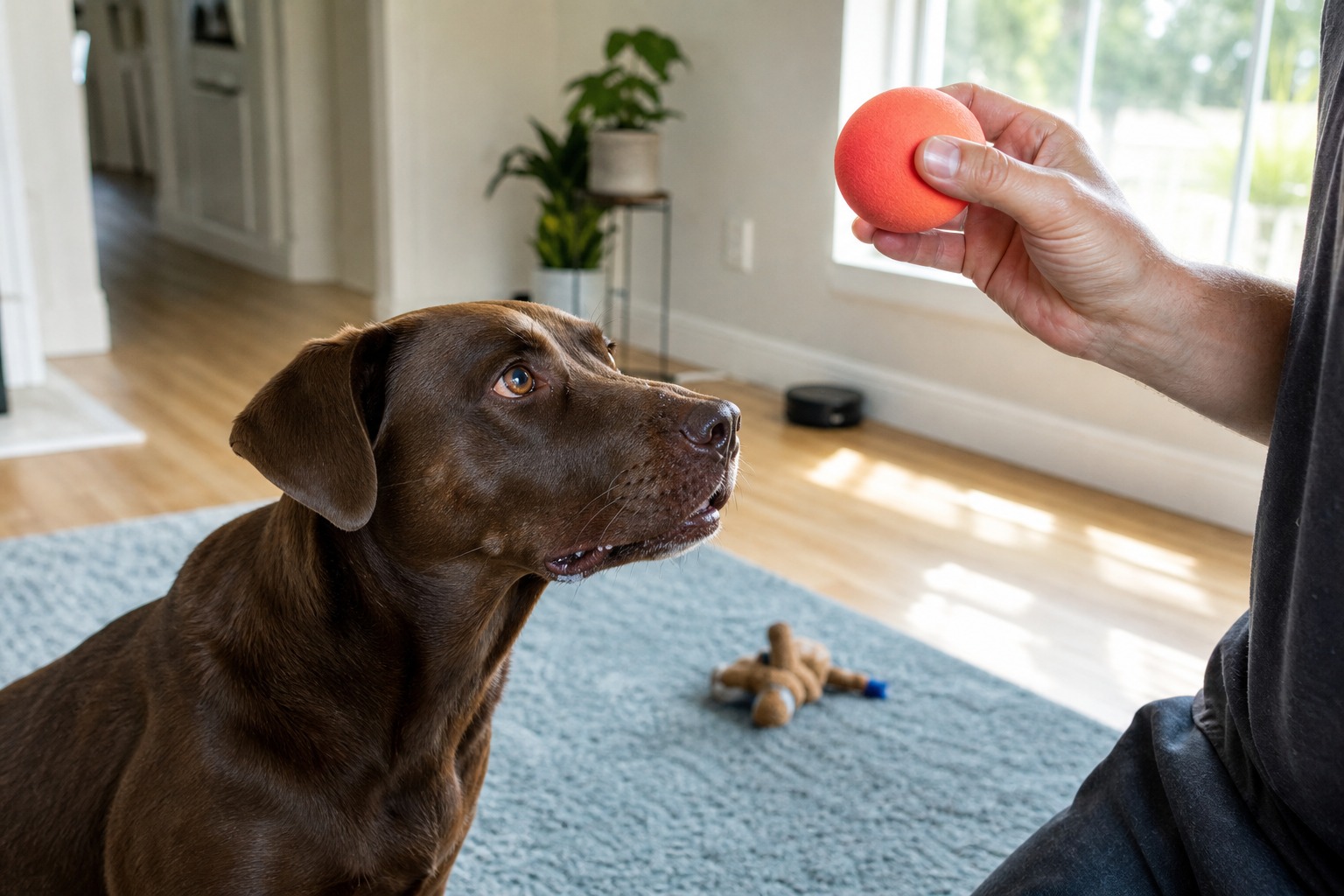
Say “get your ball” and your dog trots off and comes back with the ball. Impressive, sure, but skeptics have a ready deflation: the dog isn’t understanding the word “ball,” it’s just running a trained routine, the way it sits for a sound that means treat. A study in the journal Current Biology from 2024 finally pushed past that objection, and the answer is better than most owners hoped. When your dog hears a word it knows, it appears to conjure a picture of the specific thing that word names.
How you prove a dog is thinking, not just reacting
The trick was to measure the brain, not the behavior. Researchers at Eötvös Loránd University in Hungary fitted 18 pet dogs with a non-invasive EEG cap, the same harmless kind of electrode setup used on people, and recorded their brain activity while their owners held up familiar objects.
The clever part was the mismatch. An owner would sometimes name the object correctly, holding up a leash and saying “leash,” and sometimes name it wrong, holding up a ball while saying “leash.” When the word and the object clashed, the dogs’ brains produced a distinct spike of extra activity, a signal that the animal had expected one thing and gotten another.
That pattern is telling because it mirrors what human brains do when a word doesn’t match reality. It means the dog wasn’t just recognizing a sound; it had already summoned a mental representation of the named object and noticed when the object in front of it didn’t line up.
The finding that surprised even the researchers
Going in, the team assumed only “gifted word learner” dogs, the rare ones who know the names of dozens of toys, would show this effect. They were wrong. Dogs who knew only a handful of object words produced the same mismatch signal as dogs with big vocabularies. Lead researcher Marianna Boros framed the upshot plainly in the university’s announcement: understanding a word this way seems to be a general capacity of the species, not a talent reserved for a few canine prodigies.
The headline isn’t that some dogs are geniuses. It’s that the average dog on the average couch is doing more with your words than we gave it credit for. When you name something, a memory of that object is lighting up in there.
Why your dog still ‘fails’ at fetch, then
If dogs understand object words, why does yours sometimes stare at you blankly when you ask for the alien-shaped squeaky toy? The study offers a genuinely useful distinction: understanding a word and understanding the task are two different jobs. Your dog may know exactly which object “alien toy” refers to and still not connect that to what you want done with it, or simply get distracted halfway across the room. A blown fetch isn’t proof they didn’t understand you. Sometimes it’s proof they did, and chose otherwise.
Talk to your dog like the words land
The practical takeaway is small and free: name things, out loud, consistently.
- Use the same word for the same object. If it’s “ball,” keep it “ball,” not “toy,” then “ballie,” then “that thing.” Consistency is what lets the mental image form.
- Name objects during play, not just commands. Say the word as your dog interacts with the item they already love. The research team specifically encouraged owners of toy-obsessed dogs to name those toys often.
- Separate the noun from the job. Teach “ball” as a thing first; teach “bring it” as an action second. Blurring them is where a lot of “my dog is being stubborn” moments actually come from.
What newer research adds
The EEG study is part of a wider 2024 wave from the same Hungarian lab probing how dogs build expectations between spoken words and objects, and the findings keep reinforcing each other: dogs form semantic expectations, not just conditioned reflexes. None of this makes your dog a fluent English speaker. What it does is retire the lazy assumption that a dog responding to “ball” is a furry vending machine. There’s a mind in there matching your words to the world, and it works whether your dog knows five words or fifty.
References
- Neural evidence for referential understanding of object words in dogs — Current Biology, 2024
- Dogs build semantic expectations between spoken words and objects — Current Biology, 2024
- Your dog understands that some words “stand for” objects — Eötvös Loránd University announcement
Dr. Mehta is a board-certified veterinary nutritionist who evaluates pet food formulations, ingredient quality, and the science behind dietary trends. He writes and reviews all nutrition content at The Pet Times, including our food rankings and feeding guides.
Meet our experts ↗Keep reading
 Training'Gentle Parenting' Your Dog Isn't Permissive. That's the Part People Get Wrong.Dr. Nina Kohl · 9 min
 TrainingNever Introduce Two Dogs Face-to-FaceDr. Mara Chen · 7 min
 TrainingTeaching Your Dog 'Shake' Does Something Bigger Than You ThinkDr. Mara Chen · 5 min
 TrainingTreats Teach the Trick. Meaning the 'Good Boy' Is What Makes It Stick.Dr. Ravi Mehta · 4 min
 TrainingYour Dog Is Listening to Your Tone, Not Your WordsSasha Ford · 6 min
 TrainingYour Dog Isn't Stubborn. Your House Has Six Sets of Rules.Dr. Priya Nair · 7 min