


Treats Teach the Trick. Meaning the 'Good Boy' Is What Makes It Stick.
A 2024 study wired up sleeping dogs and found that praise and petting, not just snacks, lower stress and help them remember what they learned. Your enthusiasm is a training tool.

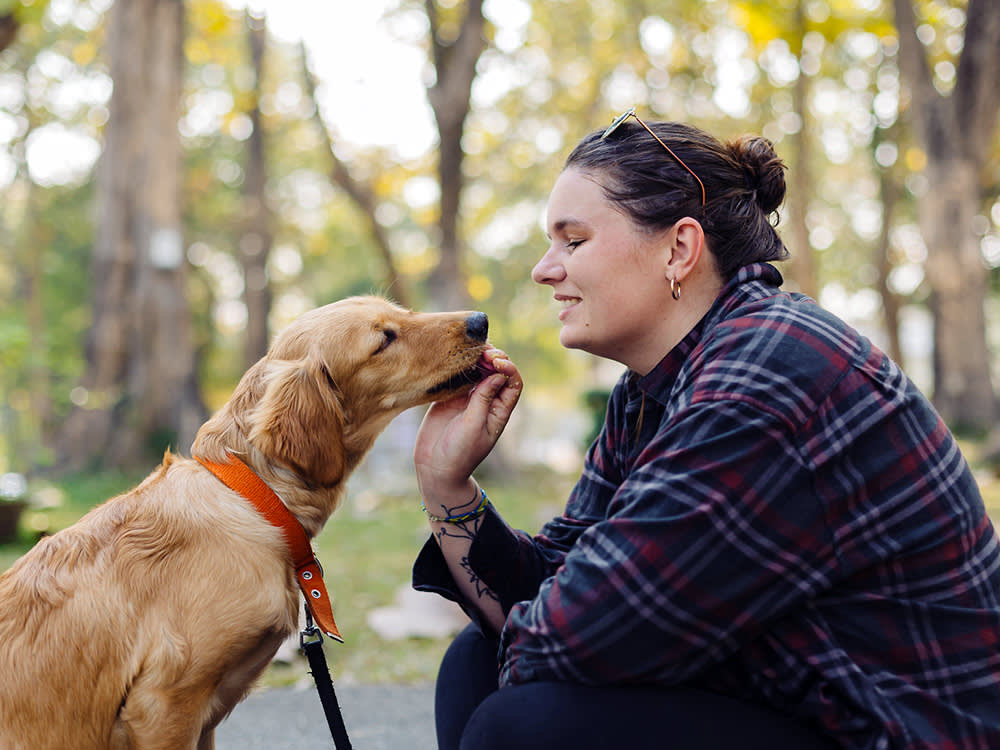
You already know treats work. Hand over a piece of chicken at the right moment and your dog files away exactly what earned it. But if you treat the snack as the entire toolkit, you are leaving your most powerful training instrument in the drawer, and it costs nothing. It is you: your voice, your hands, and whether you actually seem happy.
A 2024 study published in Scientific Reports put that idea under real scientific scrutiny, complete with brain scans on napping dogs, and the finding is worth pinning to the fridge. Dogs who got praise and petting alongside their treats learned better and were noticeably less stressed than dogs who got treats plus the occasional mild correction. The reward in your pocket teaches the behavior. The warmth on your face helps it stick.
The experiment, briefly
The researchers, led by Vivien Reicher, taught dogs new cue words for tricks the dogs already knew. To keep things fair, they used English cues rather than the Hungarian their owners actually spoke, so no dog had a head start. Then each dog was trained two different ways.
In the “permissive” sessions, a dog who got it right received the full package: praise, physical affection, and a treat. In the “controlling” sessions, a correct response earned only a treat, with no praise or petting, and a wrong response earned a soft reprimand, a firm but non-threatening “No” or “Not good.”
After each session, the dogs napped in a lab while wearing EEG sensors that let researchers watch their brains consolidate the memory. Then the dogs were retested to see what had actually stuck.
What the sleeping brains revealed
The controlling method left a mark, and not a good one. Dogs trained that way showed more stress and slept more afterward, a classic sign of an overtaxed nervous system. The scolded dogs, in particular, displayed a telltale stress behavior: they pressed closer to their owners, seeking reassurance. That matters because earlier research has consistently shown that stress drags down a dog’s ability to learn in the first place.
There was one genuinely surprising wrinkle. Across the board, dogs performed better in whichever session came first, an “order effect” the researchers link to a well-documented memory pattern in which information learned first tends to be easier to recall. But dogs who started with a controlling session and then moved to a permissive one showed a bigger jump in performance after sleeping. The likely reason is charming: those dogs got a warmer, kinder session than they had been braced for, and that pleasant surprise seems to have supercharged their learning.
Why the “positive surprise” finding is the useful one
That last result is the one to hold onto if your dog is struggling. It suggests that when a dog expects a tense, corrective vibe and instead gets encouragement, the gap between expectation and reality works in your favor. Warmth is not just pleasant. When it arrives as a relief, it appears to help the brain lock in what was learned.
Reicher’s team concluded that positive reinforcement plays a central role in both how well dogs perform and how well they feel while performing, and called for more research into exactly how praise shapes memory. The headline for owners, though, is already clear: you do not have to perform the stern, stoic trainer. Piling on the affection is not soft. It is effective.
I tell clients to stop rationing their enthusiasm. A dog who feels safe is a dog who can think, and a stressed dog is mostly just trying to make the discomfort stop. When you pair the treat with a genuine, delighted ‘good dog’ and a scratch they actually like, you’re not spoiling the lesson. You’re telling the nervous system it’s safe to keep trying, and that’s where real learning lives.
Putting it to work
None of this means throwing out treats; they remain one of the clearest signals you can give. It means stacking your warmth on top of them. Mark the moment your dog gets it right with a bright, sincere tone, and follow it with the specific kind of contact your dog enjoys, whether that is a chest rub or a scratch behind the ears, not a pat on the head they merely tolerate. Keep sessions short and end on a win, so the last thing your dog associates with training is success and affection rather than fatigue.
And if a dog has been shutting down or slow to progress, this research offers a hopeful reframe: try dialing the pressure down and the encouragement up, and give the change a few sessions. The dog who was braced for a fight may just surprise you back.
References
- Reicher, V., et al. “Potential Interactive Effect of Positive Expectancy Violation and Sleep on Memory Consolidation in Dogs.” Scientific Reports, 2024. nature.com
- Eötvös Loránd University. “Study Shows Rewarding Dogs with Praise and Petting Helps Them Learn More Efficiently.” phys.org
- China, L., Mills, D. S., & Cooper, J. J. “Efficacy of Dog Training With and Without Remote Electronic Collars.” Frontiers in Veterinary Science, 2020. frontiersin.org
Dr. Mehta is a board-certified veterinary nutritionist who evaluates pet food formulations, ingredient quality, and the science behind dietary trends. He writes and reviews all nutrition content at The Pet Times, including our food rankings and feeding guides.
Meet our experts ↗Keep reading
 TrainingTeaching Your Dog to 'Talk' With Buttons, Without Fooling YourselfDr. Nina Kohl · 8 min
 First DaysThe Only Puppy in the Litter Missed a Class. It Shows Up Years Later as a Bite.Dr. Nina Kohl · 9 min
 TrainingThat Embarrassing Baby Voice? Your Dog Is Begging You to Keep Doing It.Dr. Amara Solis · 5 min
 TrainingYour Dog Doesn't Love the Word. It Loves the Promise.Dr. Nina Kohl · 7 min
 TrainingThe Wagging Tail Lie: Why Reading One Dog Signal Gets People BittenTom Hadley · 8 min
 TrainingYour Dog Isn't Blowing You Off. Six Cues Are Just Broken.Jordan Ellis · 7 min