


Teaching Your Dog to 'Talk' With Buttons, Without Fooling Yourself
Soundboard buttons can genuinely open a channel between you and your dog. Here is how to start, the mistakes that stall people, and what the science says your dog is really doing.

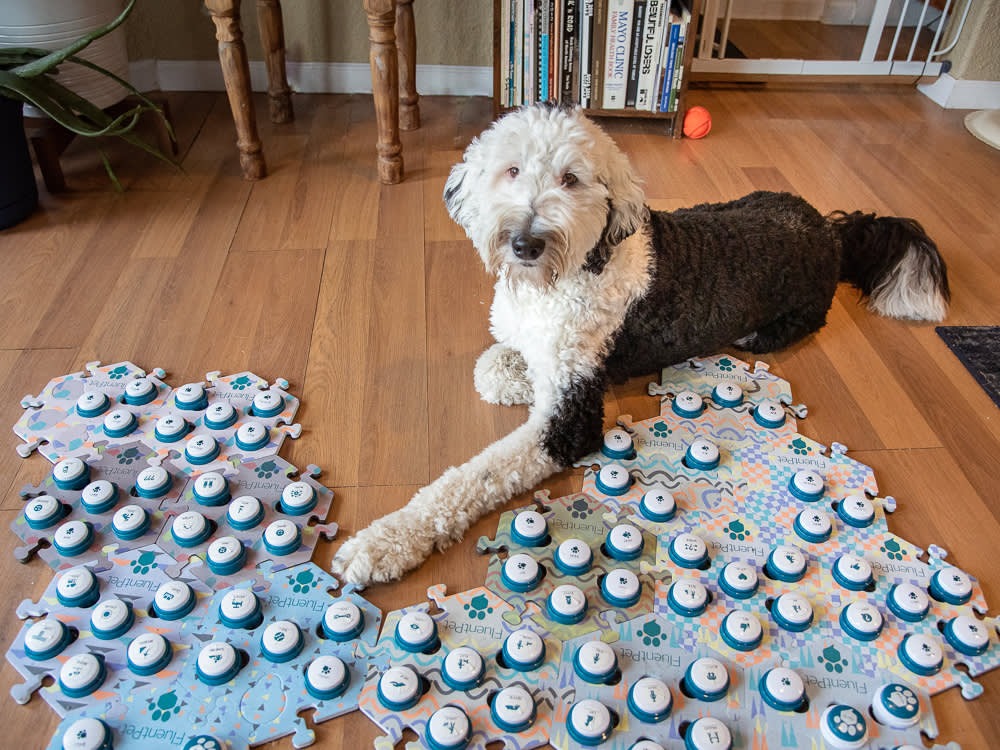
During the lockdown years, a lot of us discovered exactly how much our dogs had going on behind the eyes, mostly because we finally had time to watch. Out of that came one of the more ambitious pet projects going: teaching dogs to press recordable buttons to “talk.” Bunny the Sheepadoodle turned it into a global phenomenon, pressing buttons to complain about baths, flag an “ouch” in her ear, and ask genuinely odd questions about whether her new sibling was a dog or a human.
Your dog will probably not become Bunny. That is fine. You can still open a real line of communication, and the point of this guide is to help you do it without falling for the two traps that catch most beginners: expecting fluency overnight, and convincing yourself your dog understands more than it does. Both will steer you wrong. Done honestly, though, button training is a legitimately rewarding way to understand your dog better.
The mistake I see is people treating the buttons like a magic decoder ring. The value is not that your dog is suddenly speaking English. It is that you are forced to slow down, be consistent, and pay close attention to what your dog actually wants. That attention is the real gift, and it works whether the dog presses two buttons or twenty.
What these buttons even are
Communication buttons are a form of augmentative interspecies communication device, which is a technical way of saying they let humans and animals share a channel. They are built to help dogs, and cats, signal wants, needs, and feelings, and sometimes to ask about their world. The buttons are recordable, so you set them in your own voice with anything from a plain “outside” to a warm “love you.” The dog learns to link a button, and the word it plays, to a specific result, which is what lets them “speak” to you.
How to actually start
The best beginning is small. Choose one to three words your dog already hears constantly, put them on a mat so the buttons stay put and are easy to press, and build from there. Here is the method that works, broken down.
Use positive reinforcement, carefully. Praise your dog when they press a button, but be cautious with treats. If a treat follows every press, your dog can decide the button means “snack dispenser” rather than a way to communicate a need. Reward the act, but let the real-world outcome be the payoff.
Model the words yourself. In the early going, press the button at the exact moment its meaning applies. Pick up a toy, press “play.” Head for the door, press “outside.” Skip a rigid daily “lesson” and instead use the words live, whenever they naturally fit. Context is the teacher.
Respond when your dog investigates. At first your dog has no idea what any of it means, so react any time they press or even sniff around a button. If they nudge “outside” without fully pressing it, press it for them, open the door, and let them out. You are showing them the button has power.
Grow the vocabulary slowly. Patience is the whole game. Watch how your individual dog learns. Once they clearly grasp that pressing a button makes a specific thing happen, new words come easier. Add ones that map to different parts of daily life, so the board becomes genuinely useful rather than decorative.
Troubleshoot the over-presser. You are allowed to say “no” when a button gets hammered on repeat, and you are allowed to turn down what it asks for. But remember they need to see results to learn at all. A word that pays off only sometimes gets devalued, and the dog may quit using it. Many trainers suggest being generous early, because an eager over-user is far easier to shape down to “just right” than a discouraged dog is to restart.
What to know before you buy a kit
Good starter sets usually include a mat to anchor the buttons. Some come with common words pre-recorded, like “outside” or “play,” while others let you record your own. Begin with one to three buttons tied to words your dog hears a lot, then expand as they demonstrate understanding. Two of the most established starter systems are the Hunger for Words kit and the FluentPet kit; both are widely used entry points, and they let you scale up over time. (See the note below on where to buy.)
The honest part: what is your dog really doing?
This is where you protect yourself from wishful thinking. Yes, the buttons are more than a viral party trick, and a soundboard really can help you read your dog and give your dog a way to flag what it wants. But your dog is not Bunny, and even a dog who uses buttons well may not mean exactly what you think.
Consider the classic case. Say you train a dog to hit a button right before every bathroom trip, and it is tempting to conclude you have taught them to report a full bladder. What they have more likely worked out is that hitting the button gets the door opened for them. If your dog loves going out, they may press it whether their bladder is involved or not. That is not failure; it is just what the dog actually learned, and keeping that distinction in mind makes you a better, clearer trainer.
Every dog also learns at its own pace, shaped by age, breed, and temperament, so somebody else’s viral progress may look nothing like yours. Start with the simplest, clearest associations, giving a Kong, playing tug, even petting, where one button maps cleanly to one thing. Get those working and useful first. Only then move to more complicated ideas, and stay curious about whether the fancier associations really mean what you hope they do.
What newer research adds
For years the strongest objection to talking dogs was the “Clever Hans” problem: maybe the dogs were just reading their owners’ body language and unconscious cues, not the words. In August 2024, a study led by cognitive scientist Federico Rossano’s lab at UC San Diego and published in PLOS ONE tested exactly that. Soundboard-trained dogs heard words like “outside,” “play,” and “food” and gave appropriate responses, such as heading to the door for “outside,” regardless of who pressed the button, including when it was pressed out of sight. That result is hard to square with dogs simply cueing off a person’s posture.
The same group has follow-up work looking at which buttons dogs press most on their own, and whether the sequences dogs string together are random or not. The early answer on sequences is that they are not random, which is a genuinely intriguing hint about what is going on in there. None of it proves your dog is composing sentences, and the researchers are careful about that. But it does suggest there is more signal in the button-pressing than the skeptics assumed, which is a good reason to try it, eyes open.
Whether your dog masters two buttons or fifty, the payoff is the same one Dr. Kohl points to: you end up watching your dog more closely, and understanding them a little better. That part always works.
A note on products
The Hunger for Words and FluentPet starter kits are sold primarily through their own brands rather than as tagged retail listings, so we have linked to the makers directly for now: FluentPet and Hunger for Words. We are working on affiliate options and will update these as they become available.
Dr. Kohl is a board-certified veterinary dentist with a particular interest in preventive oral care. She reviews all dental health content at The Pet Times and contributes practical guides on home dental routines, professional cleaning, and oral disease prevention.
Meet our experts ↗Keep reading
 TrainingThere Are 6 Dog-Parenting Styles. The Research Only Likes One.Dr. Mara Chen · 7 min
 TrainingYour Dog Doesn't Know Its Name. It Knows What the Name Predicts.Dr. Amara Solis · 6 min
 TrainingYour Dog Isn't Blowing You Off. Six Cues Are Just Broken.Jordan Ellis · 7 min
 Training'Gentle Parenting' Your Dog Isn't Permissive. That's the Part People Get Wrong.Dr. Nina Kohl · 9 min
 TrainingYour Dog Isn't Reading Your Face. They're Reading Your Hand on the Leash.Dr. Lena Park · 8 min
 TrainingEvery Dog Trainer Says They're 'Humane.' Here's How to Read Past ItDr. Amara Solis · 5 min