


Your Dog Isn't Reading Your Face. They're Reading Your Hand on the Leash.
Everyone knows dogs pick up on our moods. Almost nobody knows the main channel it travels down, and it isn't your expression. It's a six-foot piece of nylon, and you tighten it before you even know you're worried.

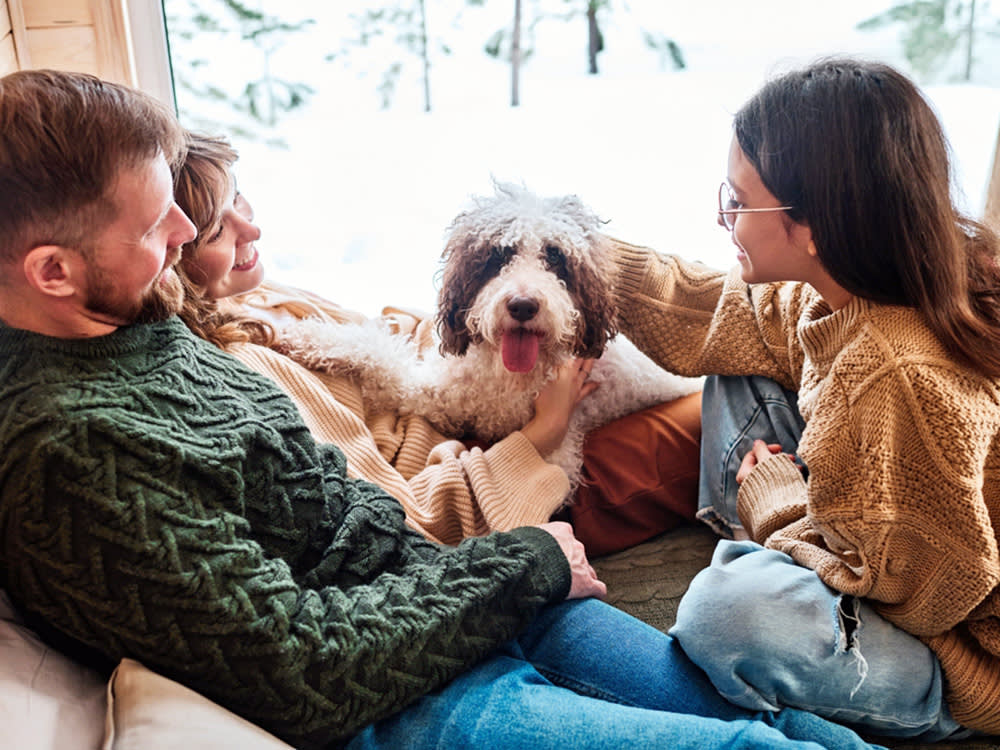
There is a party trick your dog performs constantly, and you almost certainly credit them for the wrong reason.
A stranger walks up on the sidewalk. Your dog does not immediately decide anything. They glance at the stranger, then they glance at you, then they decide.
That glance has a name. It is called social referencing, and it is the same thing a toddler does when they fall over, do not know yet whether it hurt, and look at their parent’s face to find out. Researchers have documented it thoroughly in human infants, who look to their caregivers to work out how to feel about an unfamiliar situation or object. We mostly grow out of it, and then keep doing a diluted version at parties for the rest of our lives: someone unfamiliar walks in, and you scan your friends’ faces to learn whether this is fine.
Dogs never grow out of it. They run it, all day, on you.
Which is charming right up until you understand the part almost nobody talks about: the primary channel this information travels down is not your face. It is your hand.
The leash is a wire, and you are transmitting
Dog behaviorist Paula O’Sullivan, who works specifically on how dogs and their people communicate, treats social referencing as foundational. Faced with something ambiguous, a dog consults somebody: their person, usually, though another dog will do. It is the same maneuver a child runs on a parent, and the dog performs it by reading our faces and our bodies.
But then she names the channel that undoes most people, and it is worth stopping on.
Tension, she says, is often transmitted along the leash. Something on the walk unsettles you, an oncoming dog, a cyclist, a stranger who makes you uneasy, and your hand responds before you do: the leash gets taken up, wrapped, gripped. That mechanical tightening runs the length of the line. And it lands on your dog as a message.
Now think about the order of events, because the order is what makes this so consequential.
You see the other dog. Your hand tightens. Then you consciously decide to look relaxed, arrange your face, and say “it’s fine, buddy” in a bright voice.
You are too late. The message went down the leash before your face got involved. Your dog has already been told, by the most direct physical channel available, that you have braced for something.
This is the mechanism behind a phenomenon every reactive-dog owner knows and cannot explain: the dog who gets worse precisely because you are trying so hard to prevent them from getting worse. Your vigilance is not invisible. It is being telegraphed, continuously, through a nylon strap connected to their neck.
People spend a fortune on training and then hand their dog a full anxiety report through their grip, twenty times a walk. If you want to know what your dog thinks is dangerous, do not watch your dog. Watch your own hand. It tightens before you know you are worried, and your dog reads it before you do.
The other channels: scent, tone, and the impossibility of lying
The leash is the one people miss. The rest are worth knowing because collectively they explain why you cannot fake this.
Scent. Dogs can detect the chemical changes that accompany our emotional states. O’Sullivan notes that they pick up shifts in cortisol when we are stressed. This is not folk wisdom; it is a documented finding, and it means your dog has a chemical readout of your stress hormones that operates entirely outside your control.
Voice. They register minute changes in volume, tone, and pitch, at a resolution far beyond what we consciously produce or intend. And they can match a facial expression to the corresponding tone of voice, which means they are cross-checking your channels against each other.
Body. Posture, tension, and the thousand small movements you do not know you are making.
Add it up and you arrive at a conclusion that is either beautiful or faintly alarming, depending on your mood. What O’Sullivan describes is emotional mirroring running across every available channel at once: expression, posture, tone, and scent, all read together. The upshot is a creature exquisitely calibrated to your internal state, including on the days you are convinced you have hidden it.
With another person, you can be upset and smile through it and largely get away with it. With your dog, you cannot. There is no version of the performance that works, because they are not only watching the channel you are performing on.
The practical consequence is not that you should feel guilty for having emotions. It is that reassurance has to be real to function. Saying calm words in a tight body does not transmit calm. It transmits a contradiction, and a dog resolving a contradiction between your voice and your grip will believe the grip.
It is also why losing your temper when a dog does something wrong is so much more costly than it feels. They are tracking every small shift in your mood and your voice. Staying genuinely calm is not a courtesy. It is the transmission.
Not every dog does this equally
Here is where the picture gets more useful and less universal, because the amount of referencing your dog does is not fixed.
Breed matters. Research indicates that some breeds look to their humans considerably more than others. Herding dogs, unsurprisingly given what they were built for, engage in a great deal of social referencing and behave less independently. Other breeds may barely do it at all.
That is a genuinely important corrective to the sentimental version of this idea. A dog who does not check in with you is not failing to love you. They may simply be a breed selected for centuries to make decisions without consulting anybody.
Sex matters. The same work found females consulting their people more frequently than males when deciding what to make of something unfamiliar.
Individual personality matters most of all. The Velcro dog, the one who cannot function three feet from you, will take your word for it on almost anything, and genuinely does need to watch your face before they know how to greet a stranger. The headstrong, self-employed dog will form their own view and did not ask for yours.
Knowing which dog you have changes what you should do. If you have a heavy referencer, your emotional state is doing an enormous amount of the work in every new situation, and you are, in effect, the primary training tool. If you have an independent operator, your calm matters less and your management matters more.
What newer research adds
Two developments sharpen the picture and both point the same way.
The scent channel has been tested directly, and it holds up. Researchers have collected sweat and breath samples from humans under stress and presented the odor to dogs who had never met those people. The dogs responded to the stress odor with more stressed, more pessimistic behavior in judgment-bias tasks. Read that carefully: this was the smell of a stranger’s stress, with no face, no voice, no leash, and no relationship, and it still moved the dogs’ emotional state.
Which means the emotional contagion is not merely a learned association with your particular scowl. There is a chemical layer underneath it.
Second, work on co-regulation has begun to show the effect running in both directions and over long timescales, with cortisol levels in dogs and their owners tracking each other over months, not moments. You are not just broadcasting to your dog in the instant. You are, to some degree, sharing a nervous system with them across seasons.
None of this should make you feel watched. It should make you feel useful, because the same finding that says you cannot hide your fear also says you have an extraordinarily direct instrument for delivering safety.
What social referencing really measures is how much of your dog’s world runs through you. They give us a great deal, and in exchange we serve as their interpreters: the ones who decide, on their behalf, what is dangerous, what is worth enjoying, and who deserves trust. Being handed that much authority over another creature’s reality is a privilege, and the rent on it is simple. Make them safe, and mean it.
Start with your hand. Loosen it.
References
- Merola, I., Prato-Previde, E., & Marshall-Pescini, S. “Social referencing in dog-owner dyads?” Animal Cognition, 2012. https://link.springer.com/article/10.1007/s10071-011-0443-0
- Merola, I. et al. “Dogs’ social referencing towards owners and strangers.” PLOS ONE, 2012. https://journals.plos.org/plosone/article?id=10.1371/journal.pone.0047653
- Parr-Cortes, Z. et al. “The odour of an unfamiliar stressed human affects dogs’ anxiety and cognitive bias.” Scientific Reports, 2024. https://www.nature.com/articles/s41598-024-66147-1
- Sundman, A.-S. et al. “Long-term stress levels are synchronized in dogs and their owners.” Scientific Reports, 2019. https://www.nature.com/articles/s41598-019-43851-x
- Albuquerque, N. et al. “Dogs recognize dog and human emotions.” Biology Letters, 2016. https://royalsocietypublishing.org/doi/10.1098/rsbl.2015.0883
- Feuerbacher, E. N., & Wynne, C. D. L. “Shut up and pet me! Domestic dogs prefer petting to vocal praise.” Behavioural Processes, 2015. https://www.sciencedirect.com/science/article/abs/pii/S0376635714002101
Dr. Park is a board-certified emergency and critical care specialist. She reviews our health and safety content for clinical accuracy and contributes guides on recognising urgent conditions. Her focus is helping owners act quickly and correctly when it matters most.
Meet our experts ↗Keep reading
 TrainingYour Dog Already Knows Your Name. This Game Makes Them Prove It.Dr. Mara Chen · 6 min
 Training5 Reasons Your Dog Follows You Into the Bathroom (One Is Worth Watching)Dr. Nina Kohl · 6 min
 TrainingYour Rescue Dog Isn't Being Difficult. They're Decompressing.Dr. Mara Chen · 8 min
 First DaysYour Puppy Isn't Regressing. They're in a Fear PeriodJordan Ellis · 8 min
 TrainingThe Puppy Mistake That Costs More Dogs Than Parvo DoesDr. Nina Kohl · 7 min
 TrainingYour Dog Doesn't Need a Muzzle. Train Them for One Anyway.Dr. Mara Chen · 7 min