


Teaching Your Dog 'Shake' Does Something Bigger Than You Think
The party trick is the least interesting part of trick training. What's really happening is that your dog is learning how to learn, and that skill leaks into everything else.

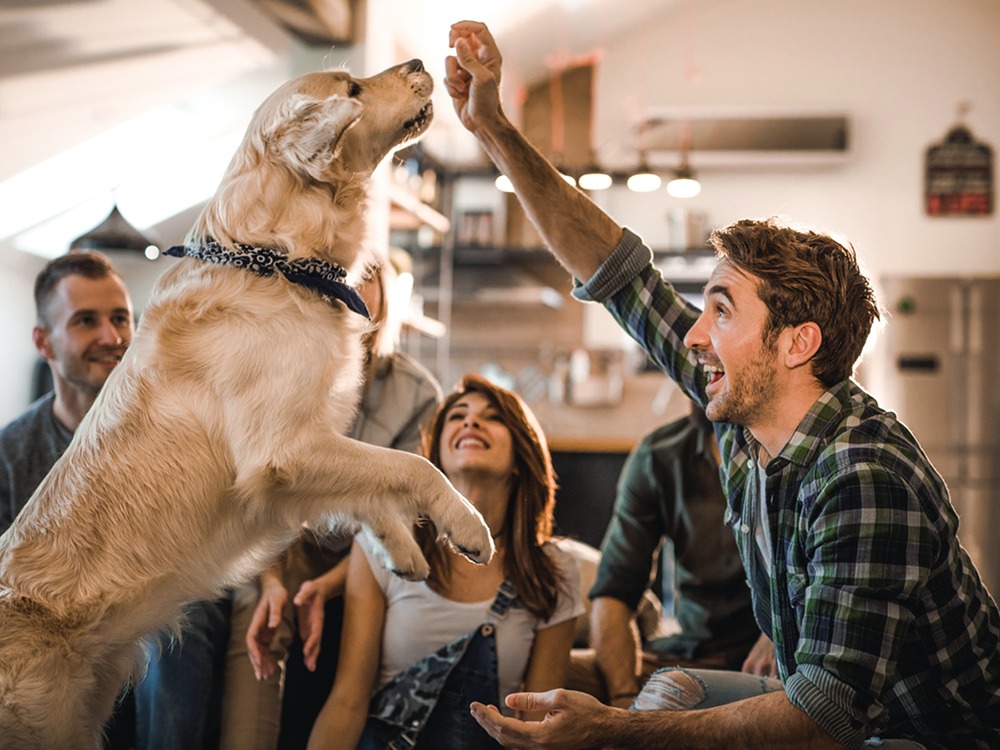
There is nothing wrong with a dog who can shake hands, and honestly, few things are more delightful than showing a friend that your dog will roll over on cue. But if you think trick training is about the trick, you’re watching the wrong thing. The high-five is the byproduct. The real event is invisible: your dog is learning how learning works, and that skill doesn’t stay in the trick. It shows up at the front door, on the leash, and in the vet’s waiting room.
What a “trick” is actually building
When a dog works out that a specific behavior makes a treat appear, they’re not just memorizing a party move. They’re discovering the whole game, that their own actions have consequences they can control, and that paying attention to you is how they crack the code. That realization, more than any single cue, is what makes a dog easier to live with.
The benefits stack up fast. Trick sessions burn physical energy and, more importantly, mental energy, which is the kind most under-exercised dogs are starving for. They reinforce the same focus and impulse control that basic obedience depends on. And because the whole thing runs on rewards and short, upbeat bursts, it strengthens the bond between you instead of straining it.
Owners come to me for a reactive dog or a jumper, and I often start with a silly trick, because a dog who has learned how to earn a reward is a dog you can actually communicate with. The trick is a Trojan horse. What you’re really installing is a learner.
The secret is to catch what your dog already does
Here’s the shortcut most people miss. The easiest tricks to teach are the ones your dog already performs on their own. Trainers call this capturing: instead of forcing a brand-new behavior, you reward one that comes naturally, so your dog offers it more often, and then you attach a cue.
Look at what your dog does without being asked. A dog who paws at things is halfway to a high-five, a wave, or a shake. A dog who tends to creep low when lying down is easy to shape into a crawl. A dog who flops onto their back with their legs in the air is already doing “belly up.” Pick a behavior that happens often, reward it every time it appears, and only then start saying the word you’ll use to request it. You can fine-tune the polish later; the point is to start with something your dog is practically volunteering.
Any age, any dog
Don’t count your dog out because they’re past puppyhood. Trick training suits every stage, and the “you can’t teach an old dog new tricks” line is exactly backwards, older dogs often focus better than puppies. Start with easy wins, a “sit,” a “down,” a “bow,” a “peekaboo”, and reward generously. Puppies can begin right away with tiny, five-minute sessions sprinkled through the day; a young dog worked patiently this way can rack up a startling repertoire, and the quiet, cooperative habit those sessions build tends to outlast any individual trick.
A first trick worth trying: the shell game
If you want a concrete place to start, the shell game is a crowd-pleaser that also teaches your dog to use their nose and think through a problem. You hide a treat under one of three identical pots, and your dog tells you which one. Use heavy clay flower pots with a hole in the base so the scent escapes and the pots don’t tip. The full step-by-step is in the how-to above; the short version is that you build it one pot at a time and keep it fun.
A couple of ground rules make it work. Be encouraging and skip the word “no,” which just deflates the game. Keep each session to a few reps, and always finish on a win, even if that means going back to a single pot so your dog gets to succeed and walk away proud.
What newer research adds
Trick training has quietly earned a place in the enrichment conversation, not just the cute-video one. The American Kennel Club now offers formal Trick Dog titles, from Novice up through Trick Dog Champion, which has given owners a structured ladder to climb and a reason to keep sessions going past “shake.” That structure matters more than a rosette: behavior and welfare researchers increasingly frame this kind of reward-based, choice-driven learning as cognitive enrichment, mental exercise that supports a dog’s wellbeing the way a walk supports their body. In practice, that means the ten minutes you spend teaching “spin” isn’t downtime from the real training. For a lot of dogs, it is the real training.
References
- American Kennel Club. AKC Trick Dog Program.
- American Veterinary Society of Animal Behavior. Position Statement on Humane Dog Training. 2021.
Dr. Chen is a small-animal veterinarian who leads health and safety coverage at The Pet Times. She writes and reviews the bulk of our illness, condition, and safety content, translating clinical guidance into clear, practical advice owners can act on at home.
Meet our experts ↗Keep reading
 TrainingThe Wagging Tail Lie: Why Reading One Dog Signal Gets People BittenTom Hadley · 8 min
 TrainingFreezing While Your Dog Dawdles? Stop Begging and Set the SceneJordan Ellis · 8 min
 Training'Gentle Parenting' Your Dog Isn't Permissive. That's the Part People Get Wrong.Dr. Nina Kohl · 9 min
 TrainingPointing at Your Dog Doesn't Work. Pointing and Staring Does.Jordan Ellis · 5 min
 TrainingStop Pushing Your Dog Down. Catch Them Doing It.Dr. Nina Kohl · 6 min
 TrainingExcited Isn't the Same as Happy. 8 Signs Your Dog Is Over Threshold.Dr. Nina Kohl · 8 min