


Pointing at Your Dog Doesn't Work. Pointing and Staring Does.
Scientists put eye-tracking headgear on dogs and found the single most reliable way to steer their attention to an object. It isn't the point. It isn't the gaze. It's the two together, and most of us only ever use half of it.
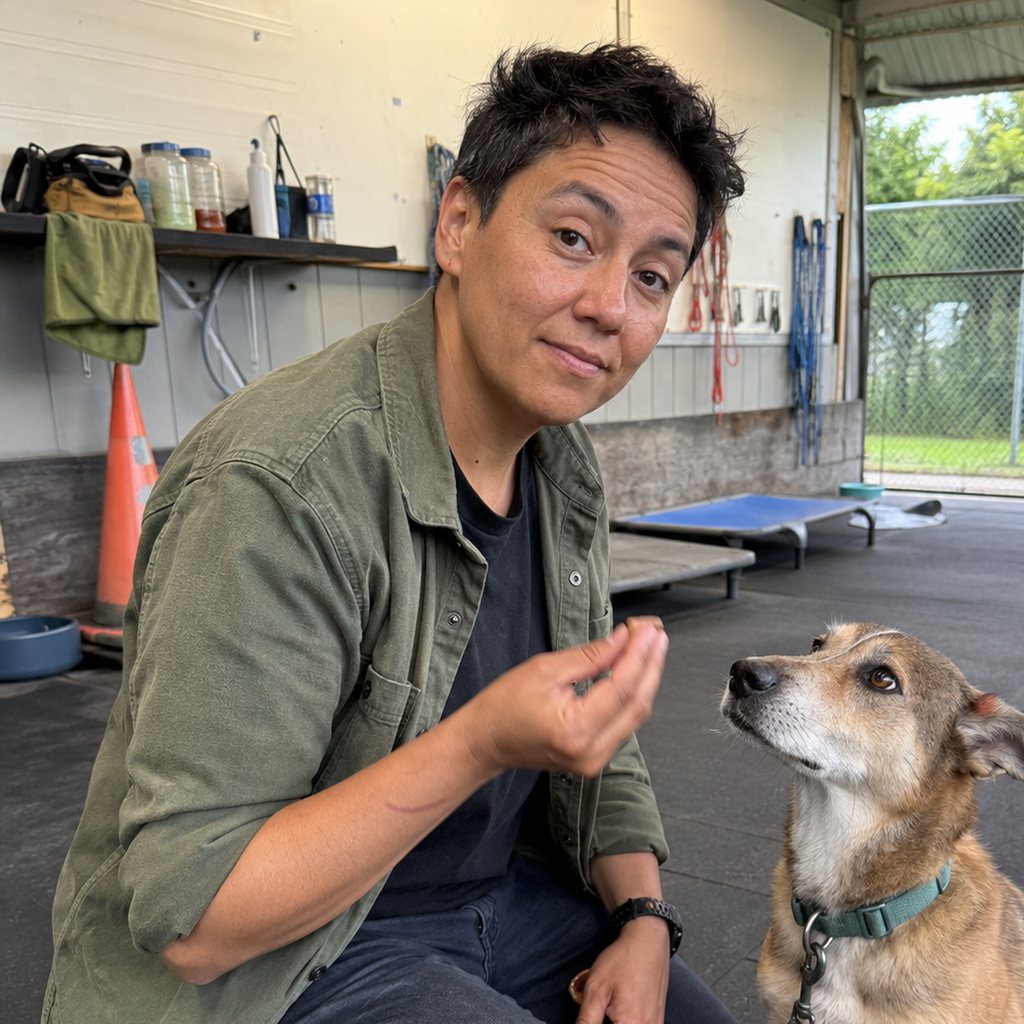

You know the standoff. Your dog is somewhere in the park, nose committed to a hedge, and you are pointing at the ball on the grass like a traffic cop, getting nothing back. You are not necessarily doing it wrong. You are, according to a clever piece of research, only doing half of it.
Scientists strapped tiny eye-tracking cameras onto dogs to watch, in real time, exactly where their gaze went when a person tried to direct them. The result is oddly specific and immediately useful: a point works far better when your eyes go where your finger goes. The combination of pointing and staring beat every other signal they tested. If you have been pointing while looking at your dog, waiting for them to follow your hand, you have been leaving the more powerful half of the cue on the table.
What the researchers actually did
The team, led by Christoph Völter and published in Proceedings of the Royal Society B in early 2025, fitted twenty dogs with head-mounted cameras that tracked precisely where each dog looked. An experimenter hid a treat in one of two bowls, knelt in front of the dog, and gave a signal. The dog’s owner handled them on a leash and then released them to choose a bowl.
The signals varied. Sometimes the experimenter pointed. Sometimes she looked at the correct bowl. Sometimes she faked throwing a ball toward it. And sometimes she pointed and stared at the same time. Whether the dog picked the right bowl changed dramatically depending on which signal they got.
The winning move: point and stare together
When the experimenter both pointed at and looked at the baited bowl, dogs performed best. The eye-tracking data showed why, in a satisfying step-by-step: the dogs shifted their gaze from the person’s face, to her pointing hand, and then to the correct bowl. The two cues chained together and delivered the dog’s attention right where it needed to go. Several dogs nailed the pointing-plus-gaze condition well above chance, and a few chose the correct bowl every single time.
The other signals were weaker on their own. A point by itself sent dogs looking toward the hand, but their gaze often did not travel onward to the bowl as reliably. A fake ball-throw pulled dogs to look in the right general direction, but they did not lock onto the bowl or choose it above chance. And plain gaze, without the hand, was similarly incomplete.
The researchers’ explanation is elegant: dogs have a hard time disengaging from your eye contact. When you look at them while pointing, your face keeps pulling their attention back to you instead of releasing it to the target. Point and look at the object together, and both cues push in the same direction, so they compound into something far more effective than either alone. It may even explain why earlier studies, testing these cues in isolation, kept getting muddy results.
This lines up perfectly with what good trainers already feel in their hands. Your dog is reading your whole body, not just your finger. When your eyes and your hand disagree, you have split the message. When they agree, you have doubled it. That is the entire trick.
How to actually use this
Turn the finding into a habit and you will spend less of your life being ignored.
Point and look at the same target. Do not point at the ball while making eye contact with your dog and waiting; send your own gaze to the ball so your eyes and hand tell one story.
Let them chain it. Give them a beat to travel the path the study dogs took, from your face, to your hand, to the object. The cue works by leading their eyes, so do not rush to repeat it.
Notice when you are undercutting yourself. If you find your dog fixating on your face instead of the thing you are indicating, that is the eye-contact trap. Break your gaze from theirs and put it firmly on the target.
What newer research adds
This study is part of a broader wave using wearable eye-tracking to move canine-cognition research out of artificial lab setups and into something closer to real interaction. For decades, scientists argued about how much dogs truly understand human pointing and gaze, and results were frustratingly inconsistent. The mobile eye-tracking approach helps explain the mess: the cues were often being tested one at a time, and it turns out dogs read them best in combination, exactly as they occur in normal life.
The practical upshot holds even if you never read a journal. Your dog is a whole-body communicator who is unusually tuned to human signals, and the clearest thing you can do is make your signals agree. Point where you are looking, look where you are pointing, and watch how much less often that hedge wins.
References
- Völter, Christoph J., et al. “Using Mobile Eye Tracking to Study Dogs’ Understanding of Human Referential Communication.” Proceedings of the Royal Society B, vol. 292, no. 2040, 2025. https://royalsocietypublishing.org/rspb/article/292/2040/20242765/104845/Using-mobile-eye-tracking-to-study-dogs
Jordan Ellis is a certified professional dog trainer with a decade of experience working with rescue organisations and private clients. They specialise in anxiety, reactivity, and positive reinforcement methods, and review all training and behaviour content at The Pet Times.
Meet our experts ↗Keep reading
 TrainingRead the Human First: How to Greet a Dog You've Never MetMarcus Webb · 9 min
 TrainingEvery Dog Trainer Says They're 'Humane.' Here's How to Read Past ItDr. Amara Solis · 5 min
 TrainingStop Steering. The Walk Is the One Thing Your Dog Should Get to Decide.Dr. Lena Park · 7 min
 TrainingThat Embarrassing Baby Voice? Your Dog Is Begging You to Keep Doing It.Dr. Amara Solis · 5 min
 TrainingAsking Your Dog for Consent Sounds Ridiculous. It Works Anyway.Dr. Ravi Mehta · 8 min
 TrainingTeaching Your Dog to 'Talk' With Buttons, Without Fooling YourselfDr. Nina Kohl · 8 min