


Asking Your Dog for Consent Sounds Ridiculous. It Works Anyway.
Not as a vibe. As a mechanic. There's a specific, teachable structure behind 'asking' a dog, trainers have a name for it, and it changes how your dog handles everything from the sofa to the vet's table.

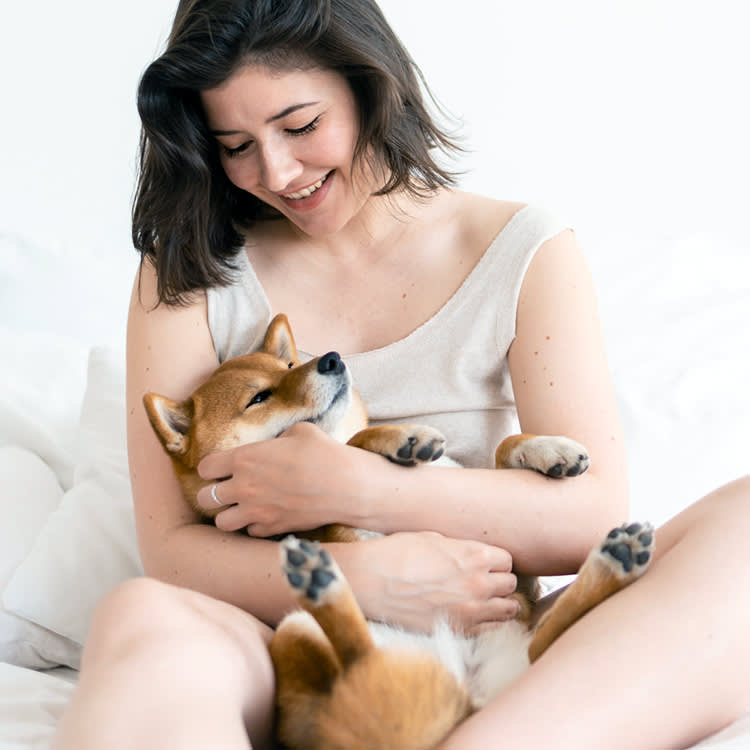
There is a version of this idea that deserves the eye-roll. The version where a person crouches in front of a Labrador and solemnly asks permission to touch him, receives no discernible answer, and pets him anyway. That’s not consent. That’s narration.
The version that works is not a vibe. It’s a mechanic, it has a name in professional training, and it produces measurable changes in how a dog handles being handled. Trainers call the core of it a start-button behavior: a specific, voluntary action the dog performs to say begin, and the absence of which means stop.
Once you see it that way, “asking your dog for consent” stops sounding like a TikTok affectation and starts sounding like what it is, which is a control the dog can actually reach.
Why the reaching is the problem
Most people already do half of this without realizing. They say something to the dog. But they say it while their hands are already moving in.
That single detail invalidates the whole exchange, because a dog cannot decline an interaction that has already started. What you get instead is a dog who tolerates, and tolerance is a much shakier foundation than it looks. Tolerance holds until the day it doesn’t, usually in front of a stranger’s kid, and then everyone is very surprised.
So the first change is small and slightly uncomfortable: say the word, and keep your hands where they are. Then wait. The three seconds you spend not reaching are the entire experiment.
Learning to read the answer
The reason people skip the waiting is that they don’t know what they’re waiting for. A dog’s “no” is quiet, and we’re trained by every other relationship in our lives to interpret quiet as agreement.
Here is the vocabulary, roughly in order of subtlety.
Yes looks like: moving toward you. Leaning into your hand. A body that goes softer rather than stiller. A wag that involves the whole back end, not just a metronome tail. Rolling over and presenting the belly, if that’s your dog’s thing. Pawing at your hand when you stop, which is about as unambiguous as a dog gets.
No, or not right now looks like: turning the head away. Turning the whole body away. A quick lick of the lips or the nose when nothing has been eaten. A yawn out of context. Shifting weight backwards onto the hind legs. Whale eye, the whites showing as the dog looks at you sideways without moving its head. Going still, which people almost universally misread as calm and which is very often the opposite. Staying tightly curled and not uncurling.
Escalation is what happens when the earlier signals are repeatedly ignored: a low grumble, a lifted lip, a growl. A growl is not a betrayal. It is a dog that has run out of quieter ways to say the thing, and punishing it teaches the dog to skip straight to the bite next time. Thank the growl. Then back off and work out what you missed.
The signals are almost never absent. They’re just below the threshold most people are watching at. By the time a dog growls, it has usually said no about six times already, politely, and been overruled every time.
The protocol, in full
-
One word, always the same one. “Pet?” is fine. “Cuddles?” is fine. What matters is that it predicts one specific thing and only that thing. In training terms it’s a predictor cue: you’re telling the dog what you’d like to happen next before it happens.
-
Ask from where you are. No leaning, no reaching, no looming. Loom is a pressure signal in its own right.
-
Give it three seconds. Dogs answer slower than we ask.
-
Honor the no, obviously and visibly. This is the load-bearing step. The cue means nothing until the dog discovers that the answer is real. Sit back. Take the hands away. Return to your book. Do it once and it’s a fluke; do it ten times and you have built something.
-
Pet in bursts, then re-check. Three to five seconds, then hands off. Watch. Re-engagement, a nudge, a paw, a shifted body pressing back into you, is a renewed yes. Nothing is a polite ending.
-
Expect to be surprised. The dogs who respond most dramatically to this are often the ones you’d least expect: the grumbly ones, the ones who’ve spent years being handled without being asked. Give a dog like that a reliable off switch and a surprising number of them start opting in.
The part everyone dodges: when a no isn’t an option
Fine, you back off the cuddle. But the nails have to be cut. The vaccine has to happen. The tick has to come out. Your dog gets a vote on your affection; your dog does not get a vote on rabies.
Pretending otherwise is where a lot of consent-based advice quietly falls apart, and the honest answer is better than the dodge. You cannot give the dog a veto over necessary care. You can give the dog a start button, and you can change how the procedure feels.
Cooperative care. Teach the dog a specific position that means “I’m ready”: a chin rest into your open palm, two front paws on a mat, a paw placed into your hand. Then, crucially, only work while the position is held, and stop instantly when it’s broken. The dog isn’t refusing the nail trim. The dog is controlling the pace of it. Most dogs, given that control, hold the position far longer than you’d expect, because the anxiety of a procedure is largely the anxiety of not being able to stop it.
Change the association, in tiny slices. This is what Fear Free-trained professionals do to a vaccine: some stroking, then a gentle pinch of the skin at the site, then a light tap with a fingernail, then the actual injection, each step paired with something excellent. Squeeze cheese. Peanut butter. A warm towel. It’s rapid desensitization and counterconditioning, compressed into a couple of minutes, and it is the difference between a dog who dreads the table and a dog who jumps onto it.
And practise it at home. Handle your dog’s paws, ears, and mouth for two seconds at a time, every day, paying every single one. When the real thing arrives you’ll be cashing a cheque you wrote months ago.
Emergencies, and the art of not winning the argument
Then there’s the third category: your dog has a chicken bone in its mouth on a Brooklyn sidewalk and you have about four seconds.
Do not grab. Grabbing teaches a dog that your approach means loss, which is the exact recipe for resource guarding, and it is how a mild bone problem turns into a dog who guards the sofa, the doorway, and eventually you.
Two things work.
Trade up, generously. Open the fridge. Get the deli meat, the cheese, the actual good stuff, not a biscuit. Throw it on the floor, several pieces, away from the dog. A dog that spits out a bone to chase a handful of ham has learned something extremely useful: that when a human approaches something valuable, more value arrives. Do this often enough, with things that don’t matter, and you build a dog who brings you the contraband.
Or change the subject entirely. Knock on the door. Ring the bell. Rattle the leash. Dogs are exquisitely interruptible, and an interruption is not a confrontation. You have not told your dog no. You have simply made something else more interesting, and while the dog is investigating the door, you pick up the bone.
Neither of these is a punishment, and that’s the point. You got the outcome without spending any of the trust.
What this is actually about
There’s a word from child psychology, childism, for the assumption that children are property, that their preferences are noise, and that they exist to be managed for adult convenience. It is a useful word because naming a bias makes it visible.
We do a version of it to dogs constantly, and we do it out of love, which is what makes it so hard to see. He doesn’t mind. It’s just a hug. I’m only cleaning your face. This is for your own good. All of it rests on a single unexamined premise: that because something makes sense to us, it must make sense to the dog.
It doesn’t. And the fix is embarrassingly small. Not a training philosophy. Not a rebrand of your whole relationship. Just a pause, a word, and three seconds of actually looking, before the hands go in.
Do that on the sofa and you’ll notice something else start to change on the walk, at the vet, at the groomer, and in the way your dog looks at you when you cross the room. Not because you’ve given anything up. Because you finally gave your dog a way to answer.
References
- Fear Free Pets. “Cooperative Care and Consent-Based Handling.” https://fearfreepets.com/
- Yin, S. Low Stress Handling, Restraint and Behavior Modification of Dogs and Cats. CattleDog Publishing, 2009.
- Handelman, B. Canine Behavior: A Photo Illustrated Handbook. Dogwise Publishing, 2012.
- Kuhne, F., J. C. Hößler, and R. Struwe. “Effects of Human-Dog Familiarity on Dogs’ Behavioural Responses to Petting.” Applied Animal Behaviour Science, vol. 142, no. 3–4, 2012, pp. 176–181. https://www.sciencedirect.com/science/article/abs/pii/S0168159112003048
- Mariti, C., et al. “Guardians’ Perceptions of Dogs’ Welfare and Behaviours Related to Visiting the Veterinary Clinic.” Animal Welfare, vol. 25, no. 1, 2016, pp. 57–65. https://www.cambridge.org/core/journals/animal-welfare/article/abs/guardians-perceptions-of-dogs-welfare-and-behaviours-related-to-visiting-the-veterinary-clinic/
- Overall, K. L. Manual of Clinical Behavioral Medicine for Dogs and Cats. Elsevier, 2013.
- Young-Bruehl, E. Childism: Confronting Prejudice Against Children. Yale University Press, 2012.
Dr. Mehta is a board-certified veterinary nutritionist who evaluates pet food formulations, ingredient quality, and the science behind dietary trends. He writes and reviews all nutrition content at The Pet Times, including our food rankings and feeding guides.
Meet our experts ↗Keep reading
 TrainingYour Rescue Dog Isn't Being Difficult. They're Decompressing.Dr. Mara Chen · 8 min
 TrainingYour Dog Doesn't Need a Muzzle. Train Them for One Anyway.Dr. Mara Chen · 7 min
 TrainingAgility Training Starts With a Cardboard Box, Not a CourseMarcus Webb · 7 min
 TrainingThe One Dog Sport Where the Anxious Dog WinsDr. Ravi Mehta · 7 min
 TrainingThe Puppy Mistake That Costs More Dogs Than Parvo DoesDr. Nina Kohl · 7 min
 First DaysYour Puppy Isn't Regressing. They're in a Fear PeriodJordan Ellis · 8 min