


The One Dog Sport Where the Anxious Dog Wins
Scent work was built for the dogs who wash out of everything else: the reactive ones, the shy ones, the arthritic seniors. Here's how the sport works and how to start it in your living room tonight.

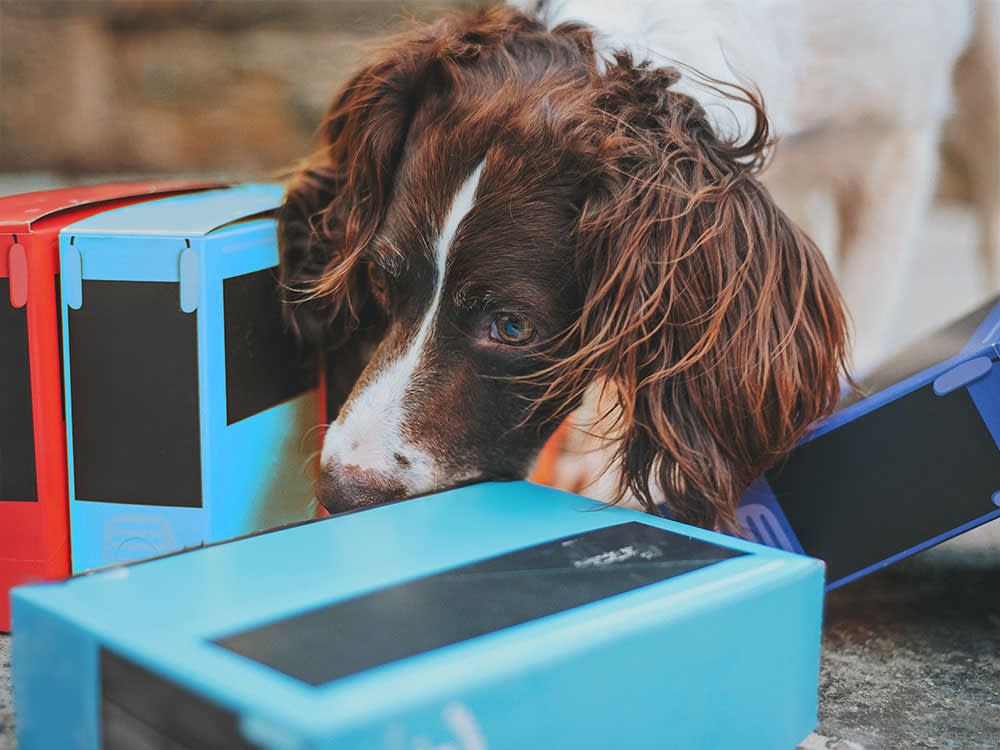
Every dog sport has an entry requirement nobody says out loud. Agility wants a body that can jump. Obedience wants a dog who can hold it together in a room full of other dogs. Flyball wants speed and nerve. Which means that a huge population of dogs — the reactive ones, the fearful ones, the three-legged ones, the arthritic thirteen-year-olds, the ones who fall apart if a stranger makes eye contact — get quietly filtered out of the whole category.
Scent work is the exception, and that’s the most interesting thing about it. It is a real sport, with real titles and real competition, and it was designed from the start so that the dog who can’t cope with any of the others can not only participate but genuinely excel.
That’s not a consolation prize. It’s the design.
Why the anxious dog does well here
Start with the format. In K9 Nose Work, dogs search one at a time. There is no group. There is no other dog in the search area, ever. A dog who spends every obedience class scanning the room for threats and absorbing nothing gets, in a scent work class, the one thing they have never had: an empty room and a job.
Then look at what the sport asks the dog to do. It asks them to use their nose, which they are already extraordinary at and which requires no instruction from you. It rewards them for pulling toward things, investigating, getting excited, and moving with intent. In most training contexts those behaviors are labeled problems. Here they are the skill.
And there’s no physical bar. A senior with worn-out hips can search from a stationary position. A dog missing a limb can do this. A dog who is scared of everything outside can start in their own kitchen.
Scent work is the only sport I can recommend to a dog who is falling apart in every other room of their life. It doesn’t ask them to be braver. It asks them to be a dog, and then it pays them for it.
What the sport actually is
The dog’s job is to find a hidden target odor and tell their handler exactly where it is. That’s it. The handler’s job is much harder than it sounds: to shut up, stay out of the way, and believe the dog.
Which is the quiet inversion at the heart of this thing. In most training, you are the one with the information and the dog is the one learning. Here the dog holds all the information and you are the one who has to learn — to read a change in their breathing, a tightening arc, a shift in the set of the tail. The dog is the expert. You’re the student who keeps guessing wrong.
K9 Nose Work as an organized sport was built in southern California in 2006 by Amy Herot, Jill Marie O’Brien, and Ron Gaunt, three professionals who worked with certified detection dogs and noticed something about their working animals: after a search, the dogs came off satisfied and loose. They wanted pet dogs to get access to that same state.
What your dog gets out of it
A brain that’s actually tired. Searching is metabolically and cognitively demanding in a way that a lap around the block is not. Fifteen minutes of hard sniffing puts most dogs down for a nap.
Refined natural skill. The training process doesn’t install a new ability, it sharpens one that’s already there — hunting, tracking a scent cone to its source, working out where the smell is strongest.
Measurably better mood. This is the part with real evidence behind it. In a study by Charlotte Duranton and Alexandra Horowitz, twenty pet dogs were split into two groups: ten did two weeks of daily nose-based searching games, ten did two weeks of heelwork instead. Before and after, all of them took a cognitive bias test — a standard way of measuring optimism in animals by seeing how readily they approach an ambiguous stimulus. The nose-work dogs got faster at approaching. The heelwork dogs didn’t. Two weeks of sniffing made dogs more optimistic about an unknown thing.
And here’s what you get: an education in canine body language you cannot buy any other way. Handlers who do this for a year read their dogs better than handlers who’ve done anything else for five.
Why the classroom feels so different
Sit in on a standard group obedience class and watch what the humans are doing. They’re managing. Bracing against the dog next to them, apologizing, tightening the leash, half their attention on damage control. The dogs are either overstimulated or shut down. Very little learning is happening for anyone.
The scent work classroom is structurally the opposite. One dog works. Everyone else is crated or out of sight. There’s no social pressure to fail under.
And the behaviors that get you a disapproving look in obedience class — barreling through the door, ignoring you completely to fixate on the environment, bouncing around like a lunatic — are here treated as drive, which is the thing you’re trying to build. Nobody is going to tell you your dog is being rude. Your dog is being useful.
Start tonight, on your kitchen floor
You need cardboard boxes and something your dog would trade a limb for. That’s the whole equipment list, which is the other reason this sport spread so fast: it was adapted from detection training specifically to be portable, cheap, and doable in a small apartment.
The full sequence is in the how-to steps above, but the through-line is this: go at your dog’s pace, and let them win a lot. Frustration is the only real failure mode here. If your dog stalls out, you made it too hard, too fast. Back up a step and let them succeed a few times before you ask for more.
If you catch the bug: competing
For handlers who want a standard to train to, titles are awarded through trials organized and sanctioned by the National Association of Canine Scent Work (NACSW). The only gate to entry is the Odor Recognition Test (ORT), where your dog has to correctly identify the target odor for their level:
- NW1 — sweet birch
- NW2 — aniseed
- NW3 — clove bud
Competition elements include box drills, interior searches inside buildings, exterior area searches, and vehicle searches. You can practice all of them almost anywhere, which is why people end up hiding birch tins in parking lots on their lunch break and feeling completely normal about it.
What’s new since this was written
The sport has grown well past its Californian origins, and it’s now big enough that the American Kennel Club runs a parallel version of it. AKC Scent Work uses birch, anise, clove, and cypress, and adds elements that NACSW doesn’t have, including a buried search and a handler discrimination division where the dog searches for your scent specifically. In October 2025, the AKC held its first Scent Work Master National Championship.
The two programs are not interchangeable, and the difference matters for exactly the dogs this article is about. AKC Scent Work is not structured around keeping dogs separated the way K9 Nose Work is. If your dog is reactive or fearful, the NACSW format — dogs crated, one working at a time, no dog-to-dog contact — is the one built for them. Start there.
Either way, the sport is far easier to find a class for than it was even five years ago. Which means the arthritic senior and the dog who can’t handle the park have somewhere to go now.
References
- Duranton, C., & Horowitz, A. (2019). Let me sniff! Nosework induces positive judgment bias in pet dogs. Applied Animal Behaviour Science, 211, 61–66.
- National Association of Canine Scent Work. About K9 Nose Work and the Odor Recognition Test.
- American Kennel Club. AKC Scent Work.
- American Kennel Club. Scent Work Master National.
Dr. Mehta is a board-certified veterinary nutritionist who evaluates pet food formulations, ingredient quality, and the science behind dietary trends. He writes and reviews all nutrition content at The Pet Times, including our food rankings and feeding guides.
Meet our experts ↗Keep reading
 TrainingThe Puppy Mistake That Costs More Dogs Than Parvo DoesDr. Nina Kohl · 7 min
 TrainingAsking Your Dog for Consent Sounds Ridiculous. It Works Anyway.Dr. Ravi Mehta · 8 min
 TrainingExcited Isn't the Same as Happy. 8 Signs Your Dog Is Over Threshold.Dr. Nina Kohl · 8 min
 TrainingYour Dog Isn't Reading Your Face. They're Reading Your Hand on the Leash.Dr. Lena Park · 8 min
 First DaysYour Puppy Isn't Regressing. They're in a Fear PeriodJordan Ellis · 8 min
 TrainingAgility Training Starts With a Cardboard Box, Not a CourseMarcus Webb · 7 min