


Stop Pushing Your Dog Down. Catch Them Doing It.
"Down" is the highest-value cue you can teach, and the easiest, because your dog already lies down a hundred times a day. The trick is to reward the behavior you're waiting for instead of forcing a body into place.

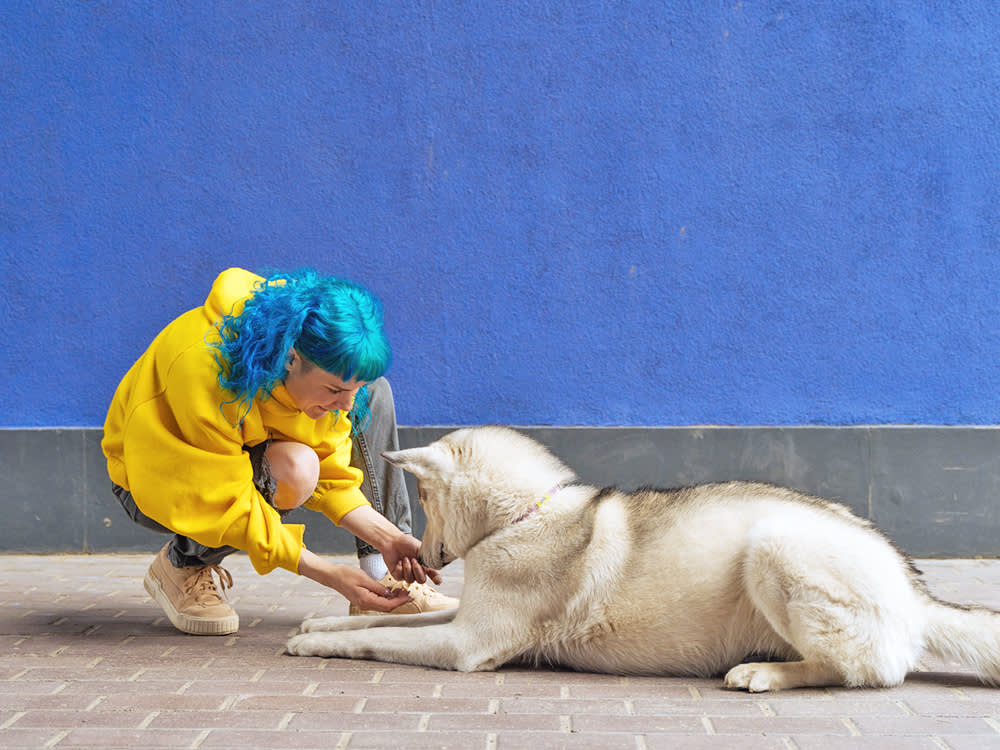
Most training cues ask your dog to do something they would rarely do on their own. “Down” is the opposite, and that is its secret. Your dog already lies down constantly, before naps, between zoomies, whenever the excitement of the moment finally drains out of them. You are not installing a new behavior. You are just teaching them to connect a word to something their body does automatically, which is why “down” is often one of the fastest, most reliable cues a dog ever learns.
It also happens to be one of the most useful. A dog who will settle on cue is a dog you can take more places, which is the quiet trade at the heart of good training: the steadier their manners get, the more of the world opens up to them.
Why “down” earns its keep
A dependable down keeps your dog anchored in one spot, and that is worth a lot in the real world. It is the difference between a dog who can come to a cafe patio, a busy vet lobby, or a friend’s living room and one who cannot. It can also head off genuine danger, the kind of moment where a dog spots a squirrel and starts to launch toward a road. A cue that drops them in place buys you the second you need.
Alongside “sit,” “come,” “stay,” and “heel,” it is one of the foundation behaviors. Get it solid and the rest of training gets easier, because your dog has learned the core lesson underneath all of it: paying attention to you pays off.
Capture the behavior instead of forcing it
There are three broad ways to teach any new skill: luring a dog into position with a treat, capturing a behavior they offer on their own and rewarding it, and shaping, where you reward small steps toward the goal. For “down,” the first two do almost all the work, and capturing is the underrated one.
To capture, you barely do anything, which is the point. Palm a few small treats, park yourself near a place your dog tends to flop down anyway, and wait. Be genuinely boring. The instant they lie down on their own, mark it, a clicker or a crisp “yes” both work, and deliver the treat slightly out in front of or above them so they have to stand to get it. That resets them, and the odds are good they will settle again. Rack up enough repetitions and your dog draws the conclusion themselves: lying down makes the good thing happen.
Luring is the more familiar method and it is reliable too. Hold a treat at your dog’s nose and draw it straight down to the floor, then slide it along the ground away from them, roughly tracing the shape of the number two. Their nose follows the treat, their body folds to follow the nose, and as soon as their elbows meet the floor you mark and reward. Once they are chasing that hand motion smoothly, you are ready to add words.
People reach for luring first because it feels active, but capturing teaches something deeper. When a dog offers the down on their own and gets paid for it, they’re learning that their choices work, not just that they can follow a cookie. That’s the dog who holds a down when the treat isn’t in your hand.
Layer in the cue, then the signal
Timing is everything when you add the word. Wait until your dog is volunteering the down on their own, a handful of times back-to-back, then start saying “down” as they are in the act of lying down, followed by the mark and reward. You are stapling the word onto a behavior that is already happening.
A hand signal reinforces the same thing and gives you a silent option. A flat, open palm held out, like you are swearing an oath, is a common one. As it becomes familiar, give the cue, spoken or visual, a beat earlier each time, until your dog is dropping in response to the cue rather than after it.
Practice like it’s school, because for your dog it is
Nobody learns their multiplication tables in one sitting, and neither does a dog. Keep sessions short and frequent, start somewhere calm and quiet like your living room, and only then work up to harder places like a park full of smells and squirrels. Rehearse the cue with different people and in different rooms so your dog generalizes it, rather than deciding “down” only means something in the kitchen.
Consistency is what wires it in. Predictable, repeated practice builds the association, strengthens the muscle memory, and, not incidentally, builds your dog’s trust that they know what you are asking.
When your dog won’t do it
If your dog refuses, do not muscle them into position. Forcing a dog down teaches nothing good and can teach something bad. Reluctance usually means one of a few things: confusion about what you want, a wobble of trust, or, importantly, physical discomfort. Lying down is a vulnerable posture, and a dog might happily sprawl on the couch at home yet balk on a cold, slick vet floor or in a tense training class. Notice where your dog hesitates; it is information.
If luring is not landing, try sitting on the floor and coaxing your dog to crawl under one bent leg with the treat, marking the instant their body hits the ground. For a dog who cannot focus, a defined spot helps: platform or mat training, teaching them to go to a specific low, non-slip surface, gives an antsy dog a predictable place to switch into training mode. And a simple timing hack works wonders, start a session after a walk, when your dog is pleasantly tired and less inclined to bounce.
Two mistakes worth avoiding
First, do not let “down” do double duty. If it means “lie on the floor,” resist reaching for the same word when you want your dog to hop off the sofa or quit propping their feet on the sill. Give those their own cue, “off” or “leave it.” Reusing one word for two jobs muddies both.
Second, respect how tiring learning is. Training is mental work, especially for a puppy, and a puppy after a training session is a lot like a kid after school, wrung out. Let them nap afterward, and break longer sessions with a little play. A short romp between reps is not goofing off; it is recess for a busy brain.
What’s new since this was written
There is now research backing up that “play break,” and it is more than a morale boost. In a controlled study of Labrador Retrievers, dogs that played for half an hour right after learning a new task performed noticeably better when retested, suggesting that a burst of post-training play helps cement what a dog just learned into longer-term memory. In other words, ending a “down” session with a game of tug or fetch is not a reward tacked on at the end, it is part of the training itself.
The broader move in force-free training has been toward exactly the capture-and-reward, never-force approach above, with a growing emphasis on ruling out pain first. If a previously willing dog suddenly resists lying down, current guidance treats that as a possible medical flag worth a vet’s eye, not a discipline problem.
This is general training and wellness information; check with your veterinarian if your dog’s reluctance to lie down seems tied to discomfort.
References
- Affenzeller, N., Palme, R., and Zulch, H. “Playful activity post-learning improves training performance in Labrador Retriever dogs.” Physiology & Behavior, 2017. https://pubmed.ncbi.nlm.nih.gov/28017680/
- American Veterinary Society of Animal Behavior, position statements on humane, reward-based training. https://avsab.org/resources/position-statements/
Common questions
Why is 'down' such an important cue?
It parks your dog in one calm spot, which is useful in public, at the vet, in a cafe, or any time you need control. A solid down can also prevent danger, like a dog bolting toward the street. More control for you generally means more freedom for them.
How long does it take to teach?
For a healthy, pain-free dog, often just a few short sessions to get the basic behavior. Making it reliable everywhere, around distractions, takes longer. There's no fixed timeline, and it's never too late to teach an older dog.
What if my dog won't lie down?
Never force them. Reluctance can signal confusion, a lack of trust, or physical pain, especially on hard floors. Try luring under a bent leg, use a comfortable surface, and train when they're a little tired.
Dr. Kohl is a board-certified veterinary dentist with a particular interest in preventive oral care. She reviews all dental health content at The Pet Times and contributes practical guides on home dental routines, professional cleaning, and oral disease prevention.
Meet our experts ↗Keep reading
 TrainingYour Dog Is Listening to Your Tone, Not Your WordsSasha Ford · 6 min
 Training'Gentle Parenting' Your Dog Isn't Permissive. That's the Part People Get Wrong.Dr. Nina Kohl · 9 min
 TrainingThe Wagging Tail Lie: Why Reading One Dog Signal Gets People BittenTom Hadley · 8 min
 TrainingStop Punishing Your Puppy. It's Backfiring.Dr. Amara Solis · 9 min
 TrainingFreezing While Your Dog Dawdles? Stop Begging and Set the SceneJordan Ellis · 8 min
 TrainingHow to Actually Start Dancing With Your Dog (No Rhythm Required)Sasha Ford · 8 min