


How to Actually Start Dancing With Your Dog (No Rhythm Required)
Canine freestyle looks like a talent you either have or you don't. It isn't. Here are the first three moves to teach, the titling ladder that lets any dog compete, and how to build a routine from your couch.
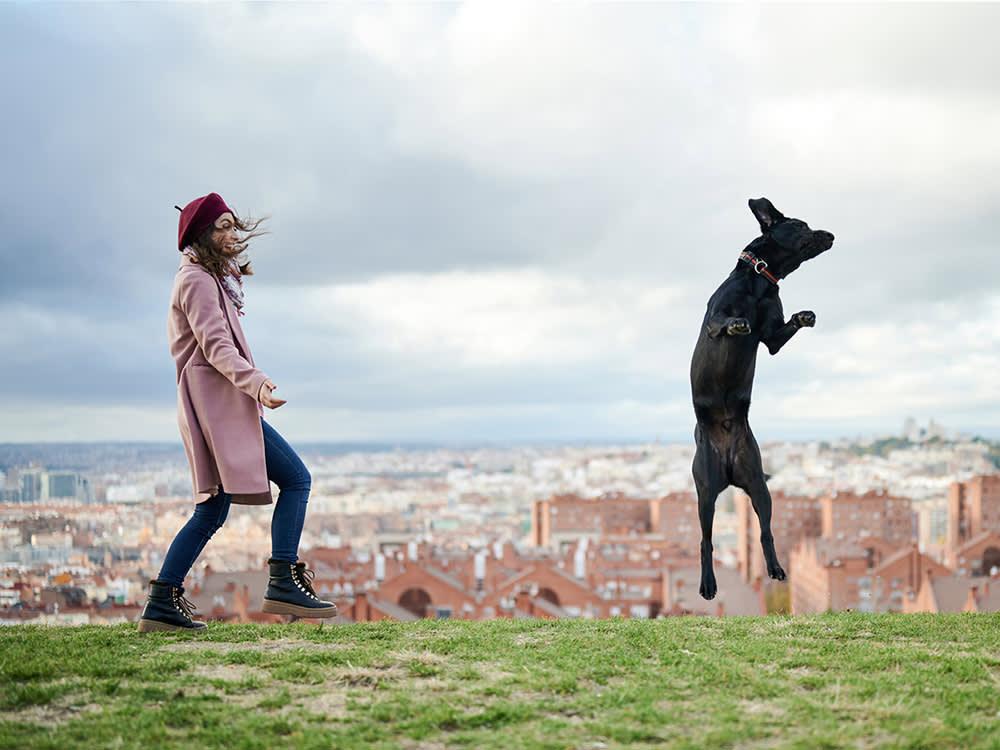
Canine freestyle — dog dancing — has an image problem, and it is scaring off exactly the people who would love it. Watch a clip of a Border Collie spinning through a flawless routine to Dance Monkey and the natural reaction is: I could never, my dog could never, and anyway I have no rhythm. Every part of that is wrong. Freestyle is not judged on your dancing. It is choreographed trick training, and the “training” half is the whole game. If your dog can learn to sit, they can learn to freestyle.
So instead of another history of the sport, this is a starting guide. Below are the first moves to teach, the surprisingly welcoming titling system that lets any dog compete at their own level, and how to build a real routine without a studio, a coach, or a lick of natural rhythm.
What freestyle actually is (and isn’t)
At its core, freestyle is creative obedience set to music. You will spot familiar building blocks — heel position, focused attention, the same skills any basic-training class teaches — but the point is to assemble them into something original that suits your specific dog. Handlers choose their own music, design a routine around their dog’s natural strengths, and can talk to and encourage the dog throughout the performance. There is no single correct routine, only the one that fits your dog.
What it is not: a test of your coordination, a breed-restricted club, or something that requires a competition venue to enjoy. The judges are watching the dog and the partnership, not your footwork.
The first three moves to teach
You do not choreograph anything on day one. You teach a small vocabulary of moves, get them reliable, and only then string them together. Trainers consistently point to a handful of beginner-friendly behaviors — spins, weaves, and bows among them — as the place to start. Here are three that give you an entire mini-routine.
1. The spin (both directions). Lure your dog in a tight circle with a treat at nose height, mark and reward the full turn, then fade the lure to a hand signal and a word (“spin” one way, “twirl” the other). Teaching both directions early keeps your dog balanced and gives you symmetry to play with later. This is usually the fastest move to get looking polished, which makes it a great confidence-builder.
2. The leg weave. With your dog behind you, lure them in a figure-eight through your legs as you step. Start stationary, one leg at a time, and only add walking once the pattern is smooth. Weaves read as impressively “dancey” on video while being, mechanically, just targeting and following.
3. The bow. From a stand, lure your dog’s nose down and back toward their chest so the front end lowers while the rear stays up, then mark the instant you get the shape. A bow is the classic freestyle opener or finale — it looks like a curtain call and doubles as a nice stretch.
Two rules make all of this safer and faster: train on non-slip flooring (a yoga mat or rug, never slick hardwood or tile), and keep sessions short and upbeat, ending while your dog still wants more. If your dog is slipping or guessing, slow down and drop the music until the behavior is solid.
Turning moves into a routine
Once you have three or four reliable behaviors, you have enough for a 60-to-90-second routine. Pick music with a tempo that matches your dog’s natural pace — a bouncy little dog and a rangy shepherd want very different beats-per-minute. Sequence the moves so transitions feel natural (a spin flows nicely into a weave, a bow makes a clean ending), and rehearse the transitions as deliberately as the moves themselves, since that is where routines fall apart. Film yourself. The camera is the most honest coach you have, and it is how most at-home freestylers refine their work.
The titling ladder: proof any dog can compete
Here is the part that surprises newcomers most. Freestyle is not an elite-only pursuit. The organizations run a graduated ladder of titles designed so beginners compete against a standard, not against the Border Collies.
The World Canine Freestyle Organization, for example, offers titles at Beginner, Novice, Intermediate, Advanced, and a top tier called Perfect Dance Partner, in both Musical Freestyle and Heelwork to Music. And the entry bar is genuinely reachable: at the Beginner level, a team needs just two qualifying scores of 7.3 or above to earn the title, with Novice through Advanced requiring three qualifying “legs” at that same 7.3 threshold. The rarefied Perfect Dance Partner title asks for five legs scored 9.5 or higher — that is the mountaintop, but you start in the foothills. At the Beginner level, judges are mainly looking for connection with your dog and simple content: turns and spins, figure eights, and basic heelwork. In other words, exactly the vocabulary you just taught.
Any dog, any place — the sport keeps opening up
While many top competitors are Border Collies and Golden Retrievers, every organization welcomes all breeds and mixes, and the sport rewards partnership over pedigree. Karen Lewis of New Mexico competes with her Staffordshire Bull Terrier, Bryce, who also does agility, and she is clear about what sets freestyle apart.
“That connection counts for even more in freestyle than it does in agility,” Lewis says. “On an agility course, you take the obstacles in more or less the same order each run. Freestyle keeps throwing new moves at you, so the dog has to keep its eyes on you nonstop to catch every signal, spoken or gestured. Meanwhile you’re improvising the whole way through, tracking your next move and when to wrap up. It’s staggering how much gets packed into 90 seconds.”
That constant back-and-forth is why freestyle builds such a strong relationship. Because it runs entirely on positive, motivational methods, you cannot force a dog through it — the focus has to be freely given, which means the training itself deepens your connection.
Access keeps improving, too. The Musical Dog Sport Association, long a treasure trove of move lists and trainer directories for beginners, has leaned into online learning with virtual workshops and titling events, and organizations increasingly accept video submissions. If there is no freestyle class within driving distance, that is no longer a reason not to start.
An easier on-ramp: trick titles
If a full choreographed routine feels like a leap, the American Kennel Club’s Trick Dog program shares much of freestyle’s foundational vocabulary and offers a gentle, gamified path up through titling levels, with plenty of judge-from-home options. Earning a few trick titles is a low-pressure way to build the exact skills — spins, weaves, focused attention — that a freestyle routine is made of. Plenty of handlers back into freestyle this way, discovering they were already halfway there.
The magic move that convinces people they can do this is the spin. It takes about ten minutes to teach and thirty seconds to make look great. Once a handler sees their own dog nail it to a beat, the whole ‘I could never’ story falls apart.
Whether you want to level up your training, deepen your bond, or just spend an afternoon making something playful together, freestyle delivers on all three. You bring the treats and the non-slip mat. Your dog brings the talent.
References
- “Welcome to the World of Musical Freestyle (Dog Dancing).” American Kennel Club, https://www.akc.org/expert-advice/lifestyle/welcome-to-the-world-of-musical-freestyle-dog-dancing/.
- “Proficiency Tests” and “Titles.” World Canine Freestyle Organization, https://www.worldcaninefreestyle.org/proficiency-tests.
- “Freestyle Moves” (resource library). Musical Dog Sport Association, https://musicaldogsport.org/.
- “AKC Trick Dog Program.” American Kennel Club, https://www.akc.org/sports/trick-dog/.
Common questions
Do I need to know how to dance to do canine freestyle?
No. Freestyle rewards your dog's precision and your connection, not your own dance ability. Beginner routines are built from simple trick moves like spins, weaves, and bows, strung together to music. Plenty of successful handlers describe themselves as having no dance background at all.
What breeds can do freestyle?
Any breed or mix. Border Collies and Golden Retrievers dominate the top competition ranks because of their drive and trainability, but every canine freestyle organization welcomes all dogs, and titles have been earned by everything from terriers to giant breeds. The sport adapts to the dog.
How do I start if there's no freestyle class near me?
You can start entirely at home. Teach a few foundation moves on non-slip flooring, add music once the behaviors are solid, and use one of the virtual workshops and video-submission titling programs several organizations now run. Many handlers train and even compete without ever attending an in-person class.
Is freestyle safe for my dog?
It's low-impact when done sensibly. Train on grippy flooring rather than hardwood or tile, skip repetitive jumping or bipedal 'standing' moves for young, senior, or heavy dogs, and check with your vet before starting if your dog has joint or back issues. The goal is fun and focus, not gymnastics.
Sasha Ford is a certified cat behaviour consultant who has worked with shelters, catteries, and private clients across the country. They review all feline behaviour content at The Pet Times, with expertise in multi-cat households, indoor enrichment, and stress-related disorders.
Meet our experts ↗Keep reading
 TrainingThat Embarrassing Baby Voice? Your Dog Is Begging You to Keep Doing It.Dr. Amara Solis · 5 min
 TrainingYour Dog Ignores Its Name. Maybe It's Time to Let Them Pick a New One.Dr. Mara Chen · 5 min
 TrainingNever Introduce Two Dogs Face-to-FaceDr. Mara Chen · 7 min
 TrainingYour Second Dog Is Copying Your First. That's the Risk, Not the Perk.Dr. Ravi Mehta · 6 min
 TrainingYour Dog Isn't Blowing You Off. Six Cues Are Just Broken.Jordan Ellis · 7 min
 TrainingTeaching Your Dog to 'Talk' With Buttons, Without Fooling YourselfDr. Nina Kohl · 8 min