


Your Puppy Is Talking to You. Here's the Translation.
Barks, whines, and howls aren't random noise. They're a small, learnable vocabulary, and how you respond in the first few months teaches your puppy which words work.

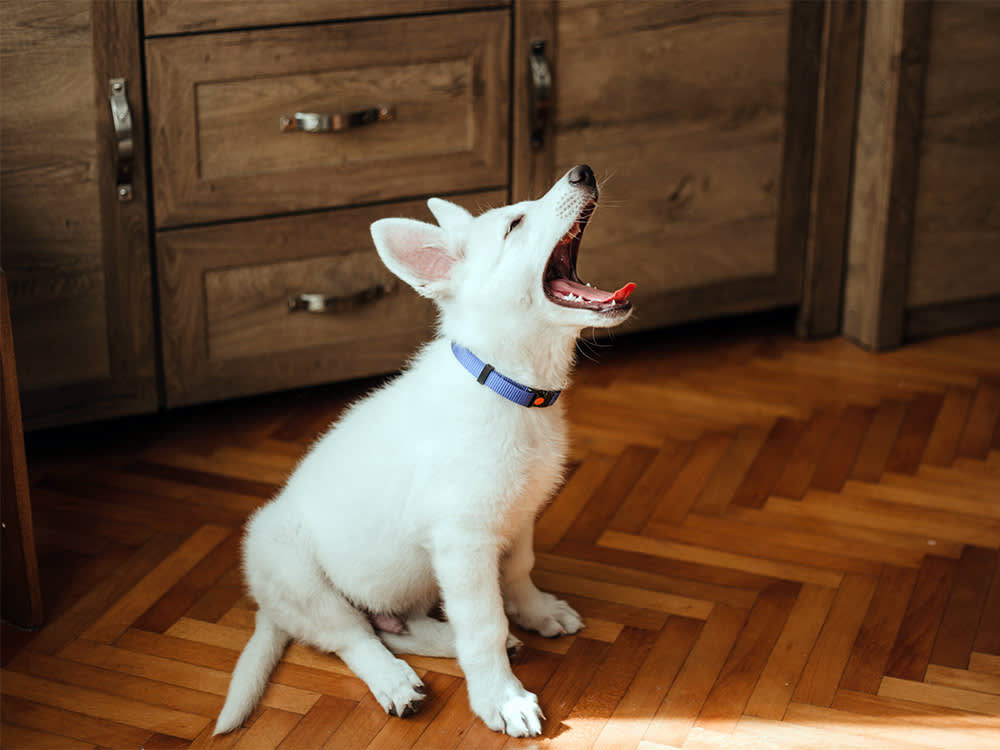
You bring your new puppy home and, somewhere around the second night, you hear a sound you did not know a dog could make. Puppies are astonishingly vocal, and every squeak, yip, and warble is doing a job. Long before they understand a single word you say, they are broadcasting their needs the same way a baby’s cry does: loudly, and with meaning.
The catch is that you are part of the conversation whether you mean to be or not. What you reward in these early weeks is what your puppy learns to repeat. So the goal is not to silence the noise, but to understand it well enough that you respond to the right things and quietly let the rest fade.
Every squeak your puppy makes is a request, and your job is to sort out which requests to grant. Answer the ones about fear, pain, or a full bladder right away. The ones that just mean ‘notice me,’ though, are best rewarded with calm attention once your puppy settles, not with an instant reaction, or you will raise a very talkative adult.
The three big sounds, and what they usually mean
Barking
A bark is the Swiss Army knife of puppy noises: it means a dozen different things depending on the moment. Your puppy might bark at another dog because they are dying to play, or at that very same dog out of fear, hoping to warn it off. They bark during play as a running commentary. And they bark, above all, for your attention.
Picture yourself lost in your phone while your puppy is feeling playful and ignored. That bark translates roughly to “Hey, I’m right here, play with me.” Be thoughtful about how you answer it. A tiny, adorable bark today becomes a booming, hard-to-live-with bark once your puppy doubles in size. If yours barks during play, try pausing the fun for a couple of seconds each time it happens, then resume once they are quiet. Stay consistent and you teach your dog that the good stuff continues when they play calmly.
Barking can also be about loneliness. If you leave the room, or you glance at the pet camera and catch your puppy sounding off, they are often just struggling to be by themselves. That is a cue to start gentle crate training, and, when tricky behaviors crop up, to loop in a trainer early so you head off bigger problems in adulthood.
Whining
A puppy’s whine is engineered to melt you, and you will need some backbone. Whining is communication, plain and simple. In the litter, it is how a puppy tells their mother that something is off or that they need something. It is also a very common “I need to go to the bathroom” signal.
That is why a predictable potty schedule pays off: as you learn your puppy’s cues, you can get ahead of the whine. Take your puppy out shortly after they play, eat, or wake up. And pay attention when the whining seems different from usual. A puppy who is suddenly whiny and acting off may need a vet visit, especially since curious puppies are experts at eating things they should not. When you cannot watch them closely, keep them in a safe, puppy-proofed space.
Howling
Does it sometimes sound like you adopted a tiny wolf? Howling is one more channel of communication. A puppy left alone in their area who starts to howl is frequently just lonely. Newly separated from their mother and littermates, puppies go through an adjustment period, and they may howl during long stretches alone because they have not yet learned to self-soothe. Breed matters here, too. Some dogs are simply wired to howl, with Beagles, Basset Hounds, Huskies, and Malamutes among the most famously vocal.
When your puppy found their voice
Vocalizing starts young. Puppies begin making sounds at roughly two to three weeks old, and at first those sounds are mostly grunts and whimpers. As they grow, the yips and true barks arrive. Some take longer than others to find their full voice, but by around sixteen weeks most puppies have it sorted out.
Reading the sounds that mean “I’m scared”
New sights and sounds can rattle a young puppy, and the sensitivity spikes during normal fear periods in development. Exposing your puppy to a wide range of experiences is a cornerstone of good socialization, but it only helps if you are watching how they cope.
Signs your puppy is stressed include lip-licking, panting, drooling, trembling, hiding, and pinning their ears flat. If you see these, ease off and help your puppy build comfort with whatever spooked them. Depending on how fearful they are, a trainer can be worth their weight in gold. The whole point is to build good associations now so you are not raising an anxious adult later.
How to introduce scary sounds the smart way
The world is full of noises your puppy has never encountered, and the best time to defuse them is before they become frightening. Do it in a controlled setting.
Think about where you live and which sounds might unsettle a young dog: thunder and fireworks are classic culprits, and construction noise is another. Find a recording of the sound, then use it to build a positive association, with food doing the heavy lifting. Treats or even your puppy’s regular kibble work well.
Start by feeding your puppy something delicious while the sound plays at a very low volume. Over multiple sessions, as your puppy stays relaxed, nudge the volume up. The tell that they are comfortable is simple: they keep eating. The moment you notice any of those stress signals, dial the volume back down. Some puppies need to hold at one level for several sessions or days before moving on, and that is completely normal.
What newer research adds
There is real science behind why a puppy’s whine is so hard to tune out. A 2022 study published in the Proceedings of the Royal Society B looked at “nonlinear phenomena,” the little roughness, jumps, and cracks that show up in puppy whines, and found that people perceive whines carrying those features as more distressing, and even judge the puppy as larger or more dominant. In other words, your ear is not imagining it: some whines are acoustically built to grab you and refuse to let go.
That is a useful thing to keep in the back of your mind. A whine that sounds especially raw and urgent may genuinely signal higher distress, which is all the more reason to check in rather than assume your puppy is simply being dramatic. Understanding the sound is the first step; responding to the right ones, and calmly ignoring the attention-seeking rest, is how you raise a confident, well-spoken dog.
References
- Massenet, Mathilde, et al. “Nonlinear vocal phenomena affect human perceptions of distress, size and dominance in puppy whines.” Proceedings of the Royal Society B, vol. 289, no. 1973, 2022.
- Cutler, Janet H., et al. “Puppy socialization practices of a sample of dog owners from across Canada and the United States.” Journal of the American Veterinary Medical Association, vol. 251, no. 12, 2017, pp. 1415–1423.
- Frank, Diane, et al. “Puppy behaviours when left home alone: A pilot study.” Applied Animal Behaviour Science, vol. 104, no. 1–2, 2007, pp. 61–70.
- Kutsumi, Ai, et al. “Importance of puppy training for future behavior of the dog.” Journal of Veterinary Medical Science, vol. 75, no. 2, 2013, pp. 141–149.
Common questions
Should I respond every time my puppy whines?
It depends on why. If the whine is a bid for attention, answering it teaches your puppy that whining works, so it is better to wait for quiet. If the whine signals fear, pain, or a bathroom need, respond and figure out what's wrong.
What sounds actually calm a puppy?
Soft classical music is a reliable choice, and there are recordings composed specifically to settle dogs. Playing it while you're out can help soothe a puppy who struggles with alone time.
What is a puppy 'whimper'?
A whimper is usually a small distress sound, made when a puppy is frightened or hurt. It's worth checking on rather than ignoring.
How do I get my puppy to stop barking constantly?
Constant barking often means boredom. More mental stimulation helps, especially sniff-led walks. A ten-minute 'sniffari' where your puppy follows their nose tires them out more than a brisk hour-long march. Teaching a settle cue and using chews also helps.
Dr. Kohl is a board-certified veterinary dentist with a particular interest in preventive oral care. She reviews all dental health content at The Pet Times and contributes practical guides on home dental routines, professional cleaning, and oral disease prevention.
Meet our experts ↗Keep reading
 TrainingYour Dog's Nibble Is a Dial, Not a Switch. You're Turning It the Wrong Way.Dr. Nina Kohl · 9 min
 First DaysYour Puppy Isn't Manipulating You. Stop Letting Them Cry It Out.Dr. Nina Kohl · 6 min
 First DaysThe Only Puppy in the Litter Missed a Class. It Shows Up Years Later as a Bite.Dr. Nina Kohl · 9 min
 First DaysYour Puppy Isn't Being Wild. They're Overtired.Dr. Nina Kohl · 6 min
 First DaysYour Puppy Thinks the Cat Is a Toy. Fix That Before They Ever Meet.Dr. Mara Chen · 9 min
 TrainingYour 'Dominant' Dog Isn't the Problem. Your Puppy Has No Brakes.Dr. Lena Park · 10 min