


Your Puppy Thinks the Cat Is a Toy. Fix That Before They Ever Meet.
Introducing a puppy to a resident cat isn't really about the cat. It's about one specific liability: a bouncy young dog whose instinct says a moving cat is a game. Here's the staged plan that keeps the peace, and the research on why puppies are actually the easy case.

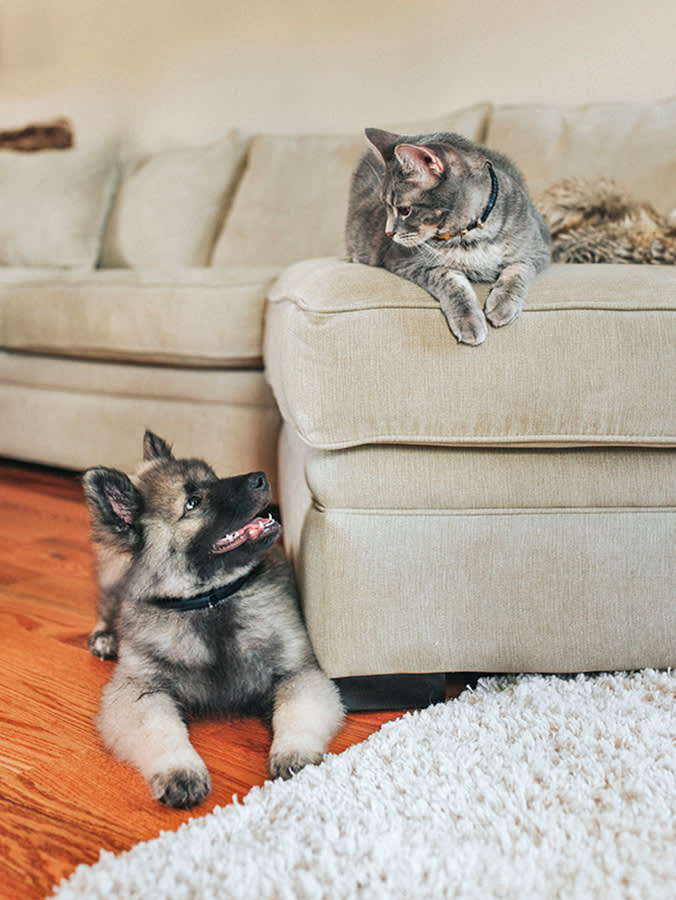
Here’s the reframe that makes puppy-meets-cat go smoothly: your cat is rarely the real problem. Cats are cautious, territorial, and slow to warm up, but they mostly want to be left alone until they decide otherwise. The variable you actually have to manage sits at the other end of the leash. A puppy is a bundle of energy with an underdeveloped brain and a hardwired reflex that says anything darting across the floor is a toy worth chasing. Get that one instinct under control, give the cat an unshakeable sense of safety, and the introduction basically runs itself. Fail to, and you’ve taught your cat that the puppy is a threat, which is a much harder hole to climb out of.
So this isn’t about forcing two animals to be friends. It’s about controlling one specific liability, the chase, while the rest sorts itself out.
Know what each animal actually is
Cats and dogs read the world in opposite registers. A cat prizes quiet, solitude, territory, and a predictable routine, and communicates in small print: a flicking tail that means back off, a slow blink that means all is well. A puppy, especially a young one, is the opposite, barreling into every new thing tail-first with more enthusiasm than judgment. Put those two together cold and you get a cat’s flat “go away” stare meeting a puppy who has no idea it’s being warned. The gap is real, but it’s bridgeable. Cats and dogs are not doomed to misread each other forever; with your guidance, they learn each other’s signals.
One useful thing to size up early is drive. Some breeds carry more chase in them than others. Herding and terrier types in particular are wired to fixate on movement, so if your puppy comes from that stock, plan for more management and more training, not less.
Do the prep before anyone meets
The introduction is mostly won in the setup. Spend a few days getting the house right first.
Start by honestly reading both animals. Is your cat bold or skittish, quick to hiss and swat or quick to flee? Is your puppy a laid-back napper or a heat-seeking missile that can’t walk past anything without investigating it? Clashing personalities need more runway, so knowing what you’re working with lets you tailor the pace.
Then build separate territory. Each animal should have its own zone stocked with food, water, toys, and a bed, divided by a baby gate or a well-placed crate so they can sense each other without contact. The cat’s zone is non-negotiable in one respect: it needs height. Shelves or a tall cat tree, positioned well out of puppy range, give your cat a lookout and, more importantly, an escape hatch when the puppy is too much. A cat who can always get above the chaos stays far calmer than one trapped at floor level.
A few rules make the prep hold:
- Keep resources separate. Food and water bowls and favorite toys stay apart, so there’s nothing to guard and fight over.
- Let them explore solo. Rotate each animal through the shared rooms one at a time, so they get used to the other’s lingering scent with no pressure and no face-off.
- Use the gates as training wheels. Barriers that let them see and smell each other without touching are your main tool through the early stages.
The staged introduction
The whole method is a ramp, and you only climb to the next rung once the current one is boring. Rushing is the single most common way people blow this.
Swap scents. Both species map their world by smell, so start there. Put something with the puppy’s scent, a blanket or toy, into the cat’s space, and do the reverse. Each learns the other exists before there’s a face to react to.
Trade spaces. Let the cat wander the puppy’s area and the puppy wander the cat’s, separately, doors closed or gate up. Presence without confrontation.
Introduce by sight. Once scent is old news, let them see each other, puppy on a leash, cat free to approach or retreat on its own terms. Read the room: if either one raises its hackles, lets out a hiss, or starts to growl, back up a step, while soft ears on the cat and a loose wag on the puppy mean you’re on track.
Supervised, leashed, and paid. Share a room with the puppy leashed, sit down, and be the calm center of it. Hand both animals treats for relaxed behavior so the other’s presence starts to predict good things.
Off-leash, briefly. When both are reliably loose and easy, allow short off-leash sessions, closely watched. Keep them brief, and the instant either animal tightens up, calmly separate and try again later. The finish line is indifference: a day when neither one particularly cares that the other is in the room.
When it goes sideways
Even a careful plan hits snags. A few common ones, and the fix:
The puppy won’t quit chasing. This is the big one, and it’s a training problem, not a lost cause. Teach a rock-solid “leave it” and “stay,” and practice them away from the cat first so they’re reliable under excitement. Burn off the energy that feeds the chasing with real exercise and mental work, and make sure the cat always has a high perch or closed-door room the puppy simply cannot reach. Management plus training, together.
The cat turns aggressive. Hissing, swatting, and hiding are fear and territory talking. Don’t punish it. Reinforce the cat’s safe zone where the puppy is banned, drop back to scent-swapping to restart the introduction more gently, and reward your cat with treats and praise for any calm moment near the dog.
The puppy steamrolls boundaries. Young dogs genuinely don’t grasp that cats need personal space. Keep the leash on to stop the pushiness in real time, and if the puppy keeps pestering, calmly remove them from the room. The lesson lands through consistency, not scolding.
Everyone’s stressed. Sometimes both animals are simply overwhelmed, more likely if your cat is older or either pet came from a shelter with a history you can’t see. When that happens, slow the whole thing down and let the more anxious animal set the tempo.
The rule I give every family is to let the more frightened animal call the pace, and never trade safety for speed. If the cat is the nervous one, the cat decides when you move forward, not your calendar. Back up to scent and short leashed sessions, and if you’re still stuck after a few weeks, that’s the moment to bring in your vet or a behaviorist.
What newer research adds
There’s real science here, and it’s encouraging, especially for the puppy case. In a study of nearly 200 households sharing a cat and a dog, about two-thirds reported a genuinely positive relationship between the two, a quarter were indifferent, and only around one in ten involved real aggression. The strongest predictor of a good outcome was age at introduction: things went best when the cat met the dog as a kitten under six months old, or the dog arrived before its first birthday. Your bouncy, exasperating puppy, in other words, is the easy case. A young dog is far more adaptable than an adult one, and you’re introducing them during the exact window the research says works best.
More recent work has zeroed in on this specific pairing, a 2022 analysis of owners introducing a new puppy to resident cats, and it echoes the playbook above: gradual, scent-first, well-managed introductions with secure retreats for the cat produce the calmest long-term households. The takeaway is hopeful. Cats and dogs have largely learned to read each other despite their instincts, and a puppy young enough to still be learning the rules is the best possible student.
The bottom line
Aim for harmony, but understand you’ll bank civility first, and that’s a win. Manage the puppy’s chase, guarantee the cat’s escape routes, move at the speed of the more worried animal, and let time do the rest. Most of these pairs end up somewhere between tolerant roommates and genuine friends. You just have to referee the opening rounds.
References
- Feuerstein, N., and J. Terkel. “Interrelationships of dogs (Canis familiaris) and cats (Felis catus L.) living under the same roof.” Applied Animal Behaviour Science, 2008.
- Thomson, J. E., et al. “Introducing a Puppy to Existing Household Cat(s): Mixed Method Analysis.” Animals, 2022. https://pmc.ncbi.nlm.nih.gov/articles/PMC9495027/
- Animal Humane Society. “How to introduce a dog and cat.” animalhumanesociety.org.
- American Kennel Club. “Cats and dogs living together.” akc.org.
Common questions
How long until my cat accepts the new puppy?
Anywhere from a few days to a few months, depending on your cat's temperament and how well the puppy behaves. Confident cats often warm up fast; shy ones need more time. Move gradually and don't rush it.
What makes a cat accept a puppy more easily?
Gradual introductions and a routine that stays consistent. Start with scent, keep interactions slow and supervised, and give your cat secure high spots so they never feel cornered.
How do I get my cat and puppy to actually bond?
Stack up calm, positive experiences where both feel safe and get rewarded. Treats, praise, and patience do the work. Some cats take a while, so give yours space and never force direct contact.
Dr. Chen is a small-animal veterinarian who leads health and safety coverage at The Pet Times. She writes and reviews the bulk of our illness, condition, and safety content, translating clinical guidance into clear, practical advice owners can act on at home.
Meet our experts ↗Keep reading
 TrainingYour Puppy Is Talking to You. Here's the Translation.Dr. Nina Kohl · 8 min
 First DaysStop Counting Your Puppy's Sleep Hours. Watch for the Change.Dr. Amara Solis · 8 min
 First DaysYour Puppy Isn't Manipulating You. Stop Letting Them Cry It Out.Dr. Nina Kohl · 6 min
 First DaysYour Puppy Isn't Being Wild. They're Overtired.Dr. Nina Kohl · 6 min
 First DaysIs Your Puppy Growing Too Fast? The Window Is Smaller Than You ThinkDr. Ravi Mehta · 5 min
 TrainingA Stranger Held His Puppy 50 Times in a Month. The Science Says He Was Right.Dr. Mara Chen · 6 min