


Your Dog Doesn't Know What 'Family' Means. They Know Exactly Who's in Their Group.
Dogs probably don't grasp family as a concept. But they track their group with startling intensity, and understanding that distinction changes how you should show up for them.

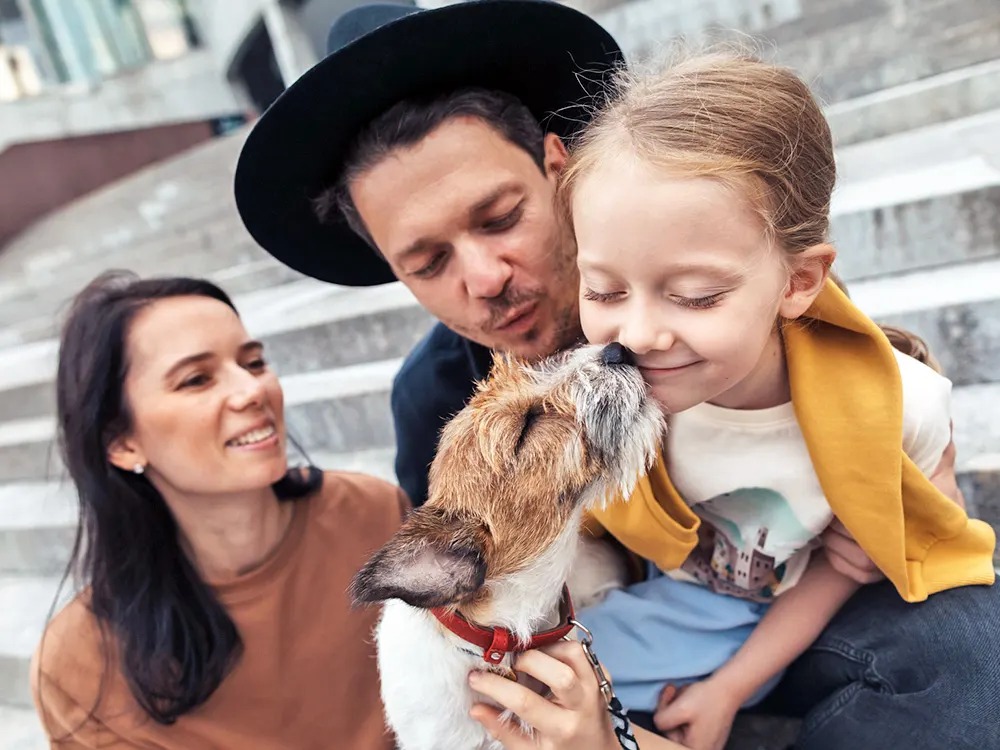
We all want to believe our dogs see us as family, ideally as their parents, though we’d settle for wise older sibling. It’s why we buy them beds, cook them special treats, and occasionally dress them in outfits they’d absolutely have vetoed if given the choice. But there’s a gap between what we mean by “family” and what a dog is actually capable of understanding, and closing that gap honestly turns out to be more reassuring than the fantasy, not less. Your dog may not know what a family is. Your dog knows, with real precision, who belongs to them.
That distinction is the whole ballgame, so it’s worth being clear about both halves of it.
The concept: probably not
Most evidence suggests dogs don’t hold “family” as an abstract concept the way we do. They don’t draw the family tree, they don’t sit around wondering how their siblings are doing, and they don’t map relationships onto the human nuclear-family model. It helps to remember how flexible canine social arrangements actually are in the wild. Run the numbers on the world’s dog population, something close to a billion animals, and roughly 750 million of them belong to no household at all. They live in loose, shifting groupings, and the tidy human home turns out to be the minority arrangement, not the default one. Free-living dogs also skip the parenting script we might project onto them; fathers, bluntly, contribute close to nothing to raising the young. The nuclear family isn’t a dog concept. It’s ours, and we hand it to them.
The group: absolutely, and intensely
Now the other half. If dogs don’t do “family” as an idea, they are exquisitely tuned to “group” as a lived reality. Dogs carry an intense, detailed awareness of who’s in their circle, who they move through the world with, and they behave measurably differently toward group members than toward everyone else. You can watch this in the most ordinary moment: compare how your dog greets you versus how they greet a stranger. That gap is your dog telling you where you sit.
The likely reason this runs so deep is that dogs and humans are both intensely social animals whose strength was never in individual power but in numbers. A lone dog, like a lone human, isn’t much against the world; the group is the survival strategy. So a dog’s sense of “my people, and then everyone else” isn’t sentimentality, it’s wiring. Whether you frame your household as a biological family, a group of roommates, or something else entirely, your dog likely experiences it as group membership, and that membership is emotionally real to them even without a label attached.
They can also pick up more than we’d guess about relatedness, mostly through scent. Dogs appear able to identify their own blood relatives by smell, and the research goes further than that: a dog can apparently sniff out whether two people are related by blood, or merely share an address. What’s odder is that not all relatives register equally. The evidence for mother-and-pup recognition surviving a two-year separation is real, if thin. Littermates, by contrast, tend to lose track of one another unless they went on living together. Useful and fascinating, and still not the same as a dog “thinking about family.”
“I gently steer owners away from asking whether their dog sees them as a parent,” says Dr. Priya Nair. “It’s the wrong question. The real one is whether your dog counts you as part of their group, and for a dog who greets you like the sun came up, the answer is obviously yes. That bond is the thing. It doesn’t need a human label to be powerful.”
What this means for how you show up
Here’s the practical payoff, and it’s lower-effort than most advice you’ll get. Dogs learn what to expect from us through experience, so if you’re affectionate, predictable, and a decent communicator, that becomes what your dog anticipates from you. Consistency is the currency. You don’t have to be perfect, and you certainly don’t have to run an agility program or a nose-work regimen to earn your spot in the group. Often the single most valuable thing you can offer is simply being there, present and available, for a creature who will spend real stretches of the day waiting for you to come home.
What newer research adds
The way you build that bond matters, and the evidence has gotten pointed about it. In research gathered by the British Columbia SPCA, the training method a household chose kept showing up in the quality of the attachment that followed. Reward-trained dogs were the ones who most reliably behaved like securely attached animals, and the people using rewards described feeling closer to their dogs. Run the household on punishment or on pressure-and-release instead, and the pattern inverts: those dogs held back during play, both from their own people and from strangers. The throughline is clear and encouraging: the group membership your dog cares about is strengthened by kindness and predictability, and eroded by harshness. You don’t need to teach your dog what family means. You just need to keep being, reliably and warmly, the person they already know is theirs.
Common questions
Do dogs understand the concept of family?
Probably not as an abstract idea the way humans do. But dogs form strong emotional bonds and have a sharp sense of who their 'people' and group are, which is the part that actually matters to them.
Can dogs recognize their biological relatives?
There's evidence they can, largely through scent. Studies suggest mothers and puppies can recognize each other after long separations, though siblings often don't unless they lived together.
What's the best way to make my dog feel like part of the group?
Show up kindly and consistently, use reward-based training, and simply be present. Predictable, affectionate presence does more for the bond than any special activity.
Dr. Kohl is a board-certified veterinary dentist with a particular interest in preventive oral care. She reviews all dental health content at The Pet Times and contributes practical guides on home dental routines, professional cleaning, and oral disease prevention.
Meet our experts ↗Keep reading
 TrainingNo, Your Cat Didn't Secretly Raise Your Dog. But Something Real Is Going On.Dr. Nina Kohl · 5 min
 TrainingYour Dog Knows You're Coming Home. It's Smelling Time Pass.Dr. Mara Chen · 5 min
 TrainingAre You Hovering Over Your Dog? The Line Between Caring and Smothering.Dr. Lena Park · 7 min
 TrainingLoving People Doesn't Make a Therapy Dog. The Real Bar Is Higher, and KinderDr. Nina Kohl · 11 min
 TrainingYour Dog Already Knows Your Name. This Game Makes Them Prove It.Dr. Mara Chen · 6 min
 TrainingThose "Puppy Dog Eyes" Weren't Invented to Manipulate You. Science Just Proved It.Jordan Ellis · 5 min