


Your Dog Knows You're Coming Home. It's Smelling Time Pass.
That uncanny way your dog is waiting at the window before you turn onto the street isn't a sixth sense. It's two ordinary superpowers stacked: a nose that can smell how much time has passed, and a mind that has memorized your routine.

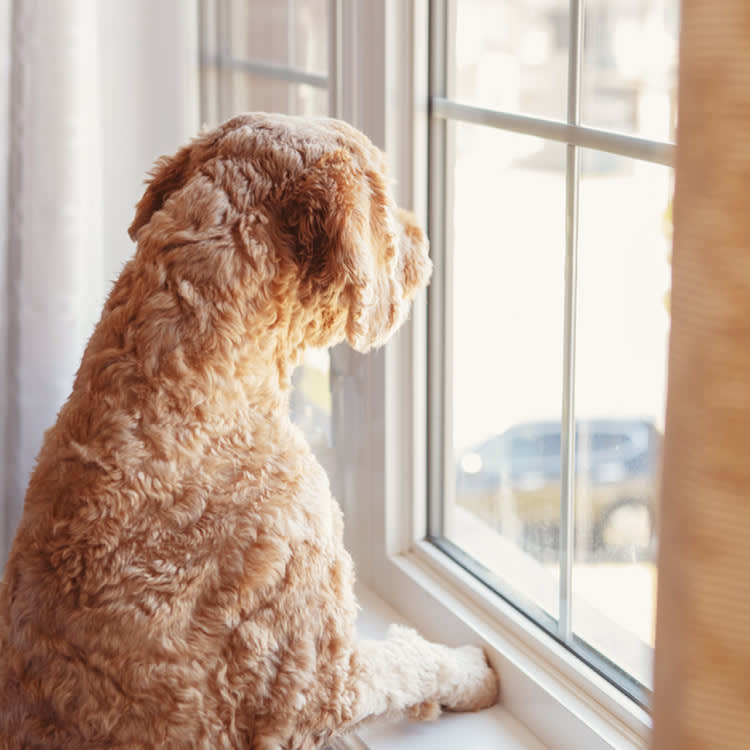
You round the corner onto your street and there it is: your dog, already at the window, already vibrating with joy, as if it clocked your arrival minutes before your key hit the lock. It feels psychic. For as long as people have lived with dogs, we have half-believed our pets possess some sixth sense for our comings and goings.
They do not. What they have is arguably more impressive, because it is real and it is measurable. The window-waiting act is two very ordinary canine superpowers working at once: a nose good enough to smell the passage of time, and a brain relentlessly cataloging the patterns of your day. Neither is magic. Together, they produce something that looks exactly like it.
Superpower one: a nose that reads a clock
The most surprising piece comes from cognitive scientist Alexandra Horowitz, whose work on canine perception suggests dogs may quite literally smell how much time has gone by. The idea works like this. When you leave the house, you leave your scent behind, soaked into the couch, the rug, the air. Over the hours you are gone, that scent slowly fades at a fairly steady rate. A dog with a nose sensitive enough to track that decline is, in effect, reading a scent-based hourglass. The thinner your lingering smell, the longer you have been gone, and the closer the animal’s learned routine says you are to walking back through the door.
There is a clever, low-tech experiment behind the theory. Horowitz had a colleague sneak a piece of clothing carrying her partner’s strong scent into the home hours after he had left, essentially topping up the fading smell to make the house seem freshly full of him again. The result was telling: the dog, who normally sensed when his person was due home and got ready to greet him, was instead found fast asleep on the couch, its internal clock thrown off by the artificially refreshed scent. It is a single anecdote rather than a controlled proof, and worth holding loosely, but it lines up neatly with everything we know about how powerful a dog’s nose really is.
That power is not a metaphor. A dog’s sense of smell is estimated to be orders of magnitude more sensitive than ours, with a nose built to detect and discriminate faint traces we cannot register at all. Using it to sense a scent slowly thinning over an afternoon is well within its range.
Superpower two: a mind that memorizes your day
The nose is only half the machine. Dogs are extraordinary at associative learning, which is a formal way of saying they are relentless at connecting cues to outcomes. Your dog is a full-time student of your schedule, and the curriculum is broader than you think.
It is not just your footsteps or the sound of your specific car engine, though it knows both. It is the whole chain of environmental tells that reliably precede your return: the rumble of a neighbor’s engine that fires up around the same time each evening, the particular slant of afternoon light through the front window, sounds from down the block, shifts in the household’s activity, and cues so subtle you cannot perceive them yourself. Your dog stitches all of these into a working model of “the human comes back around now,” and acts on it.
Why the two together look like a sixth sense
Separately, each ability is impressive. Stacked, they explain the whole illusion. The scent-clock gives your dog a rough sense of how long you have been gone; the routine-reading engine converts that plus a dozen environmental signals into a confident prediction that you are almost here. So the dog is at the window not because it received a mysterious signal from you, but because everything it can smell and everything it has learned agree that this is the moment. The precision is real. The mysticism is us.
What this means for your dog when you are away
Understanding the mechanism is not just a fun party fact, it is useful. Because your dog’s anticipation is built on routine and environmental cues, a wildly unpredictable schedule gives it nothing steady to lean on, which for some dogs adds to the stress of being alone. And because the whole system is tuned to your absence, it is a reminder that the hours before you get home are when a dog prone to separation distress is often most wound up. Predictable departures and returns, and enrichment that fills the empty stretch, work with your dog’s clock instead of against it.
None of this makes the greeting any less sweet. Knowing your dog waited because it smelled you fade and heard the neighbor’s car does not cheapen the tail-wagging welcome. If anything, it is a better story: your dog is not reading your mind, it is reading the whole world for signs of you.
What’s new since this was written
Research into canine olfaction has kept underlining just how much information dogs pull from scent alone, from detecting disease on human breath and skin to distinguishing individual people by odor. The “smelling time” idea remains a plausible, still-informal theory rather than a settled fact, but it sits comfortably inside a growing body of evidence that a dog’s nose is doing far more sophisticated work than we long assumed. The takeaway for a pet parent has only gotten stronger: your dog experiences the world primarily through smell, and a lot of behavior that looks like intuition is really just a nose and a memory doing their jobs.
References
- Horowitz, Alexandra. Being a Dog: Following the Dog Into a World of Smell. Scribner, 2016.
- Kokocińska-Kusiak, Agata, et al. “Canine Olfaction: Physiology, Behavior, and Possibilities for Practical Applications.” Animals, vol. 11, no. 8, 2021, doi.org/10.3390/ani11082463.
Dr. Chen is a small-animal veterinarian who leads health and safety coverage at The Pet Times. She writes and reviews the bulk of our illness, condition, and safety content, translating clinical guidance into clear, practical advice owners can act on at home.
Meet our experts ↗Keep reading
 LivingYour Dog Is Not Your TherapistDr. Ravi Mehta · 7 min
 LivingA 160-Pound Ranch Dog Found a Lost Toddler. His Breed Was Built for Exactly This.Dr. Nina Kohl · 6 min
 LivingNetflix's Dog Documentary Is Great. The Title Is a Lie.Dr. Nina Kohl · 7 min
 LivingIs Your Dog Really Jealous, or Just Afraid of Missing Out? The Science Is Messier Than the Headlines.Dr. Nina Kohl · 5 min
 TrainingLoving People Doesn't Make a Therapy Dog. The Real Bar Is Higher, and KinderDr. Nina Kohl · 11 min
 LivingYour Dog Isn't a Character Judge. But Their Cold Shoulder Still Means Something.Sasha Ford · 6 min