


Netflix's Dog Documentary Is Great. The Title Is a Lie.
Inside the Mind of a Dog is 75 minutes of genuinely good science and gorgeous footage. It also barely goes inside a dog's mind, and there's a choke chain in it nobody explains.

The question anyone actually has about a dog documentary is whether it is worth the evening, and the answer here is yes, with two asterisks.
Inside the Mind of a Dog landed on Netflix on August 9, 2024, narrated by Rob Lowe, and promptly climbed into Netflix’s global top 10 for films. It is 75 minutes long. It is the canine follow-up to 2022’s Inside the Mind of a Cat, and it is a much better film than that lineage suggests.
It is also not the film its title promises, and one scene in it made me sit up in a way the filmmakers almost certainly did not intend.
Start with what it gets right
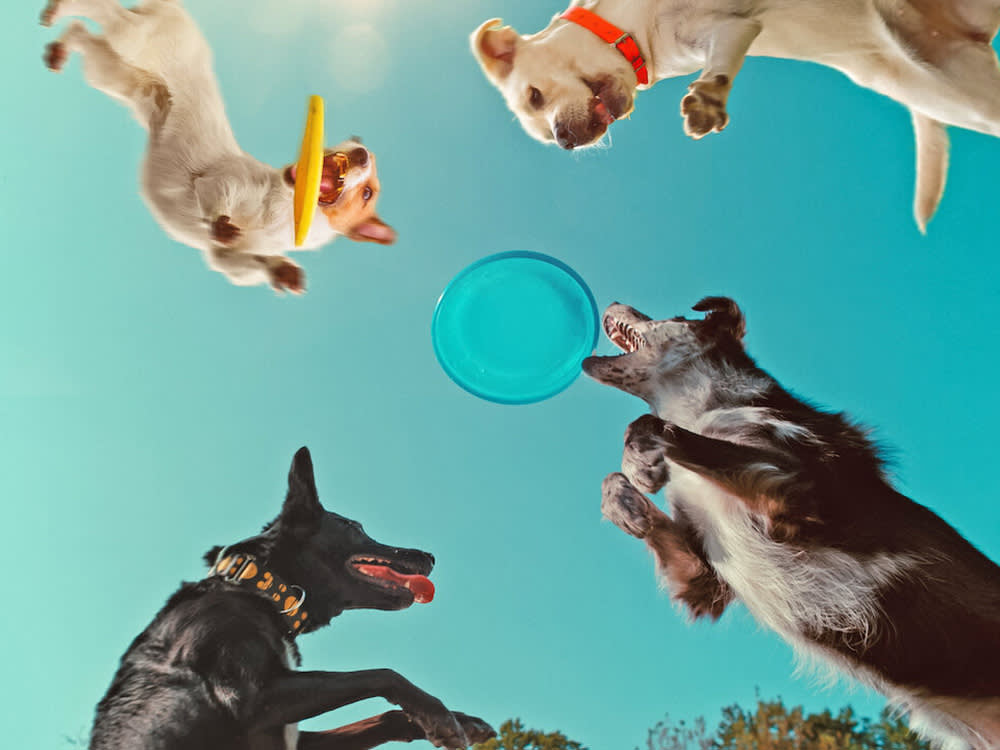
The footage is the easy part, and it is glorious. Puppies at the teat. Canine athletes launching themselves into full mid-air flips. Slow-motion running. Dogs jumping rope, of all things. The entire ridiculous repertoire of dog facial expressions, and a great deal of licking. If you just want to look at dogs for an hour and a quarter, the film delivers without breaking a sweat.
But the science is the reason to watch, and there is a lot of it, ranging from the theoretical to the immediately practical. It is quietly validating to see, after so many decades in which dogs were considered too ordinary to be worth studying, that research on them is now abundant enough to fill a documentary. The film covers:
- Dogs share 99.9 percent of their DNA with wolves.
- Friendliness and cooperation turned out to be a winning evolutionary strategy. As the scientists put it: friendliness wins.
- Puppy-dog eyes are real. The musculature around dogs’ eyes moves in a way that pulls directly at human emotion and makes us want to care for them.
- Dogs have nose prints the way we have fingerprints.
- When dogs feel positive emotions, they wag to the right.
- High-pitched, repetitive barking signals a more upset dog than other kinds of barking.
- A child’s bond with a dog can blunt the impact of a stressful event. Interacting with a dog she is attached to releases oxytocin in the child, and her cortisol falls.
- Early-life stress shapes fear and aggression later in a dog’s life.
- Classical music calms dogs. Rock music does the opposite.
That last one is going to get quoted at dinner parties for years, and it should.
The training section is the best thing in it
The stretch on training service dogs is where the film is at its strongest, and it earns that in a specific way: it shows the actual work, in real time, rather than summarizing it.
The trainers stress patience and repetition, over and over, which is not the exciting answer but is the true one. And the film understands the thing most training content misses, which is that a behavior is not trained until it survives distraction. As one trainer puts it: yes, they can sit. But can they do it with a roller coaster behind them?
So they take a dog to an amusement park and train there, in the noise and the smells and the chaos. Even better is the scene of a detection dog working a scent wall while what looks like several hundred tennis balls are dumped across the floor around him. The dog keeps working. That single shot teaches proofing better than any lecture.
And there is a long, lovely stretch of dogs acquiring the working repertoire: flipping light switches, hauling a fridge door open, nudging a dishwasher shut, touch, shake, give, closing drawers behind them. If watching a skill get assembled from nothing does something for you, that is your ten minutes.
The genuinely interesting idea nobody talks about
The bit of the film I keep thinking about is how dogs get matched to jobs by temperament, because it reframes what “a good dog” even means.
Offer a dog a locked container with food inside. Watch what happens:
- The dog who attacks the problem himself, who works the container, tends to make an excellent detection and search dog. So do the hyperactive ones. That drive is the asset.
- The dog who gets stuck and turns to a human for help tends to make a better service dog for a person with a disability. That is the trait you want in an animal whose job is a partnership.
- The dog with a chronically calm, unflappable demeanor is best suited to working alongside veterans with PTSD.
None of those dogs is better than the others. They are differently pointed. It is the most quietly useful thing in the documentary, and it applies to your pet, too.
What it is not, and why the title is a problem
Here is my first real complaint, and it is not a small one.
There is very little in this film about the mind of a dog. There is a great deal about dogs. There is almost no canine cognition work, which is the actual field the title invokes and which is, right now, one of the most interesting areas in animal science. What do dogs understand? What do they represent about the world? What do they know about what we know?
Inside the Mind of a Dog is a catchy title. It is also an inaccurate description of what is inside.
I want to be fair about the flip side of this, though, because the loudest criticism of the film online is a different and worse one. People complain that it did not cover the specific problem they have with their own dog: barking out the window at passersby, the dog who will not let anyone touch his feet for a nail trim, the dog who prefers one child to another. That is not a flaw in the film. It is a measure of the size of the subject. Seventy-five minutes buys you seventy-five minutes, and a documentary that tried to be comprehensive about dogs would be a different and much worse object.
The choke chains
My second complaint is the one that made me sit forward.
The dogs at the service dog school are wearing choke chains.
Choke chains are not generally considered appropriate training equipment. They can injure dogs, and they work by causing pain. And the strange part, the part I genuinely cannot explain, is that the trainers in this film do not use them that way. The leashes stay loose throughout. The methods on display are positive: clickers, treats, and a lot of them.
So why is the equipment there at all?
I do not want the families who are eventually matched with these dogs to look at that footage and conclude that a choke chain is standard kit. It is not. And when the training on screen is that thoroughly reward-based, it is baffling to see it delivered on hardware with a long history in far less humane methods. It is a costume from another era, worn over a modern practice, and its presence in a mainstream documentary teaches a lesson the film did not intend.
Equipment is a message, whether you use it or not. Millions of people just watched a professional put a choke chain on a service dog. Some of them will buy one on Tuesday, and nobody in that film told them not to.
What newer research adds
The cognition the film skipped is the part worth chasing on your own, and it is the fastest-moving area in the science.
The most striking work of the last few years concerns what dogs understand about human intention, not just human emotion. Dogs distinguish between a human who is unwilling to give them food and one who is unable to, and they respond differently to each. That is a considerably more sophisticated read of a person than “he has the treat and I want it.” There is also serious work now on object permanence, word learning in the small number of dogs who acquire large vocabularies, and canine dementia, which has quietly become one of the most useful models for studying age-related cognitive decline in any species.
None of that is in this film, and all of it belongs under that title.
Which is why the honest recommendation is: watch it. It is beautiful, it is smarter than it needs to be, and you will learn something. Just know that you are watching a very good film about dogs, not a film about their minds. As Lowe’s narration has it, we can all get closer to our dogs if we know their secrets. This one hands you a decent number of them. It just does not go where the marquee said it would.
References
- Netflix Media Center, “Inside the Mind of a Dog.” https://media.netflix.com/en/only-on-netflix/81681888
- Kaminski, J., et al. “Evolution of facial muscle anatomy in dogs.” Proceedings of the National Academy of Sciences, 2019. https://www.pnas.org/doi/10.1073/pnas.1820653116
- Siniscalchi, M., et al. “Seeing left- or right-asymmetric tail wagging produces different emotional responses in dogs.” Current Biology, 2013. https://pubmed.ncbi.nlm.nih.gov/24184108/
- Beetz, A., et al. “Psychosocial and psychophysiological effects of human-animal interactions: the possible role of oxytocin.” Frontiers in Psychology, 2012. https://www.frontiersin.org/articles/10.3389/fpsyg.2012.00234/full
- Bray, E. E., et al. “Effects of maternal care on the development of a canine model of service dog success.” Proceedings of the National Academy of Sciences, 2017. https://www.pnas.org/doi/10.1073/pnas.1704303114
- American Veterinary Society of Animal Behavior, “Position Statement on Humane Dog Training.” https://avsab.org/wp-content/uploads/2021/08/AVSAB-Humane-Dog-Training-Position-Statement-2021.pdf
Dr. Kohl is a board-certified veterinary dentist with a particular interest in preventive oral care. She reviews all dental health content at The Pet Times and contributes practical guides on home dental routines, professional cleaning, and oral disease prevention.
Meet our experts ↗Keep reading
 LivingYour Dog Isn't Predicting Your Pregnancy. They're Reacting to It, and That's UsefulDr. Lena Park · 7 min
 LivingIs Your Dog Really Jealous, or Just Afraid of Missing Out? The Science Is Messier Than the Headlines.Dr. Nina Kohl · 5 min
 TrainingYour Husky Isn't Arguing With You. It's Doing the Job It Was Bred For.Dr. Ravi Mehta · 6 min
 TrainingYour Dog Has a Favorite Person. Here's How to Make Sure It's You.Dr. Mara Chen · 8 min
 TrainingLoving People Doesn't Make a Therapy Dog. The Real Bar Is Higher, and KinderDr. Nina Kohl · 11 min
 TrainingYour Dog Sniffs You at the Door Because You're the Evening NewsLeila Torres · 5 min