


Your Dog Isn't Predicting Your Pregnancy. They're Reacting to It, and That's Useful
The viral question is whether dogs 'know' you're pregnant. The more useful one is what they're actually picking up, and which dogs are likely to get clingy, protective, or unsettled, so you can prepare before the baby arrives.

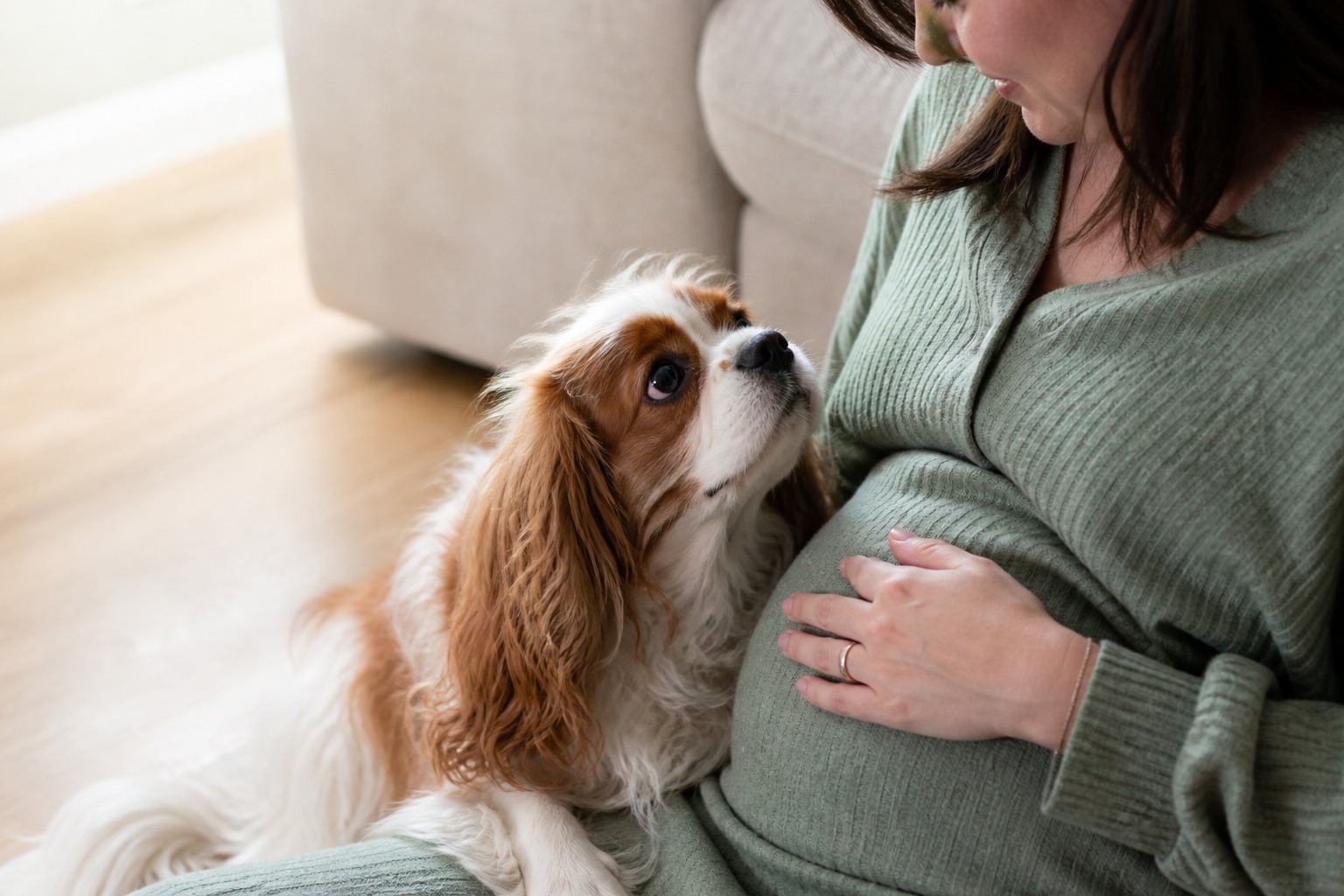
Every few weeks a video goes viral: a dog presses against its owner’s belly, and the caption insists the dog “knew before the test did.” It is a lovely story, and it has launched a thousand comment sections debating whether dogs have a sixth sense. But the question it asks, can my dog tell I’m pregnant?, is the wrong one to organize your attention around. It treats your dog like a party trick when the genuinely useful framing is this: your dog is detecting a change, without understanding it, and that detection is about to collide with the biggest routine upheaval of your household’s life. The thing worth knowing is not whether the magic is real. It is which dogs react, how, and what you can do about it before a newborn is in the house.
What your dog is actually picking up
Two channels feed your dog information, and they work together rather than competing.
The first is chemistry. A dog’s nose is estimated to be tens of thousands of times more sensitive than ours, and pregnancy is, chemically, a dramatic event. Levels of human chorionic gonadotropin, estrogen, progesterone, and relaxin all surge, and a dog’s olfactory system is built to register exactly this kind of shift in body chemistry. Dogs are documented to detect the subtle scent signatures of medical states from low blood sugar to oncoming seizures, so a hormonal sea change is well within range.
A pregnancy changes a person’s whole chemical signature, so it’s entirely plausible a dog notices the difference in how you smell. But noticing a change and understanding its meaning are different things. The dog isn’t thinking ‘baby.’ It’s thinking ‘something about my person is different,’ and a lot of dogs find different unsettling.
The second channel is behavior, and it is the one people underrate. Long before a bump shows, your routine starts bending around the pregnancy. You move more slowly, you nap when you didn’t used to, the morning walk slips, the house fills with unfamiliar gear, and the emotional temperature of the home rises and falls with the stress of it all. Dogs are relentless students of your baseline. They clock all of it, and much of the “my dog knew” feeling is really your dog responding to a dozen small departures from normal.
What the data actually says
The honest answer is that the evidence is mostly self-reported, but recent surveys have started to put numbers on the anecdotes, and the most interesting finding is not the headline one.
A 2025 poll of more than 400 pregnant and recently pregnant pet owners found that 67 percent felt their dog could tell they were pregnant. That is a striking majority, and also exactly the kind of number you would expect from a question people want to answer yes to.
The more useful study came out of Queen’s University Belfast, also in 2025, published in the journal Anthrozoös. Researchers surveyed 130 people who had owned a dog through a pregnancy and asked, in detail, what changed. Roughly two-thirds reported a behavior change during the pregnancy, and about a quarter said the change came before they knew they were pregnant. But the part worth circling is what predicted a change. It was not breed, not the owner’s age, not anything about the pregnancy itself. The dogs whose behavior shifted were disproportionately the ones that were already prone to guarding around unfamiliar people, or already fearful and anxious around other dogs, before the pregnancy began.
That single finding reframes the whole topic. A pregnancy does not install new traits in a dog. It amplifies the ones that were already there. If your dog was a bit reactive or a bit of a guarder before, that is the dog most likely to get more so, which is precisely the dog you most want to prepare in advance.
Why some dogs notice nothing at all
For balance, plenty of dogs sail through a pregnancy without registering a thing, and that is completely normal. Across the surveys, a meaningful share of owners reported no change whatsoever. A dog who keeps tackling the bump and stealing the same socks is not defective or unbonded. Many dogs simply are not the sensitive, weather-vane type, and a pregnancy that throws one dog into clingy vigilance washes right over another. Reading meaning into the absence of a reaction is as much a mistake as reading magic into the presence of one.
The part that actually matters: preparing the dog
Here is where the reframe pays off. Whether or not your dog “knows,” a baby is coming, and the window before the birth is the time to set your dog up to cope. Treat it as a training project, not a guessing game.
Settle guarding and possessiveness before the birth, not after. This is the single highest-value task, especially given what the Belfast study found. If your dog has started guarding you, growling when a partner approaches the bed or couch, or getting territorial with visitors, address it now while you have time and attention. The usual approach is to give the dog its own clearly rewarded place to rest and to roll back furniture privileges if needed, rather than negotiating with a resource-guarding dog while holding a newborn.
“The behaviors people most often ask me about are the protective ones, the barking at visitors, the guarding of the pregnant person, sometimes aimed at their own partner,” says Dr. Mara Chen, DVM. “Those almost never improve on their own once the baby arrives and the household gets more chaotic. The families that do well are the ones who treat it as a training goal months ahead, not a problem to solve in week one.”
Build a reliable ‘go to your spot.’ Teach the dog to retreat to a bed or crate on cue, and make that spot genuinely good with treats and chews, so that when the doorbell rings or the baby cries, the dog has a rewarding job to do instead of a crisis to manage. Walk-through gates help you greet guests without a frantic dog underfoot.
Introduce the baby’s world early. Put the carrier, the stroller, and the diapers out weeks ahead so the gear and its smells become old news rather than alarming novelties. Make it clear that baby toys are not dog toys by keeping them physically separated, and keep a stock of the dog’s own toys in easy reach.
Protect some routine and exercise. A lot of pre-birth stress for a dog comes from feeling suddenly sidelined. If long walks get harder, swap in more frequent short ones. The goal is for the dog to experience the changes as “I’m still part of this” rather than “I’m being forgotten,” which is the feeling that curdles into anxiety and acting out.
The bottom line
Can your dog sense your pregnancy? In the loose sense that they detect the change, through your shifting scent and your shifting habits, almost certainly. In the sense the viral videos imply, that they comprehend a baby is coming, no. And that distinction is not a buzzkill, it is the practical heart of the matter. Your dog is reacting, not forecasting, and the dogs that react hardest are usually the ones already inclined toward guarding or anxiety. Spend the months before the birth preparing that dog, and you will have done far more for your family than any amount of wondering whether your dog knew first.
References
- Wilson, S., et al. “Dog Owners’ Perceptions of Their Pet Dogs’ Behavior When Owners Became Pregnant.” Anthrozoös, 2025.
- Jenkins, E.K., et al. “When the Nose Doesn’t Know: Canine Olfactory Function.” Frontiers in Veterinary Science
- American Veterinary Medical Association: Introducing a New Baby to Your Pet
- ASPCA: Resource Guarding in Dogs
Common questions
Can dogs really sense pregnancy?
Dogs almost certainly detect the change a pregnancy brings, through scent shifts tied to hormones and through changes in your routine, energy, and body language. What they don't do is understand that a baby is on the way. They register that something is different about you, not why.
Why is my dog suddenly clingy now that I'm pregnant?
Clinginess is one of the most commonly reported changes. Dogs are sensitive to any departure from your baseline, and a pregnancy shifts your smell, your schedule, your movement, and the home itself. A dog that gets extra attached is responding to that bundle of change, not making a prediction.
Which dogs are most likely to change their behavior during pregnancy?
A 2025 study found that dogs already prone to guarding around unfamiliar people, or already fearful or anxious around other dogs, were the ones whose owners most often reported a behavior change during pregnancy. If your dog had those tendencies before, watch for them to intensify.
How do I prepare my dog for a new baby?
Start early. Introduce the baby's gear and scents in advance, settle any resource guarding before the birth rather than after, teach the dog a reliable spot to go to (a bed or crate) and make it rewarding, and keep some routine and exercise intact so the dog still feels included rather than displaced.
Dr. Park is a board-certified emergency and critical care specialist. She reviews our health and safety content for clinical accuracy and contributes guides on recognising urgent conditions. Her focus is helping owners act quickly and correctly when it matters most.
Meet our experts ↗Keep reading
 LivingThe ADA Has No Breed List. Your Landlord's Insurance Does.Dr. Priya Nair · 6 min
 TrainingYour Dog Isn't Ignoring You. You're Talking Too Fast.Tom Hadley · 5 min
 TrainingYour Tears Stress Your Dog Out. A Pet Pig Wouldn't Care.Dr. Nina Kohl · 5 min
 TrainingYour Dog Isn't Catching Your Sadness. They're Catching Something TrickierDr. Priya Nair · 7 min
 LivingYour Dog Outranks Your Best Friend, According to ScienceJordan Ellis · 4 min
 LivingYou Can't Make Your Partner's Dog Like You. So Ignore It.Dr. Ravi Mehta · 5 min