


Your Tears Stress Your Dog Out. A Pet Pig Wouldn't Care.
A study of family dogs and pet pigs found dogs get visibly rattled when a human cries, while pigs shrug it off. The gap points to something built into dogs by thousands of years of living with us.

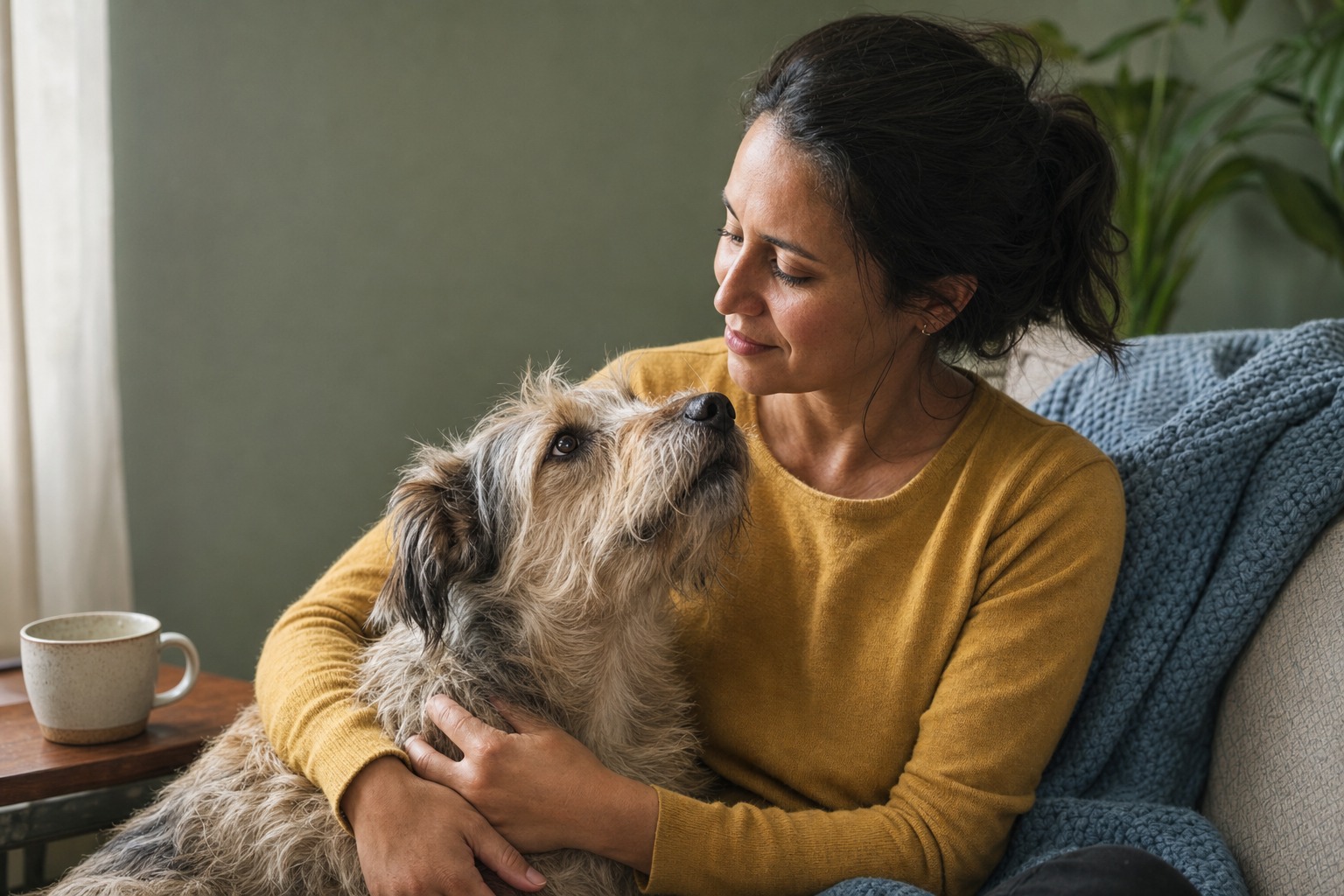
Cry on the couch and there’s a decent chance your dog is at your knee within seconds, pushing their head under your hand, looking faintly alarmed. Most of us file that under “dogs are sweet” and move on. A study published in the journal Animal Behaviour in 2024 did something more interesting with it: the researchers found a way to test whether that response is learned from living near people, or something deeper. Their trick was to bring in a second animal that also shares our homes but arrived by a very different road, the pet pig.
The setup that makes the finding convincing
Plenty of earlier research already showed dogs are tuned to human distress. Dogs will approach a crying stranger, sometimes sooner than they’ll go to their own person, and their stress hormone levels climb when they hear a human infant cry. What those studies couldn’t rule out was the obvious objection: maybe dogs learn to read us simply because they spend their whole lives underfoot.
So the team recruited both companion dogs and companion pigs from families across several countries and played each animal two recordings, one of a person crying and one of a person humming. Pigs are a smart control group precisely because they’re also domesticated and also kept as pets, but their long history with humans was about food and farming, not cooperation and companionship. If proximity alone explained the response, both species should react the same way.
They didn’t. The dogs showed more signs of stress, shaking, whining, extra vocalizing, when they heard crying, and they were quicker to look toward and move toward their owner. The pigs found the humming more unsettling than the crying, reacting to it as an odd, unfamiliar noise rather than an emotional signal.
Why that gap matters
The researchers were careful not to turn this into a pigs-versus-dogs morality tale. Study co-author Paula Pérez Fraga told Nature that the point was less about pigs falling short and more about how strikingly attuned the dogs were; it’s entirely possible the pigs simply didn’t parse the humming as meaningful. Pigs are sensitive, emotional animals in their own right.
What the comparison does suggest is that a dog’s sensitivity to a crying human isn’t just a party trick picked up around the dinner table. It looks like part of the package that came with domestication itself, the long selection for animals that cooperate with us and stay tuned to our moods.
This is the science catching up to something owners already feel. Your dog isn’t performing sympathy. When you’re upset, your dog is genuinely picking up a signal it’s wired to notice, and that’s worth respecting rather than laughing off.
What to do when your feelings land on your dog
If your dog is built to absorb your distress, that’s a two-way street worth managing:
- Don’t punish the check-in. A dog nosing at you while you cry is doing exactly what evolution built it to do. Let them lean in if that’s their instinct.
- Watch for a dog who never gets to switch off. In a household with chronic tension or frequent crying, some dogs stay in a low hum of stress. Give them an easy exit, a bed in a quiet room, a chew, a normal walk, so they can decompress instead of standing guard over your mood.
- Use your own regulation as a tool. Because dogs read your state so closely, the calmest thing in the room is often the most useful. Steadying your own voice and breathing tends to settle an anxious dog faster than reassurance aimed at them.
What newer research adds
The 2024 Animal Behaviour paper is part of a fast-growing body of work on how dogs track human emotion, and the direction of travel is consistent. Recent studies have shown dogs can smell the chemical signature of human stress and shift their own choices in response, and that they process human voices in dedicated brain regions. The through-line is that dogs aren’t guessing at our feelings from body language alone; they’re pulling signals from sound, scent, and behavior at once. The cross-species comparison with pigs is the newest wrinkle, and it nudges the explanation away from “dogs learn us” toward “dogs were shaped to read us.”
References
- Family pigs’ and dogs’ reactions to human emotional vocalizations: a citizen science study — Animal Behaviour, 2024
- Dogs might have evolved to read your emotions — Nature news coverage
- Emotional contagion: dogs and humans show a similar physiological response to human infant crying — earlier primary research on canine stress responses
Dr. Kohl is a board-certified veterinary dentist with a particular interest in preventive oral care. She reviews all dental health content at The Pet Times and contributes practical guides on home dental routines, professional cleaning, and oral disease prevention.
Meet our experts ↗Keep reading
 LivingYou Can't Make Your Partner's Dog Like You. So Ignore It.Dr. Ravi Mehta · 5 min
 LivingHis Dog Walks Into the Office at 5 P.M. and Ends the WorkdayJames Okafor · 6 min
 TrainingYour Dog Has a Favorite Person. Here's How to Make Sure It's You.Dr. Mara Chen · 8 min
 TrainingYour Dog Picked the Person Who Ignores It. Here's Why.Dr. Priya Nair · 7 min
 TrainingYour Dog Tolerates Your Hugs. That's Not the Same as Liking Them.Dr. Ravi Mehta · 7 min
 TrainingYour Husky Isn't Arguing With You. It's Doing the Job It Was Bred For.Dr. Ravi Mehta · 6 min