


Your Dog Tolerates Your Hugs. That's Not the Same as Liking Them.
The famous stat says over 80 percent of dogs look stressed while being hugged. It's probably right, but it was never peer-reviewed, and the real story is subtler. Here's what a hug means to a dog, how to read yours, and how to love on them in a way they actually enjoy.

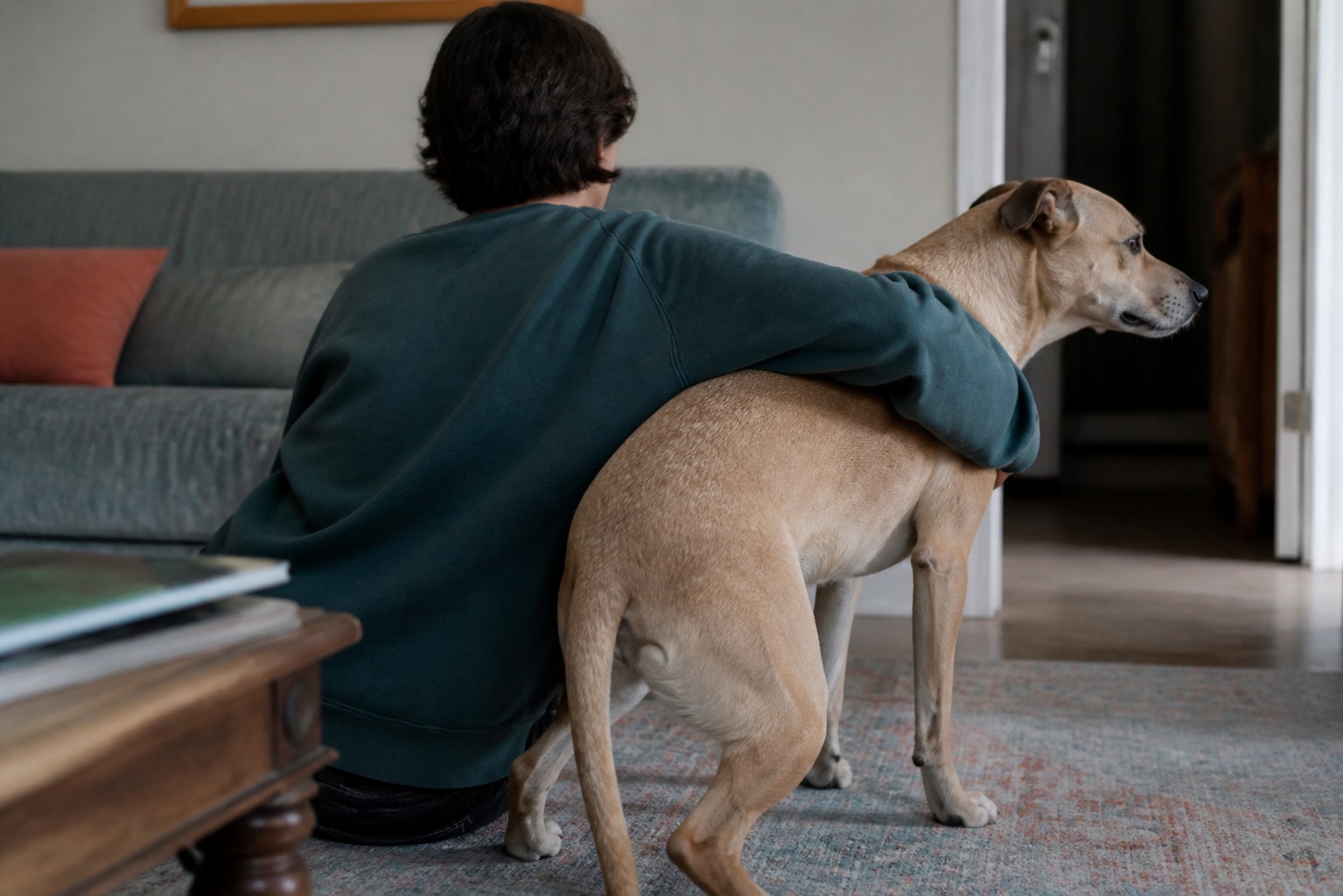
You love your dog, so you wrap your arms around them and squeeze, because that’s what love looks like to a human. Here’s the slightly deflating truth: to most dogs, that gesture doesn’t mean what it means to you. Your dog probably tolerates your hugs. A smaller number genuinely dislike them. And tolerating is not the same as enjoying, which is the distinction this whole piece turns on.
None of that means your dog doesn’t adore you or want to be close to you. It just means the specific act of hugging, arms clamped around the neck or body, lands differently for a species that never evolved to find restraint comforting. Let’s get the famous evidence straight first, because it’s usually cited more confidently than it deserves.
The stat everyone quotes, in full
The number you’ve seen, that most dogs hate hugs, traces to psychologist Stanley Coren. He looked at 250 random internet photos of people hugging dogs and sorted each dog into one of three buckets: appears stressed or anxious, appears relaxed and at ease, or neutral and ambiguous. He counted stress signals like tongue-flicking, ears down, a face turned away, “half-moon” whites showing in the eyes, a tightly shut mouth, rigid facial muscles, and a furrowed brow, against relaxed cues like an open mouth and loose facial muscles. To keep it clean, he only used photos where the dog’s face was visible and no other obvious stressor, like being lifted, was in the frame.
The tally: 204 of the 250 dogs, about 81.6 percent, showed one or more signs of stress or discomfort. Another 27 (10.8 percent) looked neutral or ambiguous, and just 19 (7.6 percent) seemed genuinely comfortable. Coren’s conclusion was blunt, that we should mostly keep our hugs for other humans.
The honest asterisk on that number
Here’s the part that rarely travels with the statistic: this was not a peer-reviewed study. Coren published it as a magazine column, based on an informal look at photos he pulled off the internet, not a controlled experiment with a random sample. So treat the exact 81.6 percent as a striking illustration, not a hard scientific finding.
And yet, the direction it points is almost certainly right, because it lines up with everything trainers and behaviorists see and with well-established canine body-language science. If anything, those photos may undersell the discomfort. They were posted by people proud enough of the moment to share it, and someone showing off their dog is not going to pick the shot where the dog is most visibly miserable, assuming they can even read the signs. So: soft evidence, but pointing the same way as the strong evidence. Most dogs are not hug fans.
Why “my dog loves hugs” is usually a misread
Plenty of loving owners are certain their dog is the exception. In practice, when people demonstrate, the “happy” dog is usually flashing quiet stress signals the owner never learned to see, a stiff body, a whale eye, a frozen little smile. It’s a lot like how nearly everyone rates themselves an above-average driver: statistically, most of us can’t be the exception, and most dogs can’t either. This is the “better-than-average” effect wearing a leash.
That misread has real stakes. Children in particular get bitten hugging dogs precisely because they miss the warning signs, leaning in for affection while the dog is signaling, clearly in dog language, please stop. A dog who has run out of subtler ways to say no may escalate.
There are true exceptions, though. A minority of dogs are genuinely fine with hugs, and whether a given hug is welcome comes down to the specific dog, who is delivering it, the moment you pick, and the way it is given. You can even teach a dog to enjoy hugs by pairing them with something wonderful, hug, then chicken, repeated hundreds of times, so the embrace comes to predict good things. The point isn’t that hugging is forbidden. It’s that you have to actually check, not assume.
How to show love your dog will actually enjoy
Start by separating a hug from a cuddle, because they are not the same experience. A hug is a full arm-wrap around the body or neck. A cuddle is leaning, snuggling, resting against you, and lots of dogs love that. So the first move is often to swap the squeeze for a snuggle.
If you do want to hug, do it thoughtfully:
- Read the dog first, and check the moment. Don’t hug a dog who’s eating, focused on something else, or plainly not in the mood, and watch continuously for stress signals during the hug, not just before it.
- Go gentle, short, and low. A brief, loose hug that stays off the neck is far easier for a dog to accept than a long, tight squeeze up high.
- Always supervise kids. Children tend to squeeze hard and hang on necks, so watch closely and coach them to cuddle rather than clamp.
- Let the dog set the terms. If you share a strong bond, your dog may tolerate an occasional hug, but don’t overdo it, and when in doubt, don’t. A dog leaning into you, or a tall dog choosing to put their paws on your shoulders, is the dog offering closeness on their terms, which is a different, welcome thing.
- Never hug a dog you don’t know. It should go without saying, but hugging an unfamiliar dog is a genuine bite risk.
A dog who ‘loves hugs’ is very often a dog who has learned to hold still and wait for it to be over. Watch the face, not your own feelings. If the head turns away, the mouth tightens, and you see white at the corner of the eye, that’s a no, and honoring it is how you keep a dog trusting your hands.
The throughline is consent. You wouldn’t grab a person you just met into a bear hug, you’d read the room and ask. Your dog deserves the same courtesy. Learn their signals, offer affection in the forms they enjoy, and back off when they tell you to. That’s not less love. It’s love that actually reaches them.
What newer research adds
The flip side of the hug research is the good news about what genuinely bonds you to your dog, and it isn’t restraint. Studies on the “love hormone” oxytocin have shown that when dogs and their people share a soft, mutual gaze, both species get a surge of it, the same feedback loop that binds parents and infants. Connection, chemically speaking, comes from eye contact, gentle touch on the dog’s terms, play, and calm togetherness, not from a tight squeeze.
So if hugging isn’t your dog’s thing, you’ve lost nothing. The affection they crave, and the affection that actually deepens your bond, is available in a dozen forms they love. Save the hugs for the humans who asked for them, and let your dog show you how they’d rather be adored.
References
- Coren S. “The Data Says ‘Don’t Hug the Dog!’” Psychology Today, 2016 (informal analysis; not peer-reviewed). psychologytoday.com
- Nagasawa M, et al. “Oxytocin-gaze positive loop and the coevolution of human-dog bonds.” Science, 2015. science.org
- American Veterinary Medical Association. “Dog bite prevention.” avma.org
This article covers dog behavior and bite safety. If your dog shows fear or aggression around handling, work with your veterinarian and a qualified, reward-based behavior professional.
Common questions
Do dogs actually like being hugged?
Most dogs don't love it. A hug wraps a dog's neck or body and can feel restraining, which reads as stressful to many of them. Some tolerate it, a minority genuinely enjoy it, but tolerating a hug is not the same as liking it. Cuddling and leaning are different and often welcome.
How can I tell if my dog dislikes a hug?
Watch the face and body during the hug. Signs of stress include a turned-away head, whale eye (whites showing in a half-moon), a tightly closed or tense mouth, ears pinned back, tongue-flicking, a furrowed brow, and a stiff, frozen body. A relaxed dog has a loose body, soft face, and often an open mouth.
Is it safe to hug a strange dog?
No. Hugging an unfamiliar dog is a real bite risk because you can't predict their reaction and you're putting your face near their teeth while restraining them. Save hugs for your own dog, if they enjoy it, and never let children hug dogs they don't know.
Dr. Mehta is a board-certified veterinary nutritionist who evaluates pet food formulations, ingredient quality, and the science behind dietary trends. He writes and reviews all nutrition content at The Pet Times, including our food rankings and feeding guides.
Meet our experts ↗Keep reading
 LivingYour Dog Isn't Predicting Your Pregnancy. They're Reacting to It, and That's UsefulDr. Lena Park · 7 min
 LivingIs Your Dog Really Jealous, or Just Afraid of Missing Out? The Science Is Messier Than the Headlines.Dr. Nina Kohl · 5 min
 LivingHis Dog Walks Into the Office at 5 P.M. and Ends the WorkdayJames Okafor · 6 min
 LivingNew York's Hottest Club Is a $795 Dog RunNina Vasquez · 8 min
 TrainingA Therapy Dog Isn't a Service Dog. Here's Where They Do Their Best Work.Sasha Ford · 7 min
 Health & WellnessDog Saliva Doesn't Heal Wounds. It Delivers Bacteria.Dr. Priya Nair · 8 min