


Your Dog Isn't a Character Judge. But Their Cold Shoulder Still Means Something.
The date didn't click with your dog, so you called it off, and now a friend says you're being dramatic. The honest answer: your dog can't read someone's soul. What they can read is worth paying attention to anyway.


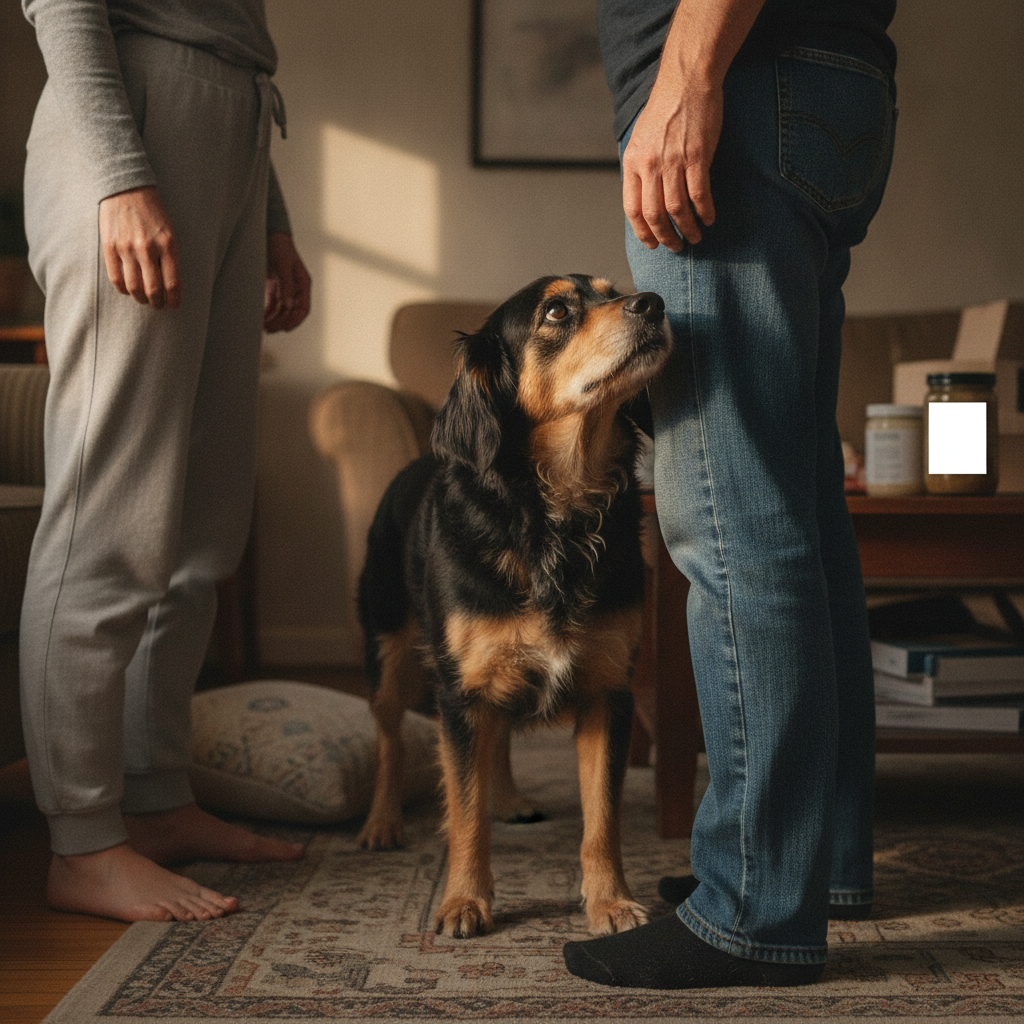
You bring a new person around, your normally easy, everyone-is-my-best-friend dog goes cool, and something in you shifts about the whole thing. Then a friend rolls their eyes and tells you that ending a promising date over your dog’s mood is ridiculous. So which is it? Is your dog a wise little oracle, or an excuse you are hiding behind?
The useful answer sits in between, and it starts with being clear about what a dog can actually do. Your dog is not a lie detector. They cannot sniff out that someone is selfish, or dishonest, or bad for you in the abstract. What they can do is read a specific, real interaction happening right in front of them, and that turns out to be worth something.
What a dog is genuinely evaluating
Dogs are far better at social bookkeeping than we tend to assume. In one well-known experiment, dogs watched a stranger either help their owner with a task or pointedly refuse to. Afterward, the dogs were less willing to take a treat from the person who had snubbed their owner. They were not judging that stranger’s character. They were tracking one concrete thing: how this person behaved toward my human.
That is the honest scope of your dog’s opinion. Not “this person is a bad human,” but “this person was cold, tense, or dismissive in a moment I witnessed.” Which, when you are deciding whether to see someone again, is not nothing.
The two very different signals hiding in a snub
The trick is that a dog’s chilly reaction can come from two completely different places, and they call for opposite responses.
Sometimes it is about the date. If your relaxed, friendly dog does something genuinely out of character, actively pulling away from a person they would normally greet, that is the reaction worth noticing. Often it comes down to body language and vibe, the person radiating discomfort, stiffness, or indifference that the dog picks up instantly and you only half-registered.
And sometimes it is simply that your date is not a dog person. Someone who is nervous around animals, or just uninterested, moves differently, hangs back, avoids eye contact, reaches out stiffly. Dogs read that as standoffish and respond in kind. That tells you something real too, but it is a preference to weigh, not a character flaw to convict on. Plenty of kind, wonderful people did not grow up with dogs and have to warm up.
“A dog’s reaction to a new person is real data, but it’s narrow data, it reflects that specific encounter, not a verdict on the human,” says Dr. Lena Park. “Before you read anything into it, ask whether you actually set the meeting up to go well. A rushed, high-pressure introduction fails plenty of perfectly good people.”
You are part of this equation
Here is the part that is easy to skip. It falls to you, the owner, to arrange that first meeting so both your dog and your date can do well, and a lot of failed introductions are really failed setups. Did you tell your date how your dog likes to be approached? Did you let the dog come to them instead of the other way around? Did you pick a calm moment, or spring the introduction at the worst possible time? A bad first impression between your date and your dog is often just choreography, not chemistry.
There is also the uncomfortable mirror. Dogs are superb at picking up our feelings and reflecting them back, which means your dog can become a vehicle for what you already, quietly, feel. If some part of you was lukewarm on this person before the walk even started, do not be shocked when your dog seems lukewarm too. That is not clairvoyance. That is your dog reading you.
The question actually worth asking
So flip it. The real question is not “does my dog approve.” It is: is my dog surfacing a gut feeling I already had but had not admitted, or is my dog a convenient reason to bail on someone who just needed a second, more relaxed try?
If it is the former, that is genuinely useful. When you have a tingle you cannot name and your dog seems to echo it, treat that as your own intuition getting a second vote, and go with it. Trusting yourself here is great. Outsourcing the entire decision to a fifteen-pound judge who once fell in love with the mail carrier is not.
And the positive version deserves airtime, because it is the sweeter data point. When a dog is unusually, wiggily delighted by someone, when they light up the second that person comes through the door, it is awfully hard not to take it as a good sign. It is not proof of a soulmate. But a warm, easy, repeated bond between your dog and a new person is a lovely thing to get to watch, and more than one relationship has quietly gotten its start in exactly that glow.
References
- Chijiiwa H, Kuroshima H, Hori Y, Anderson JR, Fujita K. “Dogs avoid people who behave negatively to their owner: third-party affective evaluation.” Animal Behaviour, 2015. sciencedirect.com
- Chijiiwa H, et al. “Cats (Felis catus) Show no Avoidance of People who Behave Negatively to their Owner.” Animal Behavior and Cognition, 2021. animalbehaviorandcognition.org
Sasha Ford is a certified cat behaviour consultant who has worked with shelters, catteries, and private clients across the country. They review all feline behaviour content at The Pet Times, with expertise in multi-cat households, indoor enrichment, and stress-related disorders.
Meet our experts ↗Keep reading
 LivingYou're Not Soft for Loving Your Dog This Much. You're Wired for It.Dr. Mara Chen · 6 min
 TrainingBaby-Talking Your Dog Isn't Silly. It's Science.Marcus Webb · 5 min
 TrainingNo, Your Cat Didn't Secretly Raise Your Dog. But Something Real Is Going On.Dr. Nina Kohl · 5 min
 LivingThere's No National Dog-Barking Law. Here's What Actually Gets You FinedSasha Ford · 11 min
 LivingYour Dog Isn't Upset When You Argue. They're Trying to Stop You.Jordan Ellis · 6 min
 TrainingYour Dog Sniffs You at the Door Because You're the Evening NewsLeila Torres · 5 min