


Your Dog Isn't Upset When You Argue. They're Trying to Stop You.
When a couple fights, the dog leans in, blocks a knee, drops a toy. It looks like distress. It's closer to a strategy, and it works on the humans more than anyone gives it credit for.
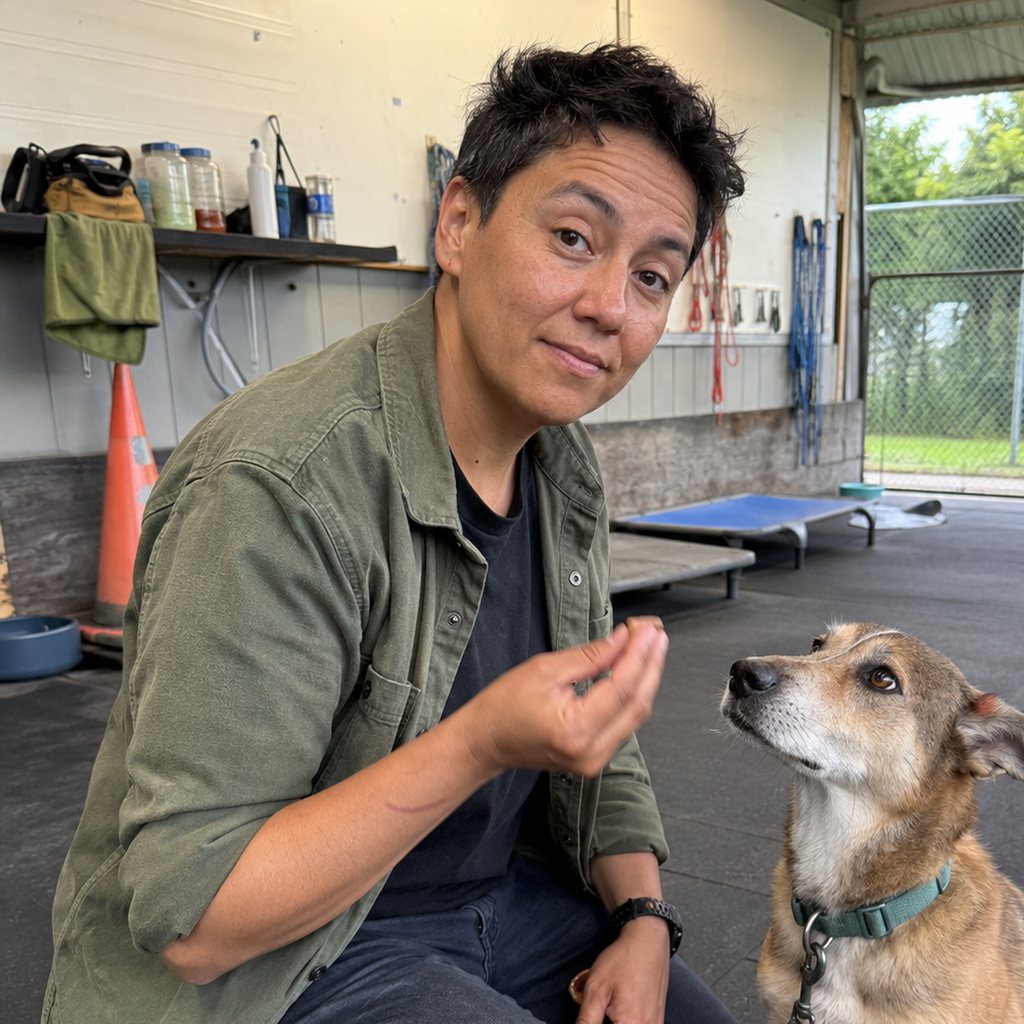
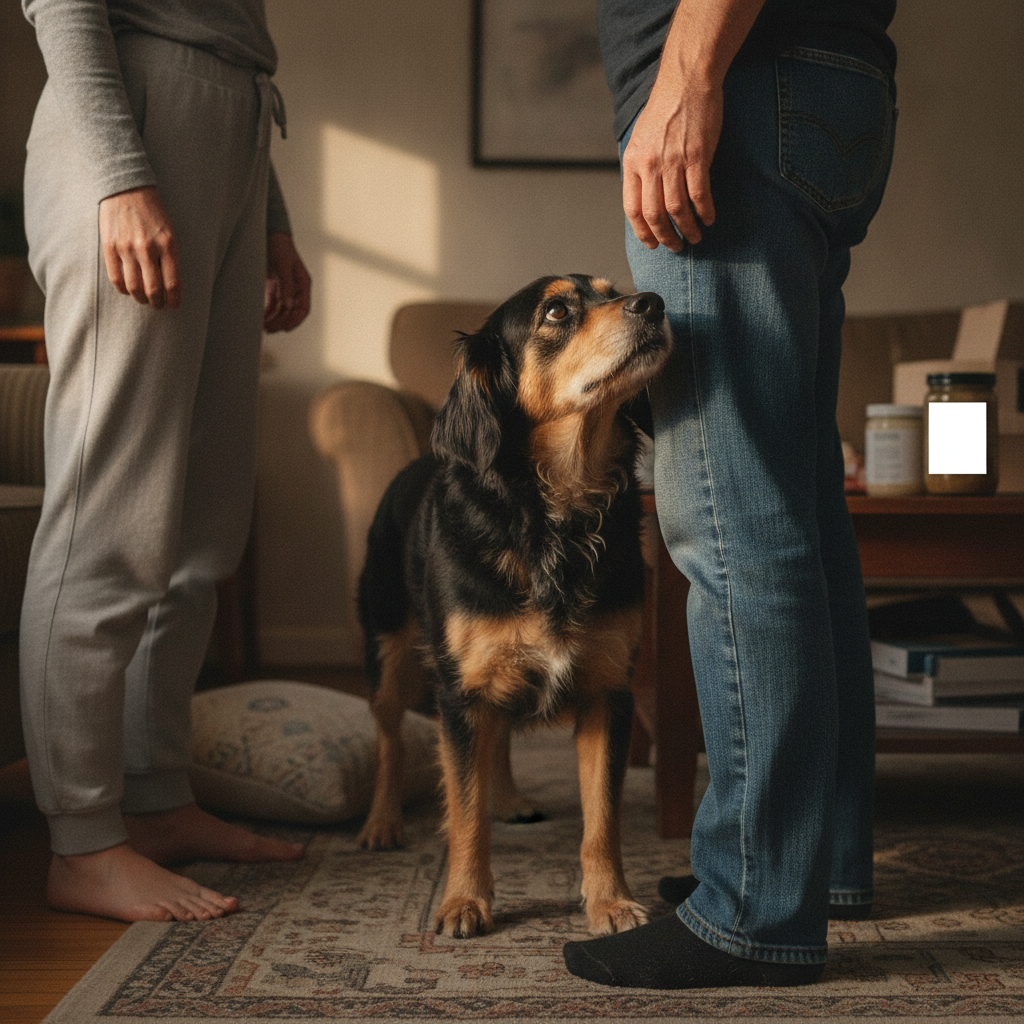
Every couple that lives with a dog knows the move. Voices climb, the room tightens, and suddenly there is a dog wedged between your shins, nose bumping the back of a knee, or flopping down heavily across two sets of feet like a furry speed bump. It is easy to read that as a dog falling apart. It is more interesting, and more accurate, to read it as a dog doing something on purpose.
Here is the reframe worth sitting with: your dog is probably not a passive victim of your argument. In the middle of the tension, they are running an interruption. And whether or not they understand a word of what you are fighting about, the interruption tends to work.
What the dog is actually reading
Start with what a dog can and cannot pick up. They do not follow the content of the fight, who forgot to text, whose turn it was, none of it. But they are not oblivious either, because a lot of what they respond to never reaches the level of words. Dogs are exquisite readers of tone, posture, and volume, and they are literally reading your body chemistry too. In a controlled study, dogs could distinguish the smell of a stressed person from the same person when calm, from breath and sweat samples alone. You can lower your voice all you want. The dog already got the memo through their nose.
So when a dog inserts themselves into a tense moment, it is not because they parsed the disagreement. It is because the two people they are bonded to are throwing off every signal that says something is off, and the dog wants that signal to stop.
Why leaning in is a strategy, not just stress
Dogs are social problem-solvers, and one of the tools in the kit is soliciting attention to break a pattern. A dog who blocks your path, leans a full body weight against your leg, or trots over with a toy is not just anxious. They are pulling focus, and they are good at it. It is very hard to keep the heat in an argument when a 60-pound animal is methodically pressing a slobbery toy into your thigh and staring up at you.
That is where the effect loops back onto the humans. The second one of you bends down to reassure the dog, the fight has already been paused. Your attention leaves the conflict and lands on the animal. What started as a truce staged for the dog’s benefit can quietly turn into a real cooling-off, which is sometimes all a stuck argument needed. The dog did not resolve anything. The dog created the gap where resolution becomes possible.
“A dog nosing into a tense moment is usually trying to defuse it, not cower from it, and the tool they reach for is the one that works on us: making themselves impossible to ignore,” says Dr. Lena Park. “The useful part for the humans is to let it land. Take the interruption, take the breath, and come back to the conversation a notch calmer.”
The part that can go sideways
Not every dog’s response is sweet. If your dog is more strongly bonded to one partner than the other, escalating tension can read to them as a threat aimed at their person, and some dogs will resource-guard that human, putting themselves protectively in the middle or getting reactive toward the other partner. That is not a dog being dramatic; it is a dog doing threat management with the only logic they have.
It also helps to know the limits of a dog’s understanding, because it saves you from a pointless performance. Plenty of couples try to visibly “make up” in front of the dog, the way you might reassure a kid that everything is fine now. Dogs do not have the cognitive flexibility to track a make-up-and-break-up arc. Staging a reconciliation for their benefit mostly reassures you, not them. What the dog registers is the emotional temperature in the room right now, not the narrative you are trying to sell.
What to actually do with it
You cannot hide the fight from the dog, so the better goal is to take care of the dog through it and let the dog’s instinct do a little work on you.
A few things that help:
- Give the dog a real off-ramp. Rather than just soothing them in the hot zone, redirect that energy into something regulating: a decompression walk on a long line, a lick mat, or a good long chew. These give an unsettled dog a biological task instead of a worry.
- Make space if they need it. For a fearful or sensitive dog, one who startles at raised voices or sudden movement, the kindest option can be an easy exit, a quiet room or the yard, so they are not stuck marinating in the tension.
- Reconnect afterward, together. A short walk or a play session as a unit, both humans and the dog, resets everyone. It also happens to be the exact thing that pulls a couple back onto the same team.
Read plainly, the dog in the middle of your argument is not a fragile bystander you have to protect from the truth of your relationship. They are a small, insistent de-escalation device with a great nose and no stake in who was right. The least you can do is take the hint.
References
- Wilson C, et al. “Dog olfactory perception of stress-related volatile organic compounds from human breath and sweat.” PLOS ONE, 2022. journals.plos.org
- ASPCA. “Canine Body Language.” aspca.org
Jordan Ellis is a certified professional dog trainer with a decade of experience working with rescue organisations and private clients. They specialise in anxiety, reactivity, and positive reinforcement methods, and review all training and behaviour content at The Pet Times.
Meet our experts ↗Keep reading
 TrainingThose "Puppy Dog Eyes" Weren't Invented to Manipulate You. Science Just Proved It.Jordan Ellis · 5 min
 LivingYour Dog Probably Doesn't Want to Be in Your WeddingNina Vasquez · 8 min
 TrainingYour Dog Is Chasing Your Laugh. Science Says It's No Accident.Dr. Nina Kohl · 4 min
 TrainingYour Dog Can't Catch You in a Lie. It Can Decide You're Not Worth Trusting.Dr. Priya Nair · 6 min
 TrainingAre You Hovering Over Your Dog? The Line Between Caring and Smothering.Dr. Lena Park · 7 min
 TrainingYour Husky Isn't Arguing With You. It's Doing the Job It Was Bred For.Dr. Ravi Mehta · 6 min