


Your Dog Probably Doesn't Want to Be in Your Wedding
Ninety-one percent of pet parents celebrate their wedding with their dog in some way, but almost no dog can handle a full ceremony and reception. An honest decision guide: how to ask your dog instead of yourself, the four hard limits, the small role that actually works, and how to honor them in spirit.
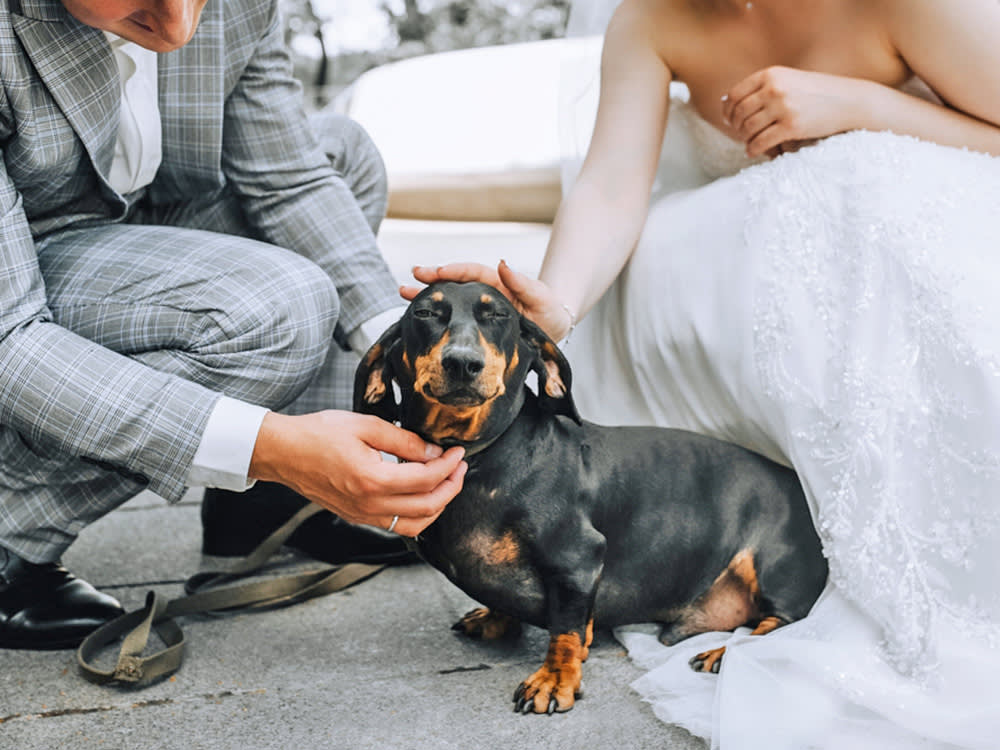
Here’s a statistic that surprises no one who’s been to a wedding lately: according to a 2021 WeddingWire survey, 91 percent of pet parents mark the occasion with their dog somehow, and 30 percent hand the dog a role in the ceremony itself. Dogs are the new ring bearers, the “best dogs,” the dogs of honor. The instinct is lovely.
The instinct is also where most people start asking the wrong question. It isn’t “how do I include my dog in my wedding.” It’s “should I, and if so, for which twenty minutes.” Because the honest truth, one that professional trainers and wedding-day dog handlers will tell you directly, is that almost no dog can do an entire wedding, start to finish. The kind thing, and the thing that actually makes for better photos, is to plan around what your specific dog can genuinely handle.
The one test that beats every checklist
Before you sketch out a role, run a simple thought experiment: ask the dog, not yourself. If you could explain the whole day to your dog in advance, the hundreds of guests, the speakers, the sweating, the strangers, and then ask whether they wanted to come, what would they say yes to, and what would make them unsure?
That reframe matters because your emotions and your dog’s are pointed in different directions. You want them there. They may just want a nap. Dogs need far more sleep than we do, and adult dogs spend close to half the day asleep, so a seven- or eight-hour event is a physical marathon before you add any of the social pressure.
“People plan the dog’s role around the wedding they’re imagining, not the dog in front of them,” says Dr. Mara Chen. “I tell couples to picture their dog’s hardest ten minutes of the day and design backward from that. If your dog can’t relax in a room full of new people on a normal Tuesday, a room of two hundred won’t be the exception. The most loving plan is usually a short, well-supported cameo and a quiet place to disappear to.”
The four hard limits
Before anything cute, four practical constraints decide what’s even possible.
The venue. Even the best plan collapses if dogs aren’t welcome. If having your pup there matters, put that at the very top of your venue checklist. A backyard, a rustic barn, or another outdoor space almost always has looser rules than a formal church or ballroom, and some venues have health codes that forbid animals wherever food is served.
A place to decompress. Your dog needs somewhere quiet to be “off,” because no dog stays “on” for the length of a wedding. That might be a hotel room, a calm corner of the venue, or an air-conditioned vehicle with someone watching. Many couples who hire dog attendants have the pro pick the dog up in the morning, meet all their exercise and enrichment needs, and then bring them in only for the moments that matter.
Temperament. Picture your dog’s tolerance on a spectrum. On one end sit dogs who genuinely can’t be there at all. On the other are easygoing dogs who’ll hang out happily and then unwind in a room of their own. Most dogs land somewhere in between: fine for some parts, overwhelmed by others. Weddings ask for a level of socializing dogs rarely face, and the sensory load is real. Dogs hear high-frequency sound roughly four times farther than we do, so a speaker system, screaming, and singing can be genuinely painful and confusing. Add that you’ll be stressed, heart pounding, and your dog will read that too.
Training, and its limits. You want your dog comfortable and polite, which for a wedding can mean anything from settling amid huge distractions and holding a loose leash past rows of guests to simply being willing to eat a treat somewhere unfamiliar. Start from your actual dog: list the scenarios they’ll face, then the skills each one needs. And know that dogs struggle to perform familiar cues in unfamiliar contexts, a problem trainers call generalizing. A dog who heels perfectly on your morning route may fall apart on an aisle, in a new outfit, with a stranger holding the leash. Training helps, but it doesn’t erase feelings, so build a shy dog’s role around less pressure rather than expecting obedience to carry them through.
The role that actually works
If, having weighed all that, your dog is a good candidate, keep their part small and well-supported. A few options, from lowest stress to highest:
- Wedding witness. Twenty-three states legally allow a pet to act as one of your witnesses. It’s ideal for dogs who’d hate a big party: you create one quiet moment where they “sign” the certificate, and you’re done.
- A cameo, then an exit. Have your dog with you in the calmer morning hours as you get ready, or bring them out for the ceremony or first dance with a designated attendant ready to whisk them off afterward. Every pro says the same thing: a dedicated dog handler, hired or a trusted friend, is what makes canine participation go smoothly.
- Ring bearer or “dog of honor,” with a safety net. These are the crowd-pleasers, but they demand the most training and generalization. Collar or harness attachments can secure a ring box so your dog doesn’t have to hold anything, and an attendant just off-camera can settle an antsy pup.
Give your vendors and guests a heads-up, too. Your photographer, caterer, and coordinator can plan around a dog if they know one’s coming, and guests behave better with a little guidance. Some couples use a lighthearted “please don’t feed or crowd the dog” note, or clip a “don’t feed me” sign on their pup, or even have the dog’s entrance announced so no one is startled.
When the answer is no, honor them in spirit
If you decide the day is too big for your dog, don’t carry guilt about it. Dogs don’t know what weddings are, so they won’t feel left out. And there are endless ways to include them anyway. Fifty-seven percent of pet parents in the WeddingWire survey featured their dog in their wedding decor: cake toppers shaped like the dog, framed photos on reception tables, custom stickers in the favors, a treat bar with doggie bags for guests’ own pets, even signature cocktails named after them. Custom cocktail napkins are one of the easiest ways to put the dog on the bar, and we compared three shops that make them. Plenty of couples FaceTime their dog into the reception or play a short pre-recorded video before dinner.
It helps to remember the analogy the pros use: cognitively, a dog navigating a chaotic celebration is a lot like a human toddler. You wouldn’t expect a toddler to enjoy an eight-hour black-tie event, and you’d build in naps and an early exit without a second thought. Extend your dog the same grace. Whatever you choose, one thing holds true no matter what: your dog is going to adore you for the rest of their days, and that’s the relationship worth celebrating anyway.
Common questions
Can my dog really be the ring bearer?
Some dogs can carry rings down the aisle, usually with a collar or harness attachment that keeps the ring box secure rather than relying on the dog to hold it in their mouth. But it takes real, event-specific training, and it works best for calm, well-generalized dogs. If your dog gets antsy in new settings, a designated attendant walking alongside is a safer bet.
Can my dog legally be a witness at my wedding?
In 23 states, a pet can serve as one of your wedding witnesses. It's a lovely low-stress option for dogs who can't handle a big party, since you can create an intimate moment where your pup 'signs' the marriage certificate without the chaos of a full ceremony.
How do I know if my dog is too anxious for a wedding?
Watch how they handle crowds, noise, and new people in everyday life. A dog who is fear-reactive to large groups, startled by camera flashes, or overwhelmed by loud sound probably shouldn't attend the main event. That doesn't mean excluding them entirely, though. A few photos in a quiet, neutral spot can capture the moment without the stress.
Nina Vasquez writes about life at home with pets and the relationships at the heart of it. Her work covers day-to-day living, people-and-pet stories, and the products that fit into a real household, with a warm, grounded take on everyday pet ownership.
Meet our experts ↗Keep reading
 LivingYou're Not Soft for Loving Your Dog This Much. You're Wired for It.Dr. Mara Chen · 6 min
 TrainingYour Dog Is Fluent in Play. You're the One Who Can't Read the RoomDr. Nina Kohl · 5 min
 LivingYour Dog Isn't Predicting Your Pregnancy. They're Reacting to It, and That's UsefulDr. Lena Park · 7 min
 TrainingYour Dog Sniffs You at the Door Because You're the Evening NewsLeila Torres · 5 min
 LivingA 'Soul Dog' Isn't Magic. It's Fluency, and You Can Build It.Jordan Ellis · 8 min
 TrainingDoes Your Dog Know How Much You Love Them? The Honest Answer Might Free You Both.Dr. Amara Solis · 5 min