


You're Not Soft for Loving Your Dog This Much. You're Wired for It.
The feeling that you'd do anything for your dog isn't sentimentality. It's the same neurochemistry that bonds a parent to a child, running in a loop the two species spent 30,000 years building together.

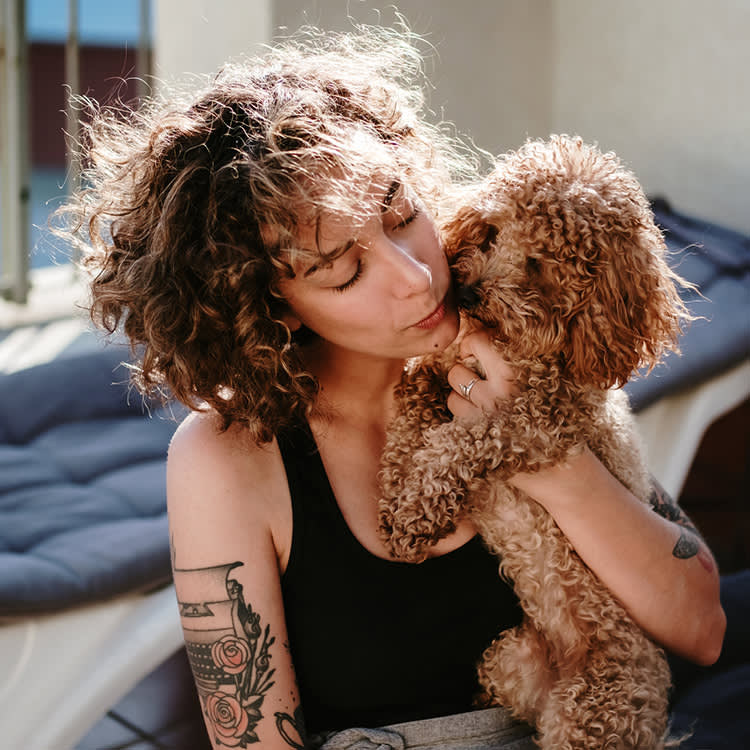
At some point most dog people catch themselves feeling faintly ridiculous, canceling plans to get home to a dog, tearing up over a gray muzzle, describing an animal as the love of their life and half-meaning it. If that’s ever made you feel soft, here’s the reframe: the pull you feel isn’t a character flaw or an excess of sentiment. It’s chemistry, and it’s the same machinery that binds a parent to a child. You are, quite literally, built to feel this way about your dog.
The love runs on the same hormone as parenthood
The most powerful bonds between humans are driven in part by oxytocin, a hormone woven through social behavior, and interactions with our dogs light up that same system. Petting your dog raises oxytocin in both of you. Higher oxytocin makes you want more contact, which raises it further, which pulls you closer still, a self-reinforcing loop that spins up the way it does between people and their kids. Remarkably, you don’t even have to touch: gazing into each other’s eyes sets off the same cascade.
That bond does real work. When researchers look at how dogs attach to their humans, the securely bonded ones venture out and explore with more confidence, the very pattern seen in securely attached children. The animal on your couch relies on the bond with you the way a child relies on a parent, and it steadies them.
You read each other, which almost no two species can do
Here’s what makes the dog-human relationship strange and special: the two species read each other’s emotions at a level normally reserved for members of one’s own kind. Dogs distinguish a neutral human face from an emotional one, and can tell a happy face from an angry one. Anyone who’s tried to hide a bad mood from their dog knows this already, they just know.
It runs the other way, too. Even people with no training in animal behavior are decent at reading dogs, a sad dog and a happy one are easy calls, though novices miss the subtler shades of a slightly nervous dog. We’re good with their voices as well. In one line of research, people readily told playful growls from aggressive ones, and could even distinguish a dog growling over food from a dog growling at an approaching stranger. Experienced owners did better, but beginners still managed.
The wiring underneath this is uncannily parallel. Dogs identify individuals by face, and their brains process faces with a specialized region, much as ours do. Voice lands in a matching spot too: the same stretch of the temporal lobe lights up in each species, with crying, laughing, whimpers, and sharp barking all registering near the auditory cortex. Physiologically, visually, acoustically, and neurologically, people and dogs are tuned to one another. The closeness isn’t a story we tell ourselves. It’s a biological fact.
People apologize to me for how much they love their dogs, as if it’s an embarrassing overreaction. I tell them the overreaction is the evidence. Your brain is running a bonding program that evolution usually reserves for your own offspring, and it’s pointed at a completely different species. That’s not you being silly. That’s one of the more remarkable relationships in the animal world, happening on your living room floor.
Shared purpose deepens it
Biology sets the stage, but the relationship grows the way any relationship does, through shared experience. The more you do together, the closer you feel, and the clearest examples come from teamwork. There’s a reason a working dog and their handler are called a “team”: pair a person and a dog around a shared job, search and rescue, detection, military, police, or service work, and they build a closeness that spills well beyond the work itself. Each brings a distinct skill, each depends on the other, and the trust that requires bonds them tightly.
You can even watch it from the outside. In canine freestyle, essentially dancing with a dog to music, the appeal isn’t the choreography; it’s seeing a dog and person move in genuine sync, a visible symbol of the emotional closeness underneath. And tellingly, dogs often prefer the people who play with them to the people who feed them, even when great treats are on the table. Across many species, mothers who play with their young end up more strongly bonded to them. If you want to build a relationship, shared fun may simply be the most powerful tool there is, worth remembering the next time you’re tempted to treat play as optional.
What newer research adds
Two studies have since put hard numbers on what owners always sensed. In 2015, researchers found that when dogs and their owners spent time gazing at each other, the dogs’ gaze raised the owners’ oxytocin, which in turn raised the dogs’ oxytocin, an actual measured feedback loop between two species. Tamed wolves, who don’t seek human eye contact, showed no such effect, suggesting the loop is something dogs and humans co-evolved, not a generic mammal trait. Then in 2022, a team discovered that dogs’ eyes well up with extra tears when reunited with their owners, but not with familiar strangers, and that oxytocin appears to drive it, the closest science has come to documenting a dog crying with something like joy.
Our bond with dogs stretches back some 30,000 years, and for almost all of it we understood the feeling long before we could explain the mechanism. Now we can name the hormone and trace the loop. It doesn’t make the connection less magical. It just confirms what heart-dog people have always insisted: the love is real, it’s mutual, and it’s written into both of you.
References
- Nagasawa, M., et al. “Oxytocin-gaze positive loop and the coevolution of human-dog bonds.” Science, 2015. pubmed.ncbi.nlm.nih.gov/25883356
- Murata, K., et al. “Increase of tear volume in dogs after reunion with owners is mediated by oxytocin.” Current Biology, 2022. cell.com
Dr. Chen is a small-animal veterinarian who leads health and safety coverage at The Pet Times. She writes and reviews the bulk of our illness, condition, and safety content, translating clinical guidance into clear, practical advice owners can act on at home.
Meet our experts ↗Keep reading
 TrainingYour Dog Knows You're Coming Home. It's Smelling Time Pass.Dr. Mara Chen · 5 min
 LivingA 'Soul Dog' Isn't Magic. It's Fluency, and You Can Build It.Jordan Ellis · 8 min
 TrainingYour Dog Already Knows Your Name. This Game Makes Them Prove It.Dr. Mara Chen · 6 min
 LivingThere's No National Dog-Barking Law. Here's What Actually Gets You FinedSasha Ford · 11 min
 Training5 Reasons Your Dog Follows You Into the Bathroom (One Is Worth Watching)Dr. Nina Kohl · 6 min
 TrainingLoving People Doesn't Make a Therapy Dog. The Real Bar Is Higher, and KinderDr. Nina Kohl · 11 min