


Your Dog Is Fluent in Play. You're the One Who Can't Read the Room
Dogs broadcast a whole vocabulary of 'let's play' signals, and humans misread most of them. Here are the five to know, plus the everyday mix-up that gets a friendly dog scolded for trying to have fun.

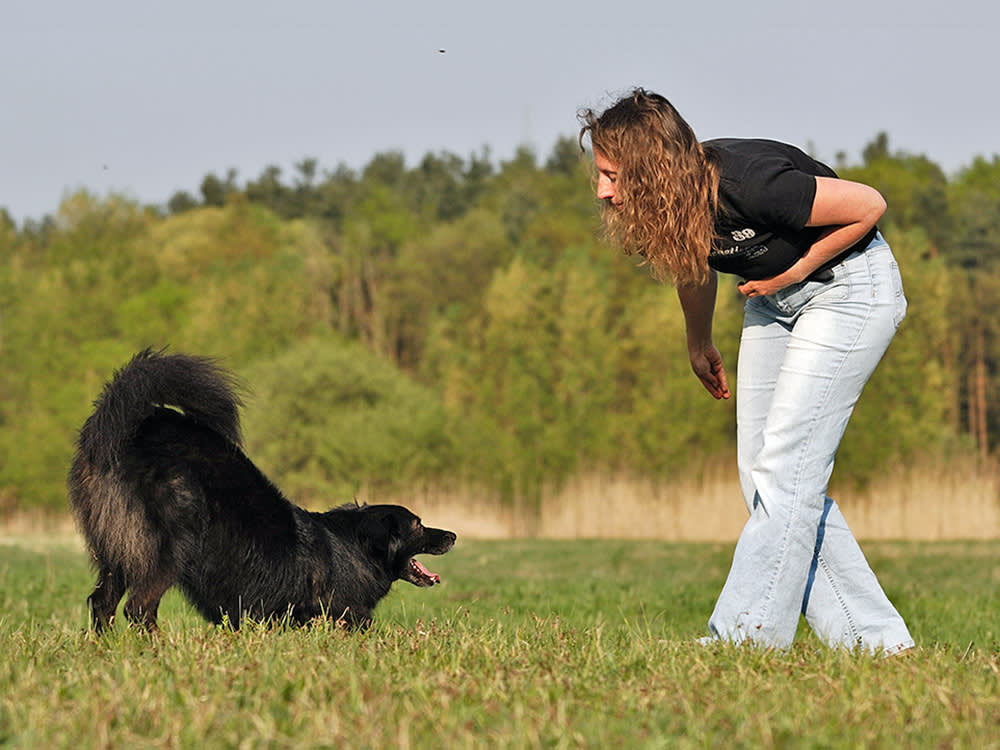
A dog grabs another dog’s foreleg in their mouth at the park. Attack? Almost certainly not, it is play. A dog’s jaws hang open in what looks like a grin. Plotting something? No, also play. One dog swats at another with a paw like a boxer working the bag. Confused about the sport? Not at all, that swat is one of the most common ways dogs say “let’s go.”
Dogs are broadcasting invitations constantly. The problem is not on their end. It is that we, the supposedly clever species, are surprisingly bad at reading a language our best friends use all day long. Learn even the basics and you will understand your dog, and the dogs they meet, far better.
1. The play bow
The famous one, and for good reason: it is universal and unmistakable. Elbows and forearms drop to the ground while the back end stays up, the spine often curving, the tail high and wagging, and the front legs sometimes splaying outward into a rough “V” rather than staying parallel. Dogs throw a bow right before play kicks off and again in the middle of it, likely to reset the mood, reassure a hesitant partner, or simply keep the fun rolling. Humans can borrow it too, either the full floor version or a quick standing dip where you bend your knees and spread your arms low.
2. The play face
One particular expression reads as “I’m playing,” and dogs are far from the only species that wears it. Known as the mammalian play face, it turns up in creatures ranging from wild canids to primates, and Charles Darwin was among the first to write it down. The muscles go slack, the mouth falls open into something like a loose smile with the jaws slightly parted, and the lips pull back sideways rather than curling up vertically the way a snarl does. Relaxed, open, sideways: that is a face inviting a game.
3. The gentle paw-mouth
Dogs often open play by taking a potential partner’s front paw softly in their mouth. The key word is softly, a controlled, deliberately inhibited hold with no real pressure, and many dogs answer it by mouthing back and rolling straight into a chase or a wrestle.
This is also where dogs and humans collide. When a dog tries the same move on a person’s arm, the person tends to jerk back, alarmed or annoyed, and the invitation fizzles. That is not the dog’s failure to communicate; it is ours to receive it. It is also fair to simply prefer that dogs keep their teeth off your skin, no judgment either way, just know that from the dog’s side it was a friendly opener.
4. The paw bat
Boxing at a partner with the front paws is a classic “want to play?” and one most dogs understand even if they do not use it much themselves. It might spill into more paw work or morph into wrestling, chasing, or body-slamming.
Here is the mix-up that gets good dogs in trouble. When an eager dog springs up toward someone who then pushes them back down with both hands, a great many dogs read that shove as play, hands on them, energy up, and get bouncier and jumpier in response. The human pushes harder, gets more frustrated, and starts scolding, while the dog grows baffled and hurt: they offered a game and are somehow being yelled at for it. The whole tangle comes from two species reading the same gesture in opposite directions.
5. The play roll
Another opener is a particular kind of roll: a dog lowers close to the ground and twists their upper body so one shoulder, then the other, touches down, ending up briefly belly-up right near another dog’s head. Often they follow it with a soft paw-bat at the other dog’s face or a gentle mouth on a paw. Note that this is not the anxious belly-up of appeasement; in the middle of play, it is a confident, playful move, an “I’m down here, come and get me.”
When dogs skip the whole script
Sometimes there are no formal signals at all, and it is still play. A dog might just start acting playful, running in loose circles around another dog, moving with an exaggerated bounciness that looks nothing like a serious run, or approaching and retreating over and over, and the other dog reads the intent and joins in. Offering one end of a tug toy and waiting a beat for the other dog to grab on is another signal-free invitation. The playful meaning is obvious in the movement itself.
Close friends often drop the formalities entirely. Dogs who live together or see each other constantly frequently pounce, chase, and wrestle with no preamble, because everybody in the group already assumes it is a game. It is like human siblings who tackle each other without warning; nobody thinks it is an assault.
The danger is carrying that shorthand to a stranger. A dog who launches into full-contact wrestling with an unfamiliar dog, no signals, no warm-up, can easily be read as attacking, and the other dog may defend itself. Same as a person who body-slams a sibling for fun versus body-slamming a stranger on the street. Context is everything, and among dogs who do not know each other, the signals are what supply it.
What’s new since this was written
Researchers who study animal play increasingly frame these behaviors as “metacommunication,” signals about signals, a dog’s way of putting quotation marks around a bite to say “this one doesn’t count.” The play bow in particular has been studied closely in adult dogs, where it appears to work mostly as a tool to restart play after a pause rather than only to smooth over a rough move. The throughline across the newer work is the same lesson owners keep relearning: dogs are precise and honest communicators about play. The comprehension gap is on the human side of the leash.
The single most useful thing I teach owners is that a dog jumping up or mouthing your sleeve is usually a bid to play, not defiance. Once people stop taking it personally, they stop escalating it, and the whole interaction gets calmer.
References
- Byosiere, S.-E., Espinosa, J., & Smuts, B. Investigating the function of play bows in adult pet dogs (Canis lupus familiaris). Behavioural Processes (2016). https://pubmed.ncbi.nlm.nih.gov/26923096/
- Bekoff, M. Dogs at Play: How and Why Bowing Came to Mean “Let’s Play.” Psychology Today (2025). https://www.psychologytoday.com/us/blog/animal-emotions/202503/dogs-at-play-how-and-why-bowing-came-to-mean-lets-play
Dr. Kohl is a board-certified veterinary dentist with a particular interest in preventive oral care. She reviews all dental health content at The Pet Times and contributes practical guides on home dental routines, professional cleaning, and oral disease prevention.
Meet our experts ↗Keep reading
 LivingNetflix's Dog Documentary Is Great. The Title Is a Lie.Dr. Nina Kohl · 7 min
 TrainingA Therapy Dog Isn't a Service Dog. Here's Where They Do Their Best Work.Sasha Ford · 7 min
 LivingNew York's Hottest Club Is a $795 Dog RunNina Vasquez · 8 min
 LivingYour Dog Isn't Upset When You Argue. They're Trying to Stop You.Jordan Ellis · 6 min
 TrainingYour Dog Is Chasing Your Laugh. Science Says It's No Accident.Dr. Nina Kohl · 4 min
 TrainingYour Dog Isn't Trolling You. They're Playing, or Trying to Tell You Something.Dr. Nina Kohl · 7 min