


Your Dog Isn't Being Difficult. They're Begging for a Schedule.
Some dogs don't just enjoy a routine, they fall apart without one. Here are 7 signs your dog is one of them, and why predictability calms an anxious brain.

There’s a certain kind of dog who seems to be lobbying, constantly and politely, for a more predictable life. Not a bad dog. Not even an especially difficult one. Just a dog who is visibly happier when they know what’s coming and visibly rattled when they don’t. Trainers see this dog constantly.
Here’s the reframe worth starting with: for these dogs, a routine isn’t pampering or a nice-to-have. It’s the mechanism by which an anxious brain borrows a sense of control. A dog who can predict when dinner, the walk, and the evening chew will arrive has fewer unknowns to brace against, and fewer unknowns means a calmer nervous system. So the real question isn’t whether routines are good. It’s whether your dog is one of the ones who genuinely needs one. These seven signs tell you.
1. They light up for training, not just the treats
Some dogs adore training out of proportion to the snacks involved. That’s a tell. Training gives a dog a tiny lever of control over their world: do the thing, make the good thing appear. That feeling of “I can make outcomes happen” is deeply soothing to an anxious dog, and the same dogs who relax into training tend to be the ones who settle most once a dependable daily schedule is in place. If your dog treats a sit-stay like a job they love, they’ll probably love a routine too.
2. They pick up patterns fast
There are dogs who never quite connect the dots beyond “leash means walk” and “bag rattle means treat,” and they’re perfectly content taking life as it comes. Then there are the dogs who clock everything. They shoot you a pointed look at 9:57 because the 10:00 walk is imminent, and they expect the stuffed toy at the same hour daily. The dogs who read patterns this effortlessly are, in my experience, the very ones whose wellbeing depends on those patterns holding. The knack and the need come as a pair.
3. They find the world a little scary
If your dog treats the ordinary world as mildly spooky, unpredictability makes everything scarier still. Routine is the antidote. Every time you meet an expectation, dinner really does land at six, a fearful dog banks a little confidence. Genuinely fearful dogs need a full plan to work through their fears, but a steady routine is one of the best background supports there is, easing general anxiety and heading off new fears before they form. It also tends to quiet the stress behaviors that ride along with fear, like barking, chewing, and pacing.
4. They keep checking your face for instructions
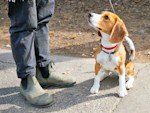
Some dogs use their person as a living instruction manual, forever glancing up as if waiting for the next update to download. If your dog reads tentative, keeps scanning your face before committing to anything, and seems to want your say-so at every turn, a predictable daily rhythm will help them feel far more secure. Less guesswork is less stress. When the day’s shape is knowable, they don’t have to look to you to narrate every moment.
5. They live in watchdog mode
Dogs who are perpetually on alert, scanning, reactive to anything new, never fully off duty, do markedly better with structure. The logic is almost arithmetic: fewer surprises means fewer things to react to, and a routine manufactures fewer surprises. Give a hypervigilant dog a predictable day and you often see something you rarely saw before, a dog who actually relaxes enough to nap.
6. Small changes throw them completely
For some dogs, moving the couch a few inches is a full-blown crisis. If your dog’s whole sense of stability wobbles at minor disruptions, they’re telling you they lean hard on consistency to cope. A steady daily schedule minimizes behavior problems and supports overall wellbeing for these dogs, and it builds patience, which in turn cuts down on demand-barking and other attention-seeking behavior. The more reliable their world, the less every little change costs them.
7. They come undone when you leave
Here’s the sign the original list missed, and it may be the most important one. Watch what happens around your departures. A dog who paces, whines, shadows you toward the door, or can’t settle after you leave is a dog for whom predictability is doing real work, or failing to. Modern behavior science on separation-related distress leans on exactly this principle: making departures more predictable, rather than sneaking out or scrambling the cues, helps a dog cope. If your dog struggles most when alone, they belong firmly in the routine-needing group, and a consistent departure ritual is part of the answer.
Routine is a kindness, not a cage
It’s worth saying what a routine is not. It’s not a rigid, joyless minute-by-minute regime. It’s a reliable shape to the day, the same rough sequence and timing for the anchors that matter: meals, walks, play, rest, and a bit of enrichment. Within that frame there’s plenty of room for spontaneity. The point is simply that your dog can answer the question “what happens next?” and usually be right.
People sometimes worry a routine will make a dog rigid or bored. It’s the opposite. For an anxious dog, knowing what’s coming is what finally frees them up to relax, explore, and play, because they’re no longer spending all their energy bracing for the unknown.
Cut the uncertainty around when a dog will eat, walk, play, and rest, and you get a calmer, more confident, less confused animal. For the dogs on this list, building a predictable day really is one of the kindest, most concrete things you can do for them.
What newer research adds
The instinct behind all of this now has solid support in behavior science. Research on separation-related problems, one of the most common and welfare-damaging issues dogs face, increasingly points to predictability as a treatment lever, not just a comfort. Rather than trying to hide the signals that you’re about to leave, current thinking favors keeping departure cues consistent so the dog isn’t left guessing, which reduces the contextual fear that fuels the distress.
The same principle shows up wherever researchers study canine stress. In shelters and veterinary clinics, consistency of the people handling a dog and predictability of what happens to them measurably lowers stress and improves welfare. The throughline is clear and it scales down to your living room: for a dog wired to worry, a predictable world is a calmer world. A dependable routine isn’t spoiling your dog. It’s preventive care for their nervous system.
References
Common questions
Do all dogs need a strict routine?
No. Some easygoing dogs take life as it comes and do fine with a loose schedule. The dogs who truly need predictability are the anxious, fearful, vigilant, or change-sensitive ones. This article's signs help you tell which kind you have.
How does a routine actually help an anxious dog?
Predictability gives an anxious dog a sense of control. When meals, walks, and rest happen at reliable times, there are fewer surprises to brace against, which lowers baseline stress and reduces stress behaviors like barking, chewing, and pacing.
What should a dog's daily routine include?
Consistent timing for the big anchors, meals, walks, play, rest, and enrichment like a stuffed toy, matters more than a rigid minute-by-minute plan. Aim for the same rough sequence and windows each day so your dog can predict what's coming next.
Can changing my dog's routine cause behavior problems?
For change-sensitive dogs, yes. Abrupt disruptions, even small ones like rearranging furniture or a shifted feeding time, can trigger stress, demand-barking, or other attention-seeking behavior. Ease transitions gradually when you can.
Dr. Park is a board-certified emergency and critical care specialist. She reviews our health and safety content for clinical accuracy and contributes guides on recognising urgent conditions. Her focus is helping owners act quickly and correctly when it matters most.
Meet our experts ↗Keep reading
 TrainingYour New TV Is Half the Reason Your Dog Won't Stop Barking at ItDr. Nina Kohl · 8 min
 TrainingYour Dog Isn't Being Rude to Strangers. They're Scared.Dr. Lena Park · 7 min
 TrainingYour Dog Growls When You Pet Them. Don't Punish It, Read It.Dr. Mara Chen · 7 min
 TrainingYour 'Stubborn' Dog Is Actually Terrified. Here's What to Do.Dr. Nina Kohl · 10 min
 TrainingYou Didn't Cause Your Dog's Leash Reactivity. Here's How to Manage ItDr. Amara Solis · 7 min
 TrainingThe Stuffed Kong Won't Save You: 7 Lies About Separation AnxietyDr. Amara Solis · 9 min