


Your Cat's Tail Isn't Talking to You. It's Talking to Whatever They're Looking At.
Eight tail signals, and the reading error almost everyone makes. A swishing tail means nothing until you know what your cat is aiming it at, and their ears may be the better tell anyway.

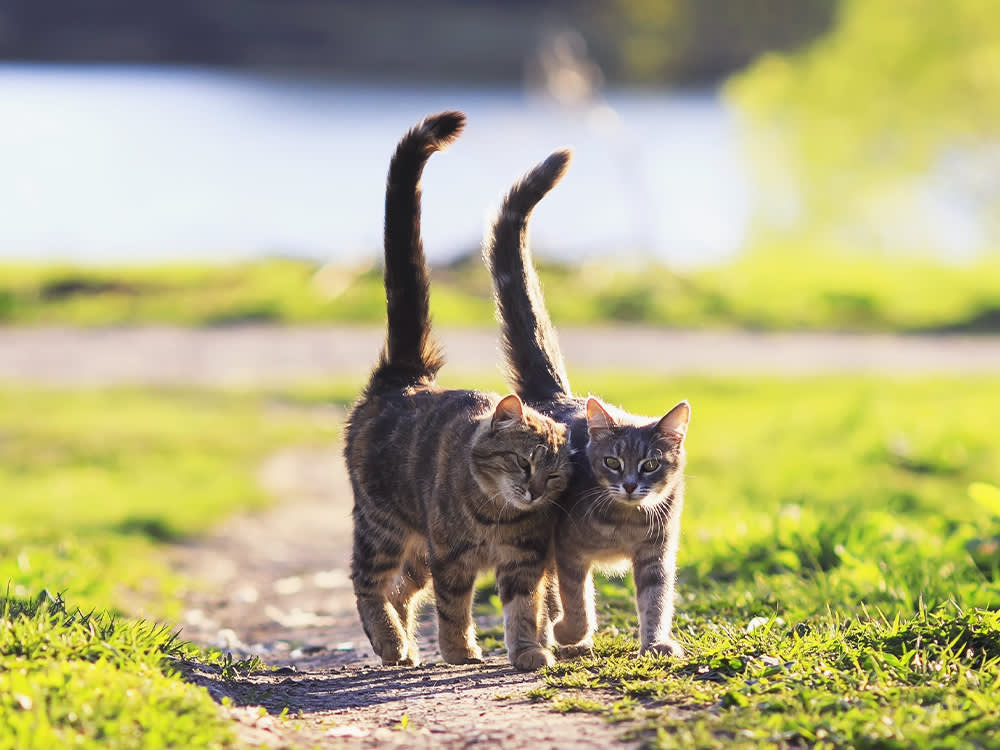
Here is the mistake nearly everyone makes with cat tails.
They see a swishing tail and ask, “what is my cat telling me?”
Most of the time, your cat is not telling you anything. The tail is a readout of their internal state, and that state is usually a response to something else in the room: the bird at the window, the dog on the stairs, the sound of a cupboard. Read the tail without following the gaze and you will get it backwards about half the time, which is exactly how people end up getting bitten by a cat they were confident was happy.
So the rule that governs everything below: the tail gives you the emotion. The context tells you what it is about. You need both.
Eight signals, worst misreads first
Most tail guides open with the happy ones, which is pleasant and useless. The signals that cost you something are the ones people get wrong, so those come first.
1. Fast whipping, and thumping
The most catastrophically misread signal in cat ownership, and the reason is that people are running dog software on a cat.
A whipping tail is fear or aggression. It is a warning, and the message is to back off, or to stop doing the thing you are currently doing. It is not excitement. It is not delight. It does not mean carry on.
Thumping, where the tail is driven against the floor, says the same thing. Angry, or at absolute minimum, thoroughly done with you.
If you take one thing from this article, take this one. A wagging cat is not a happy cat.
2. Slow swishing, which is not the same thing at all
And here is why the previous entry needs a partner, because the two get confused constantly and they mean opposite things.
A tail swishing slowly, side to side, is a deeply focused cat, roughly the way a person taps a foot while concentrating. You will see it during play, or while they are watching a bird through the window.
Speed and tension are the tell. Loose and slow is concentration. Fast and hard is a warning. When you cannot tell which one you are looking at, stop looking at the tail and look at the rest of the cat.
3. Wrapped tightly around themselves
The one that gets missed, because a curled-up cat reads as a cozy cat, and this is the entry on the list most likely to be a medical problem.
A cat lying down normally lets the tail fall away from the body, loose. Cinched tightly around them is different, and it can mean pain or illness.
Give them room, and then watch. Is food still going down? Water? Are they using the litter box on schedule? Have they gone under the furniture? Have they stopped caring about play, or treats? Give it twenty-four hours, and if nothing has changed, phone your vet.
4. Straight and puffed
Frequently arriving with an arched back and a hiss. A puffed, rigid tail is a frightened cat: startled, or feeling genuinely threatened.
This is where the context rule earns its keep. Look where your cat is looking. Whatever has alarmed them lies at the end of that stare, and it is very rarely you.
5. Twitching and quivering
Small, jerky movements show up in play and in hunting, and they mean roughly what a slow swish means: engagement. But a twitch can equally be mild irritation, so again, read the room before you reach out.
Quivering is a bigger, more emphatic thing. A tail shivering like a current running up a spine means a highly stimulated cat, usually a pleased one: you have come home after a long absence, or a cat they like has walked in.
One caveat that will spare you an awkward moment. Cats also quiver their tails while spraying. If yours is patrolling the yard with a quivering tail, let them finish before you go over for a cuddle.
6. Straight up
Now the good news, with a single condition: the tail must not be puffed, hair standing out like a pipe cleaner.
An upright, unpuffed tail is a confident, contented animal. Comfortable, in a good mood, and rather pleased with themselves.
7. The question mark
Upright, with a curl at the tip. Also a happy one, and this one comes with an invitation attached: the cat would like to interact.
So take the hint. A stroke, a snuggle, a headbutt, a couple of minutes of play. They are, in effect, asking.
8. Wrapped around you
The feline version of an arm around your shoulder. It usually arrives as part of a whole greeting package, alongside a body pressed against your leg and a running purr.
Take the win.
The tail is not the whole cat
This is the part most tail guides leave out, and it may be the most useful thing here.
The ears may be the better predictor. A study published in the journal Animals found that when cats interact with other cats, ear position is the best predictor of whether the interaction will end well or badly. Not the tail. The ears.
Which means that if you are trying to referee a two-cat household, or read a cat who is about to have opinions about a visitor, you should be watching the ears at least as hard as the tail.
And the voice adds another layer. A meow can be a greeting or an objection. A purr is usually contentment, though not always. A growl or a hiss means frightened or angry. A yowl usually means a cat in real distress.
Cats are constantly broadcasting, on several channels at once, and we insist on watching only one of them. The tail tells you the volume. The ears and the eyes tell you the mood, and where they are pointed tells you the subject.
For cats without a tail, whether through injury or breeding, none of this is lost. Losing a tail is a genuine adjustment, and cats are tough, and they work it out. What you do instead is read the rest: posture, eyes, ears, and whiskers carry the information the tail would have carried. And this is true of every cat, tailed or not, which is that fluency comes from hours. Live with an animal long enough and their particular dialect stops being a puzzle.
What newer research adds
The most useful development in cat communication research is not about tails at all. It is about how badly humans read cats in general.
Studies testing people’s ability to identify feline emotional states from video have consistently found that most of us are not very good at it, and that experience with cats improves accuracy only modestly. Cats are subtler than dogs, their signals are lower-amplitude, and the ones that matter most, the early warnings, are the easiest to miss. That is why so many cat bites and scratches feel, to the human involved, like they came out of nowhere. They did not. The warning was there, in the ears and the tail and the skin twitching along the back, and it was quiet.
The practical fix is not to memorize more signals. It is to stop reading them in isolation. Take the tail, add the ears, add the eyes, add what the cat is actually looking at, and only then decide what is happening. A cat with a straight-up tail and flattened ears staring at a doorway is not inviting you over.
Cats are quite communicative creatures. It is just that their tails, more often than not, are aimed at something that is not you.
References
- “Ear Position as a Predictor of Cat-Cat Interaction Outcomes.” Animals, MDPI. mdpi.com/journal/animals
- International Cat Care. “Understanding Feline Body Language.” icatcare.org/advice/understanding-your-cat-s-behaviour
- The Ohio State University Indoor Pet Initiative. “Cat Behavior and Communication.” indoorpet.osu.edu/cats
- American Association of Feline Practitioners. “Feline Behavior Guidelines.” catvets.com
Common questions
What does it mean when my cat's tail is straight up?
Provided it is not puffed, it is a friendly, confident signal. Your cat is comfortable and in a good mood. Paired with a curl at the tip, it is often an invitation to interact.
Is a wagging cat tail like a wagging dog tail?
No, and this is the most dangerous misreading in cat ownership. Fast whipping and thumping in cats signal irritation, fear, or aggression, not happiness.
What if my cat has no tail?
Cats are resilient and adapt. Read their body posture, eyes, ears, and whiskers instead, and know that the more time you spend with them, the more legible they become.
My cat wraps their tail around themselves. Should I worry?
Possibly. Cats usually let the tail relax away from the body when lying down. Wrapping it tightly around themselves can indicate illness or pain. Watch appetite, litter box use, hiding, and interest in play, and call your vet if it persists beyond a day or so.
Dr. Kohl is a board-certified veterinary dentist with a particular interest in preventive oral care. She reviews all dental health content at The Pet Times and contributes practical guides on home dental routines, professional cleaning, and oral disease prevention.
Meet our experts ↗Keep reading
 TrainingCan a Cat Heal Itself by Purring? The Science Is Stranger Than You ThinkDr. Nina Kohl · 7 min
 TrainingIt Was Never the Baby Voice. Your Cat Is Listening for YouDr. Priya Nair · 5 min
 LivingYour Cat Isn't Trying to Cuddle. They're Doing Math.Dr. Nina Kohl · 6 min
 TrainingThat Sneer Is Your Cat Tasting the Air. Here's the Organ Doing ItDr. Amara Solis · 5 min
 TrainingYour Cat Isn't Attacking You. You Live on a Hunting Route.Dr. Amara Solis · 9 min
 TrainingYour Cat Clears Eight Feet From a Standstill. Here's How.Dr. Amara Solis · 6 min