


Your Cat Clears Eight Feet From a Standstill. Here's How.
A cat can rocket eight feet into the air with no run-up. Here is the biomechanics behind the leap, which breeds jump highest, and why a cat that stops jumping is telling you something.

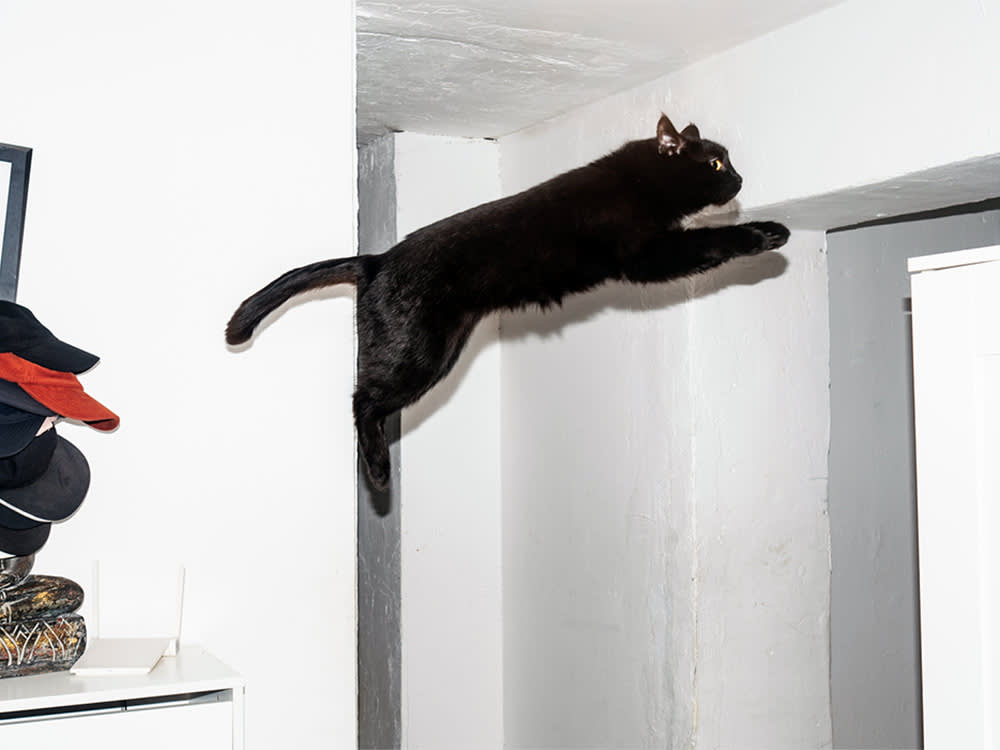
Watch a cat go from a dead stop on the floor to the top of the refrigerator and you have just seen one of the most efficient jumps in the animal world. No wind-up, no running start, no visible effort. Most house cats can launch roughly eight feet straight up, close to nine times their own height. Put a human on that scale and you would be hopping onto a three-story roof from your kitchen tiles.
The leap looks casual, but it is the product of some genuinely impressive engineering. And once you understand the machine behind it, you also understand why a change in your cat’s jumping is worth paying attention to.
A predator’s launch system
Your cat may spend twenty hours a day napping in a sunbeam, but the body doing the napping is built for ambush hunting and quick escapes. Everything about the jump traces back to that job.
The engine is the back half. A cat’s hind legs are packed with powerful muscles, especially the big thigh and calf groups, that fire in an explosive burst to throw the body upward. Those legs are also long relative to the cat’s size, which gives them a longer runway to build force, the same way a longer lever moves more with each push.
The rest of the body is tuned to support the launch and stick the landing. A cat’s spine is unusually flexible, so it can coil and then extend to add reach, and even twist in midair to line up a precise touchdown. Stretchy tendons and ligaments store energy on the crouch and snap it back on the release, a bit like a drawn bow. A strong core keeps everything stable in flight. Retractable claws dig in like cleats for grip at takeoff and landing. And because cats walk on their toes rather than their heels, they get a built-in spring at the very start of the push.
Then there is the aiming system. Cats judge distance with sharp depth perception, and their whiskers, including the ones above the eyes and on the wrists, act like little measuring antennae that help them read a gap before they commit. The ankle bones absorb the shock of impact so the landing does not rattle the rest of the body. Add it up and you have a small animal that can point itself at a target across the room and hit it.
Which cats jump highest
Any healthy cat is a good jumper, because the basic hardware is standard issue. The differences that do exist come down mostly to build, athleticism, and health rather than pedigree. That said, a handful of breeds are known for being especially lean and springy, among them the Abyssinian, Bengal, Savannah, Oriental Shorthair, Siamese, Cornish Rex, Devon Rex, and Maine Coon.
The record book is a fun footnote here. There is no official title for the highest vertical leap, but a tuxedo cat named Waffle the Warrior Cat holds the mark for the longest horizontal jump at seven feet. Savannahs, on the tall and leggy end, are said to manage vertical leaps over ten feet, and Bengals can reach around eight. At the other end, short-legged cats like Munchkins, and cats living with arthritis or joint conditions such as those seen in some Scottish Folds, tend to keep all four paws much closer to the ground.
When the jump is a warning sign
Here is the part most articles skip. Because jumping is so central to how a cat moves through the world, a change in it is one of the earliest, clearest signals that something hurts.
Cats are experts at hiding pain. A cat will not limp dramatically or complain. What it will do is quietly stop making the leap onto the windowsill it used to own, or start scrabbling and missing where it used to land clean, or take the couch in two hops instead of one. If your cat’s relationship with height suddenly shrinks, treat it as data, not as your cat simply mellowing with age. Early arthritis is common and very treatable, and catching it starts with noticing the jump that no longer happens.
People bring me a senior cat and say nothing is wrong, it just does not get on the bed anymore. That sentence is the symptom. A cat giving up its favorite high perch is often the first thing you will ever see of joint pain, and it is worth an exam long before the cat is obviously limping.
Keeping the landings safe
There is no neat ceiling on how far a cat can safely jump down, and the old reassurance that cats always land on their feet is only half true. The righting reflex is real, but from too low a spot a cat has no time to rotate, and from a great height it can rotate perfectly and still break bones on impact. Falls from windows and balconies injure plenty of cats every year.
You cannot ground a cat, and you should not try, since climbing and leaping are healthy exercise. What you can do is make the landings kinder. Give your cat sturdy, non-slip surfaces to aim for, like a solid cat tree or wall shelving with traction. For seniors or cats recovering from injury, add pet stairs or a ramp to their favorite perch and pad the floor below high spots with something soft. Keep everyone at a healthy weight to spare the joints, favor gentle low-impact play over hard jarring jumps, and keep up regular checkups, because managing something like arthritis early makes a real difference to how long your cat keeps flying.
What newer research adds
The counterintuitive science on cat falls still holds up and is worth knowing. In a classic study of cats treated after falling from high-rise buildings, injuries did not simply climb with every extra floor. Cats that fell from the greatest heights sometimes fared better than expected, likely because a longer fall gave them time to right themselves, relax, and spread out to slow their descent. It is a fascinating quirk of feline physics, and also not an invitation to test it: the same research documented plenty of serious injuries, and an open upper-story window remains a genuine hazard.
References
- Whitney, W. O., and Mehlhaff, C. J. “High-rise syndrome in cats.” Journal of the American Veterinary Medical Association, 1987.
- “Osteoarthritis in Cats” American Association of Feline Practitioners.
Common questions
Do cats always land on their feet?
Usually, but not always. A cat's righting reflex lets it rotate mid-fall to bring its feet down first. From very low heights there is not enough time to rotate, and from very high ones the cat can land correctly and still be injured. A safe landing is never guaranteed.
Should I worry if my older cat stops jumping to high spots?
Yes, it is worth a look. Cats hide pain well, and a cat that used to rule the bookshelf but now stays low is often dealing with arthritis or another joint problem. Mention the change to your vet rather than writing it off as simply getting old.
Dr. Solis is a board-certified veterinary dermatologist with over twelve years of clinical experience. She advises on skin conditions, allergies, and grooming practices that affect coat and skin health. All dermatology and allergy content at The Pet Times is reviewed by her team before publication.
Meet our experts ↗Keep reading
 TrainingYour Cat Is Not Judging You. Your Cat Cannot Judge You.Dr. Mara Chen · 9 min
 TrainingYour Cat Isn't Aloof, Waterproof, or Low-Maintenance: 8 Myths to RetireDr. Nina Kohl · 8 min
 Health & WellnessThe Glow in Your Cat's Eyes Is a Free Eye Exam. Learn to Read It.Dr. Ravi Mehta · 8 min
 LivingYour Cat Has Been Asking for the Same 7 Things. You Keep Hearing 'More Cuddles.'Dr. Priya Nair · 8 min
 TrainingToilet-Training Your Cat Means Throwing Away Their Health ChartDr. Ravi Mehta · 8 min
 Health & WellnessStop Wrestling Your Cat for Pills. Train Them Instead.Dr. Lena Park · 9 min