


Stop Wrestling Your Cat for Pills. Train Them Instead.
The internet is full of videos of people forcing pills into furious cats. There's a better way that starts before your cat is ever sick — and it keeps you unscratched and your cat's trust intact.

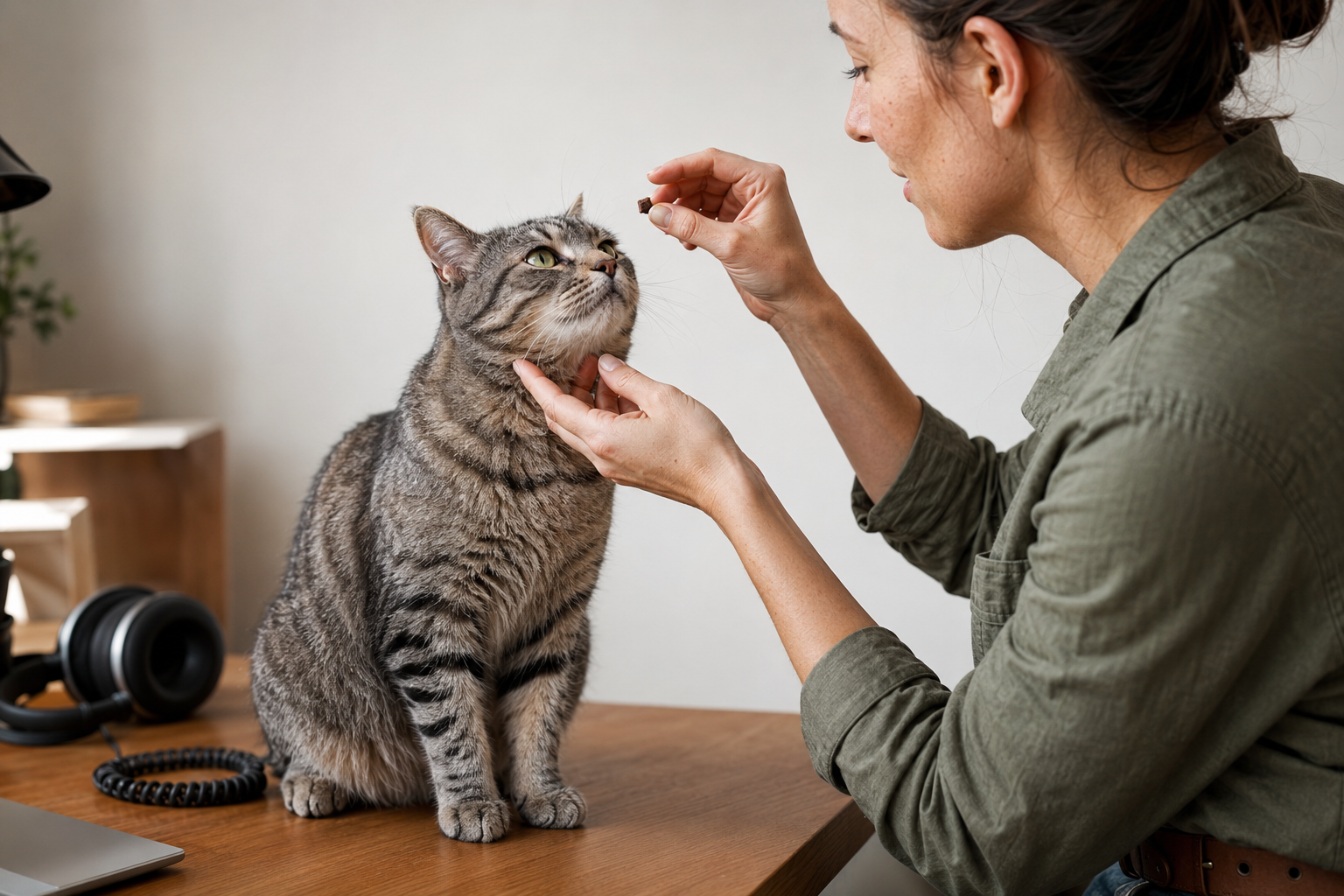
Search “how to pill a cat” and you’ll find a genre of video that’s hard to watch: a person pinning a rigid, wild-eyed cat, prying its jaws open, and shoving a tablet down its throat while promising a treat will make it all okay afterward. It won’t. The notion that a cat wipes a traumatic experience from memory the moment you offer a snack is, to put it plainly, wishful thinking. Would you shrug off being held down and force-fed just because a cookie showed up on the plate afterward?
Here is the reframe this whole piece turns on: the question is not “how do I get a pill into my cat,” it’s “how do I teach my cat to take a pill.” Medicating a cat is genuinely one of the hardest parts of cat ownership, and force makes it worse every single time, more stressful for the cat, more dangerous for you, and harder with every dose. The alternative is to teach the skill before your cat ever needs it, and to make taking medicine a small, pleasant, unremarkable part of their life. Let’s walk through why force fails and what to do instead.
The real preparation happens long before the vet visit
Most people think “preparing” to pill a cat means laying out supplies and pulling on a thick sweater to survive the claws. The real preparation is training, and it starts long before there’s any medicine in the house. You cannot cram this the evening you get home from the clinic; a cat learns the skill of accepting medication over weeks of low-stakes practice, ideally beginning the day they join your family. Teaching a cat to participate in their own care, calmly taking a pill when the time comes, is as much a part of raising a cat as teaching them to tolerate nail trims or the carrier.
Why the forceful methods backfire
The classic force method shows up in nearly every how-to video with the same steps: turn the cat away from you, spine pressed to your body so they can’t reverse out, recruit a second person to pin a “difficult” cat, guard yourself with gloves or a wrapped blanket while holding the shoulders down, wedge the jaws apart, drop the pill onto the back of the tongue, then close the mouth and rub the throat to force a swallow. And if you get bitten, seek medical care, because cat bites are prone to serious infection.
The problem isn’t the mechanics, it’s what they do to your cat and your relationship. Force puts the cat in the position of having medication done to them, with no say, and most cats find that deeply upsetting. An upset cat is harder to medicate next time, not easier, and every forced dose raises the odds of a bite or scratch that lands you at the doctor. There is almost always a better path.
The stress-free methods to try instead
When a cat is willing, medicating them can be a non-event: you offer, they take it, you both move on with your day. That’s the goal, and these approaches get you there.
Make the medicine palatable. Ask your vet whether the drug can be compounded into a tastier form. Many medications can become a flavored liquid, often fish-flavored, that plenty of cats will happily lick from a syringe. Some can be turned into a flavored chewable tablet instead. Cats are more suspicious of the chewable than the liquid, but when it works, it makes everyone’s life easier.
Hide it in wet food. Wet food masks a pill well enough for many cats to swallow it without noticing. To be fair, some cats will surgically eat around the pill even in tuna, so use the most irresistible food you’ve got: tuck the pill into a small amount and serve it alongside additional plain wet food. Easy cheese works for this too. The trick that keeps it working is giving your cat the same food without a pill on other days, so they never get wise to the pattern.
Use pill pockets. These are treats with a hollow center, soft and moldable like play-doh, so you can bury a pill completely. Some cats take them eagerly. Try them empty first to confirm your cat likes the flavor, and keep offering empty ones now and then so the treat stays trustworthy.
Wrap it in a soft treat. Any soft treat big enough can be molded into a homemade pocket. Again, give empty ones first, and keep mixing empties in. A method that works for many cats is three treats in a row, varying which one holds the pill; start with the pill in the middle so your cat gets a clean treat first, then the pill, then a chaser. The ultimate version for some cats is a freeze-dried minnow sliced open at the belly to tuck a pill inside.
Use a gel capsule. Slip the pill into the smallest gel capsule that will hold it, then coat the capsule in something irresistible, tuna water, a bit of real salmon, wet food, or pureed chicken. Get your cat comfortable eating empty coated capsules before you ever add a pill, and slip in an empty one now and then to keep the routine pleasant.
Train the taking itself. This is the throughline of every method above: give your cat “blanks,” an empty pill pocket, a gel capsule, a blob of wet food, or a syringe of tasty puree, a few times a week when there’s no pressure and they’re relaxed. It becomes a normal, pleasant habit. Then, when a real pill is needed, you do exactly what you’ve always done, just with the medication added, and keep the blanks going between doses so the treat never becomes a warning sign.
The one safety step people skip: chase it with water
There’s a cat-specific danger worth calling out. A pill given dry can lodge in a cat’s esophagus, and certain medications are especially irritating there, capable of causing painful inflammation or even a stricture that narrows the esophagus over time. So if a pill goes down without food, follow it with a small amount of water (a few milliliters via a syringe) or a lick of food to wash it all the way down. This single habit prevents a genuinely serious complication, and it’s another reason the food-based methods above are safer than a dry, forced pill.
Cats aren’t being dramatic when they fight a pill, they’re frightened, and a frightened cat learns fast. The owners who succeed long-term are the ones who practice with empty treats when nothing is wrong, so the real dose feels familiar. And please, whatever method you use, make sure the pill is washed down with a little water or food. A dry pill sitting in a cat’s esophagus is one of the avoidable problems I really don’t want to see.
The best safety tip is training, not gloves
The strongest protection against scratches and bites isn’t a thick blanket, it’s a cat who isn’t fighting you in the first place. A cat who lashes out during pilling is simply a cat who resents the whole ordeal, so the durable fix is teaching them to accept it calmly, not armoring up for a battle you’ve already lost.
What if your cat simply refuses?
Stay patient and keep rotating methods, and hold onto the belief that you’ll find a way to get the medicine down that doesn’t upset anyone. If nothing works, tell your vet, because they need to know about a missed dose to advise you on the medical consequences. To avoid injury and protect your bond, you can also have someone else administer the medication so the bad association doesn’t attach to you, leaving you free to keep training. Many veterinary practices will do this for a fee, which can be a good option for a short course of medication. If you must resort to a forceful approach as a genuine last resort because the stakes are too high to skip a dose, do it somewhere other than the spot where you’ve been training, and ideally somewhere other than your regular vet’s office, so your cat doesn’t come to dread the places and people you need them to trust.
Bottom line
Medicating a cat is hard, but the difficulty comes almost entirely from treating it as something to force. Flip it into something to teach, practice with empty treats when your cat is well, disguise the pill in food they already trust, and always send it down with a little water, and you protect your cat’s health without wrecking their mental health or your relationship in the process.
References
- Cornell Feline Health Center. “Pilling Your Cat.” Cornell University College of Veterinary Medicine.
- VCA Animal Hospitals. “Giving Oral Medications to Your Cat.” vcahospitals.com.
- German, A. J., et al. “Oesophageal strictures in cats associated with doxycycline therapy.” Journal of Feline Medicine and Surgery.
- American Association of Feline Practitioners. “Feline-Friendly Handling Guidelines.” catvets.com.
Not a substitute for your vet. Our guidance is educational. For urgent symptoms, contact a vet or emergency clinic right away. Editorial standards
Dr. Park is a board-certified emergency and critical care specialist. She reviews our health and safety content for clinical accuracy and contributes guides on recognising urgent conditions. Her focus is helping owners act quickly and correctly when it matters most.
Meet our experts ↗Keep reading
 TrainingToilet-Training Your Cat Means Throwing Away Their Health ChartDr. Ravi Mehta · 8 min
 TrainingYour Cat Isn't Aloof, Waterproof, or Low-Maintenance: 8 Myths to RetireDr. Nina Kohl · 8 min
 TrainingYour Cat Isn't Broken. But 3 of These 7 Habits Deserve a Vet Call.Dr. Nina Kohl · 8 min
 LivingYour Cat Has Been Asking for the Same 7 Things. You Keep Hearing 'More Cuddles.'Dr. Priya Nair · 8 min
 TrainingYour Cat Clears Eight Feet From a Standstill. Here's How.Dr. Amara Solis · 6 min
 TrainingYour Cat's Bowl Is Boring. Make Her Hunt for Dinner.Dr. Amara Solis · 7 min